In 1968 Jerry Snell opened a door in the hallway outside our first hour chemistry class. He invited me into what I discovered was a darkroom. Soon I was on the school newspaper and annual staff as a photographer. Later I learned that Jerry was a Lutheran who was planning to become a pastor. A few years later I was not only a Lutheran, but I was heading off to seminary to become a Lutheran pastor, too. Jerry followed a year later and served as a pastor in Missouri until his untimely heart attack and death. I thank God for Jerry and enjoy photography still today – not to mention rejoicing in having served as a Lutheran pastor in congregations in Utah, Colorado, Arkansas and Texas. I’ve retired now and serve part time as a Congregational Support Specialist for the Texas District of the LCMS. I also provide coaching and leadership training through various PLI cohorts and with individual congregations and organizations.
David Bahn is a follower of Jesus Christ, husband to Diane, father and grandfather. He is an avid amateur photographer. His photo website is “Flowers by God Photos by David” He also publishes a devotional blog DavidBahn-Reflections.com.
He and Diane live in Cypress Texas and enjoy visiting their grandchildren who live in the United States and Germany.
He graduated from Concordia Theological Seminary in 1979, and earned a Doctor of Ministry degree from Fuller Theological Seminary in 1991.
Diane, his wife, is now retired from PLI (PLIleadership.org). They have offered presentations on Marriage and Ministry Partnership, Leadership, Changing Your Congregation’s Culture, and Missional Living. They look are working with PLI International training pastors and wives of the ELVD Diocese of the Lutheran Church of Tanzania.
David’s personal mission statement is “Leading people to realize Jesus’ calling and plans for their lives.”
And they went with haste and found Mary and Joseph, and the baby lying in a manger.17 And when they saw it, they made known the saying that had been told them concerning this child.18 And all who heard it wondered at what the shepherds told them.19 But Mary treasured up all these things, pondering them in her heart. – Luke 2:16-19
Mary Did You Know is a favorite Christmas song of mine. Diane and I will sing it on Christmas morning before worship at St. John. My favorite??? Stay tuned…
Mary did you know?
Mary was told by the angel Gabriel that her son would be
called the Son of the Most High, and the Son of God;
that he would reign on David’s throne forever (Luke 1:31-35).
Yet could she know he would walk on water?
Could she imagine him stilling the storm with one hand?
Might she have guessed he would heal the blind,
make the lame to walk, and raise the dead?
How could she imagine that a sword would so
pierce her own soul as she watched her son
hang on a cross and die between two criminals?
Can you imagine her delight when three days later Jesus rose from the dead?
Mary may or may not have known all those things. Be we have the witness of the Scripture telling us that this child whose birth we celebrate today is the Son of God, did all those things, lived a perfect life, died for us and for our salvation, and rose from the dead.
We now live under him in his kingdom and serve him in eternal righteousness, and in anticipation of his second coming at the end of all time.
All the ends of the earth shall turn to the Lord. – Psalm 22:27
The true light, which enlightens everyone, was coming into the world. – John 1:9
This image of Christmas lights was captured with a zoom lens and long exposure. The display was at a large equipment business along US 290 in Houston, Texas. It featured everything from angels to Santa and his sled.
John Thomas Ralph Augustine James Facenda has resonate iconic voice you might recognize. He was a fixture on Philadelphia radio and television for decades, and achieved national fame as a narrator for NFL Films and Football Follies. Wikipedia notes that, “Through his work with NFL Films, Facenda was known by many National Football League fans as ‘The Voice of God.’”
That monicker may have been more apropos than NFL fans thought. In 1948 Facenda recorded a narrated version of the Christmas story. His deep voice,rhetorical style, and clear articulation are iconic of that era. And while the style might be dated, the story of Jesus’ birth – even with the imagined realities surrounding the challenges faced by Mary and Joseph – is eternal in nature and meaning.
The true light was coming into the world! God was not willing to let us remain in the darkness of sin and godlessness. The saddest thing of all surrounding this celebration of Christmas is the total abandonment of the birth of Christ by far too many people. It’s not so much that people are in the dark as they have closed their eyes to the light of Jesus as his followers seek to honor him and celebrate his birth.
One day it will no longer be so. One day all the ends of the world will turn to the Lord. One day Jesus will be acknowledged to be Lord of all, by all people. Some will do it under duress. Others will delight to call him Lord. In the meantime even those who do not know it are enlightened by his birth, life, death, and resurrection. For wherever there is grace, truth, justice, sacrifice, hope, goodness, and life, it is because of Jesus. He is the wellspring of all that is truly good.
This is the word of the Lord to Zerubbabel: Not by might, nor by power, but by my Spirit, says the Lord of hosts. – Zechariah 4:6
By faith the walls of Jericho fell down after they had been encircled for seven days. – Hebrews 11:30
These beautiful flowers were in abundance in Alaska – August 2016
I’m not always a great example of faith – especially when it comes to the long-term hold to a promise faintly lit and far away. Prayers for healing when the disease continues to take its toll soon give way to whimpers of groaning and last gasps of hopelessness. Fruitless job searches while retaining any sense of God’s daily provision begin to evaporate into days and months of futility. Overtures for forgiveness and reconciliation are rebuffed – even though every effort is made to show contrition and prove good faith.
How does one hope to hold to the hope of healing, employment, or reconciliation when they seem so far away and unattainable?
Sometimes the rewards of faith come only after a long path of patient obedience. That was certainly the case in Jericho. That path was one of seven days of trips around the walls. Seven days of obedience that seemed senseless at best – at least I would think of such a command as silly at best. But the children of Israel marched around the walls for seven days until on that last trip on that last day they blew the trumpets and the walls came tumbling down!
How often we think we can do more in our own power than God can do if we wait on his promises to bear fruit. One of my favorite sayings is, we tend to overestimate what we can do in the short term, but underestimate what God can do in the long term. Faith holds to that reality, and sometimes over a long path of patient obedience.
There is only one way to hold on to faith when the path is long and dark. In those times we must lean into the promises of God, learn more about how God has worked in the past, and look to the most amazing and perfect display of God’s faithfulness and love: the Baby of Bethlehem. His path was long and difficult, but he never wavered from it and won salvation for us. His is a path worth following no matter how long it may take.
Woe to those who are heroes at drinking wine, and valiant men in mixing strong drink, 23 who acquit the guilty for a bribe, and deprive the innocent of his right! – Isaiah 5:22-23
For with the judgment you pronounce you will be judged, and with the measure you use it will be measured to you. – Matthew 7:2
This cut-off bamboo stalk reminds me of the promise of God in Isaiah 42:3, “a bruised reed he will not break, and a faintly burning wick he will not quench; he will faithfully bring forth justice.” Photo taken at Mercer Arboretum, February 2016
Have you ever been busted? Not by the police – though that would certainly qualify – but by your son or daughter, a co-worker, neighbor or friend? I have. It’s amazing how undone I was when it happened.
It was 1992 at Rosswood Country Club golf course. Our family membership there (in Arkansas) cost just a bit more than a membership at the local pool, and provided free golf, tennis, and pool privileges. It was quite a deal for a young family on a tight budget: built-in entertainment and family fun. Once in a while we would go there for Sunday lunch after worship – a real treat!
On the day of busting (probably a Friday afternoon) I was finishing a round of golf with a couple of pastor buddies and heading toward the 18th green when suddenly my second-oldest son shows up. What’s the problem you say? Well, I was smoking a cigarette and as far as my family was concerned I didn’t smoke! I was so busted. Undone.
There is, however, something far worse than being discovered to be a golf course smoker. (I’ve since moved on to a very occasional cigar on the golf course during the 5 or 6 rounds of golf per year that I play.) The far worse thing is to be found to be more stern on others while justifying my own affluence; making the poor bear the burden of my ease of life; being a heroic wine-drinker while mocking the wino, or mixing drinks like a master bartender while making fun of the alcoholic who has just fallen off the wagon. It’s pretty easy these days of festive abandon.
The judgment of God is without fault on any of these fronts. He has done nothing wrong of which we can accuse him; we’ll never bust him. Nor has he made fun of those who sin in an attitude of smug superiority. Rather he searches for the lost and parties with the repentant sinners.
For that to happen he had to take on human flesh and dwell among us. And that he did 2000 years ago. For that we can thank God. Because of that, we may also remember to be gracious to others – just as God has been gracious to us.
God does great things beyond searching out, and marvelous things beyond number. – Job 9:10
For from his fullness we have all received, grace upon grace. – John 1:16
Taken in Alaska – July 2016
Many years ago in a town far away I had a conversation with my dental hygienist. Perhaps it is because it was around this time of year. Maybe it was because of what she said. Likely it was both. She confided in me that they told their children that they weren’t going to spend nearly as much money on their Christmas gifts that year – perhaps only $500 or $600 each(!). That really struck me partly because that was likely our total Christmas budget – including the cost of the gas to drive to and from Missouri after the Christmas Day service at the church I served. One more layer to this onion: that was at least 23 years ago. Today that would equal $1,125.42…per child. Try multiplying that times 4!
Perhaps your situation and resources and situation are such that spending $1,000 or more per child is not outrageous. Maybe your love language is giving gifts, and your Christmas tree is piled high with beautifully-wrapped gifts under the tree. Maybe you’ve arranged for a Mercedes to be delivered to your home, to be put in the driveway with the requisite red bow for your dear one to see on Christmas morning. If that’s the case, hopefully you will use it to drive to church on Christmas morning (Christmas falls on a Sunday this year after all).
Maybe you’re not a gift-giver, but you use words to express love. It could be that you have that loving touch that you love offering and receiving. There are those who experience love by acts of service, and still others appreciate quality time and see that as the means of experiencing and expressing love.
Whatever your love language may be, look at how it is spoken this Christmas! Grace upon grace poured out for you and me. The abundance of love, and words of grace and truth pour from Jesus’ lips. Consider the time Jesus spent with his disciples, or the way he touched the blind or the children. Grace upon grace; love overflowing.
God does good work; marvelous things without measure! His grace knows no limits, nor does he skimp on showing his love – in the end giving himself fully to a lost, wayward, erring, and deceived race, who took, beat, mocked, crucified, and killed him. Grace upon grace poured out from the cross, and into our lives…now and through all eternity.
Light dawns for the righteous, and joy for the upright in heart. – Psalm 97:11
When they saw the star, they rejoiced with exceedingly great joy. – Matthew 2:10 (NKJV)
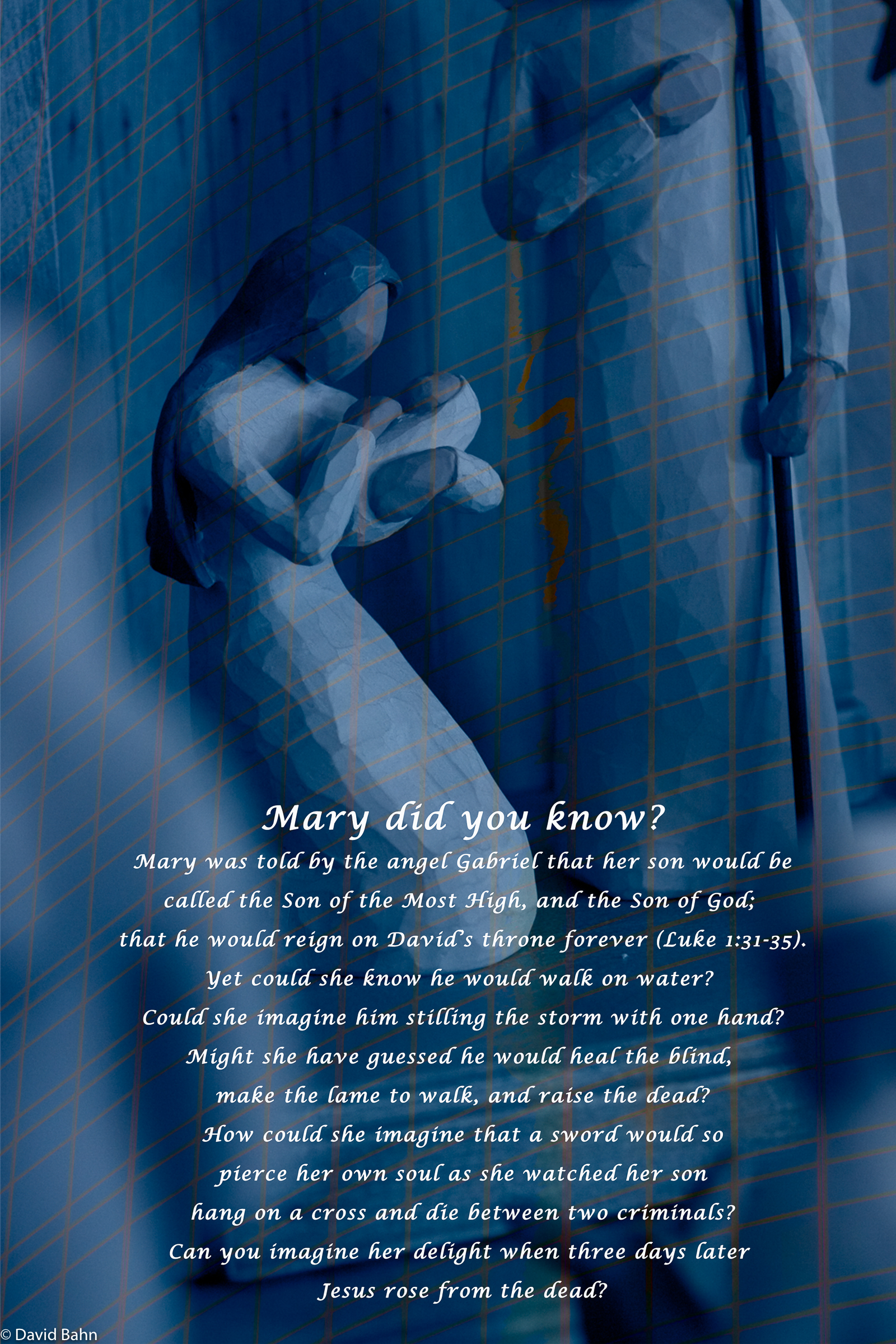
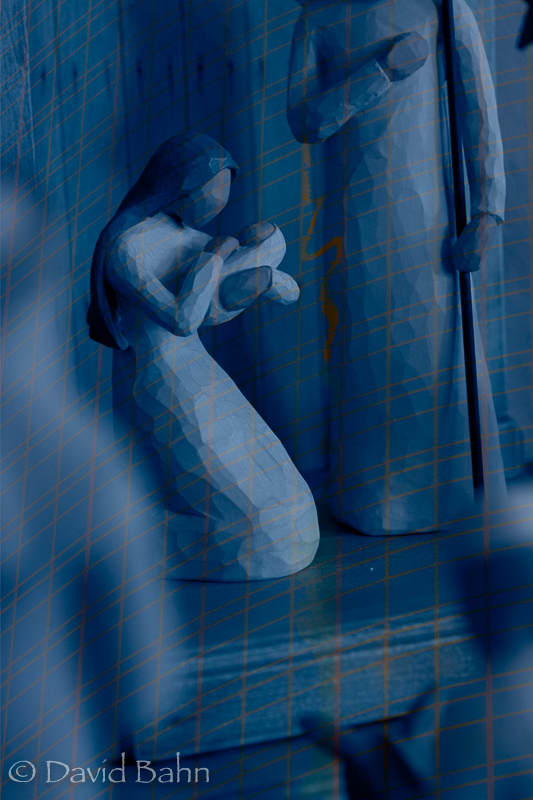
“Mary Did You Know” was one image of four that I displayed at the Christmas in the Arts event at St. John. It is two photos, one superimposed over the other in a manner that brings the blue color cast and the lines and squiggle. The one photo is of one of our nativity scenes, the superimposed photo is of a building in downtown Houston. (Taken in 2010)
Some people are said to have an eye for photography; that is they see great image opportunities in their mind’s eye before capturing them in the camera. It takes a good eye to be a good photographer. I’ve been told I have a good eye, and occasionally I manage to capture a good shot. Others with whom I consort, however, display photos that I could only hope to capture. The simplest scene becomes a photo offering that inspires and enriches.
When it comes to faith, God, God’s promises, and spiritual truths, the eyes of faith see things that the casual observer misses. What’s more, although seeing with the eyes of faith is a lifelong pursuit, it is something even a child can do. Often they do it better than we adults. For seeing with the eyes of faith requires that we look beyond the obvious, and focus on God’s word and promises. Seeing with the eyes of faith requires that we repent of our short-sightedness, look into the heart of God, and believe what he has revealed about himself in the Baby of Bethlehem.
I’m not certain whether the magi struggled to follow the star, suffering with the crises of the soul in the darkness of the night, or struggling with doubts of their quest. It is clear, however, that they saw not only the star, but something beyond it. Their joy would indicate that God had worked faith in their hearts, and that their faith was being rewarded by this sighting.
The promise to the righteous and upright in heart is a promise to the faithful. It is offered to those who hold God in high esteem and who believe his word. It is made more secure in those who recognize in Jesus the righteousness of perfect faith. It is rewarded because such faith is well placed.
Perhaps there is a dark place from which you are seeking God’s light. Maybe the light of God’s love seems dim and far away. When you hold the goodness, faithfulness, grace, and love of God in your heart, that dim light will grow strong and bright. The darkness of doubt will give way to the enlightenment of God’s favor. That is the message and promise of Christmas which we see with the eyes of faith.
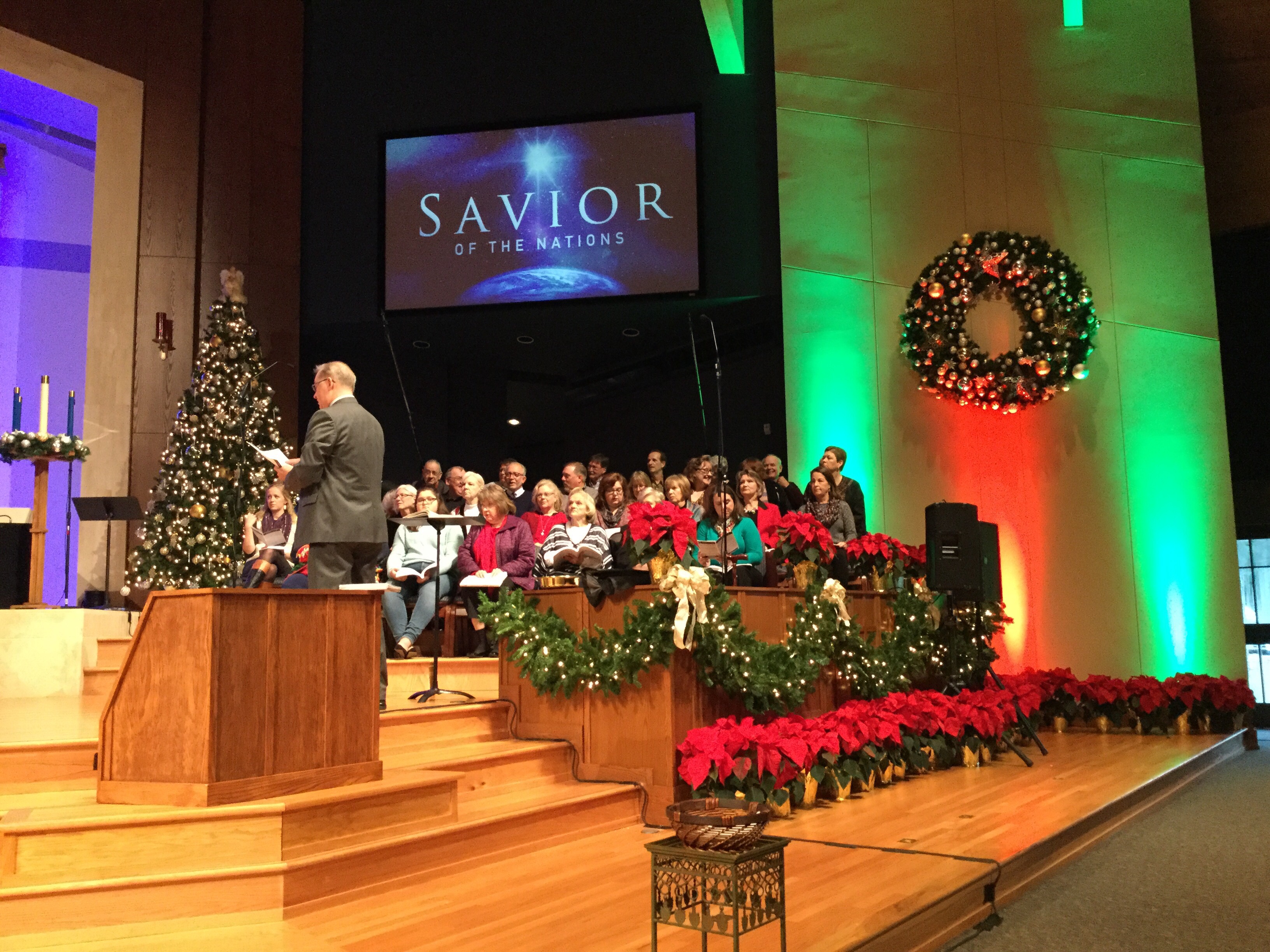
I receive a daily email from Hank Bitten, a Luther scholar from New Jersey. The Choir at St. John Lutheran Church rehearses for Sunday worship and an afternoon Christmas concert.
Here was his message today (12/18/16)
Martin Luther brought Christmas into the home and making this a family festival of joy with the Christmas tree, manager, candles to remind us of the light of the Star, and Christmas hymns. Luther understood the importance of the two natures of Jesus Christ – true man and true God. The Catholic Church has been celebrating the Christ-Mass since the third century but the reformers banned many of the special days for saints as they understood these days of recognition as a form of idol worship. The Germans are credited with making Christmas into a festival that lasted a month (Dec. 1-Jan. 6). Christmas Day worship as we know it is one of the gifts of the Reformation!
Other 16th century reformers opposed the joyous celebration of the birth of Jesus on December 25 because they taught that God deserves our praise and worship every day. Christmas was banned in Scotland and England during the time of the Puritan Revolution around 1650. Victorian England in the 19th century (Charles Dickens) contributed to our Christmas celebrations with gingerbread houses, greeting cards, and public displays.
Christmas was designated as a national holiday in the United States on June 26, 1870. Unfortunately, we are living in a time of unprecedented change as our families receive more Facebook greetings than Christmas cards and we should not take for granted that Christmas Day will continue to be recognized as both a secular and religious holiday in future decades. This is why our faith matters – a faith that God sent His only Son to live among sinners in an angry, hostile, and party-driven world!
The article below provides an interesting perspective on how we remember Jesus on Christmas.
Merry Christmas – enjoy the lights and the Light of the World,
Hank
Reformers’ disagreement on Christmas yields lessons
by David Roach, posted Tuesday, December 13, 2016
NASHVILLE (BP) — When it came to celebrating Christmas, leaders of the 16th-century Protestant Reformation were divided on whether followers of Jesus should say “bah humbug” or “joy to the world.”
While Martin Luther loved to celebrate Christmas with feasting and special church services, the so-called Reformed wing of the Reformation, led by Ulrich Zwingli and John Calvin, raised objections to such festivities, arguing believers should worship God only in ways explicitly commanded by Scripture and that a festival in December commemorating Christ’s birth was not commanded.
The Reformed wing’s Puritan heirs in England and New England were adamant in their rejection of Christmas celebrations. English Puritan William Prynne (1600-1669) argued, for example, that “all pious Christians” should” eternally abominate” Christmas festivities, said church historian Michael Haykin. In New England, celebrating Christmas could result in a fine. Though few modern Christians share such sentiments against Christmas, a North Carolina pastor who holds a Ph.D. in church history told Baptist Press, believers can draw insights from both sides in the debate.
Andy Davis, pastor of First Baptist Church in Durham, N.C., advocates a “mediating position,” in which believers acknowledge the food and fun of Christmas as good gifts from the Lord but also recognize that secular Christmas festivities can stray far afield from celebrating the incarnation. “Take the Christmas blessings, and look upward to the giver,” Davis said. “The happiness that we feel when we look at the lights and we enjoy the holiday — all of it comes from God. And ultimately God has so much more to give you than just that. He has His own Son, and the center of everything is the giving of Christ.”
Reformers differ
Among the Reformers, differing views of Christmas stemmed largely from differing views of worship, Haykin, professor of church history and biblical spirituality at Southern Baptist Theological Seminary, told BP.
Luther held the “normative principle” — the belief Christians may worship God in any way not forbidden by Scripture — while Zwingli and Calvin held the “regulative principle” — the belief Christians may only worship God in ways commanded by Scripture. Thus, Luther retained the Roman Catholic traditions of Advent and Christmas and may have been among the first people to decorate a Christmas tree with candles, Haykin said. “It was a festival he delighted to celebrate.”
The first seven sermons in “The Complete Sermons of Martin Luther” edited by John Nicholas Lenker are all designated for the Christmas season. For Zwingli and Calvin, in contrast, “there are questions raised about” Christmas, Haykin said. He noted all Reformers praised God for the incarnation but differed over the appropriateness of an official festival on Dec. 25.
Preaching on Christmas Day 1551, a Tuesday, Calvin noted, “I see here today more people than I am accustomed to having at the sermon,” according to Calvin’s “Sermons on the Book of Micah” translated by Benjamin Wirt Farley. Then Calvin warned, “When you elevate one day alone for the purpose of worshiping God, you have just turned it into an idol. True, you insist that you have done so for the honor of God, but it is more for the honor of the devil.”
Still, Calvin’s admonition seemed to be a caution rather than a prohibition of Christmas. In a 1551 letter quoted by Presbyterian pastor Phil Larson, Calvin said he “pursued the moderate course in keeping Christ’s birthday.” Similarly, in a 1555 letter he noted, “A church is not to be despised or condemned because it observes more festival days than the others.”
Nearly a century later, the Puritans, who drew theological inspiration from Calvin among other sources, took his view a step further, formally outlawing Christmas in England in 1647, Haykin said. In America, the Pilgrims of Plymouth Colony permitted nonbelievers among them to celebrate Christmas in the early 1620s, Davis said. But when some nonbelievers were seen playing a game on Christmas Day, the colony’s governor “confiscated their game equipment and said they were free to not work, but they had to stay indoors and would best spend the time by reading the Bible and praying.”
Caution about Christmas in British territories prevailed until the 1800s, Davis said, because of a desire not to return to Roman Catholic practices. ‘Scraps’ from God’s table The Reformers’ and Puritans’ reticence about Christmas should not be dismissed altogether in the modern world, Davis said, noting the holiday often is celebrated with “fantastic busyness” and “materialism” but “no real, vibrant piety.”
Even when charity and thankfulness are involved in the celebration, Davis said, meaningful references to Christ can be removed, as in Charles Dickens’ famous novella “A Christmas Carol.” Yet “you can go too far in the opposite direction” by eschewing traditional Christmas celebrations altogether, Davis said. “The ‘eat, drink and be merry’ thing is like scraps that fall from the table of God. It’s common grace blessings that people enjoy,” he said. “… Why wouldn’t you want something like that?”
It’s understandable that some Christians reject Christmas activities that are merely cultural with no celebration of Christ, Davis said. But the culture “just doesn’t get it” when Christians denounce the holiday altogether.
A more productive message in 21st-century America is, he said, “These blessings are gifts from God. But He has so much more to give you than that. He came into the world to save sinners.”
David Roach is chief national correspondent for Baptist Press, the Southern Baptist Convention’s news service. BP reports on missions, ministry and witness advanced through the Cooperative Program…
Have I any pleasure in the death of the wicked, says the Lord God, and not rather that they should turn from their ways and live? – Ezekiel 18:23
Do you not realize that God’s kindness is meant to lead you to repentance? – Romans 2:4
This photo of a fir tree in Alaska with water dripping from some of the needles, reminds me of God’s “grace, like rain, flowing down on me.” (Photo taken July 2016)
I have a friend who is not married and living with a woman to whom he has been faithful (as far as I am aware) for 20 years or more. In fact when I discovered they were not married, I was a bit taken aback; I had no clue prior to his admission. His admission, furthermore, wasn’t so much an admission as it was a matter of fact. I think he was being just a bit provocative by telling me, seeing if I would react or challenge him. Another two friends have found each other late in life and appear to be living together. I won’t draw any conclusions about them, but I do wonder. Then there are others who simply don’t seem to care about God in the least, and still others who are antagonistic toward God and religion.
I wish I knew how to speak into their lives about their lifestyles, choices, faith, or unbelief. Perhaps a more courageous person would offer a challenge. I’m thinking of Jesus and the woman at the well (cf. John 4), asking her to call her husband and then challenging her about her relationship with the man with whom she lived. But I don’t even know how to get the conversation going.
My approach of kindness, patience, and quiet faithfulness is neither bold nor brave. To some extent it is a bit of a cop-out – a live-and-let-live approach to life that is so very politically-correct these days. Perhaps I could get a bit more of an edge, offer a bit more challenge, poke a little bit here and there.
On the other hand, however, I am comforted by these verses: God is kind and patient. Though not without purpose, God waits, yearns, offers opportunities and spaces for people to come to their senses, and receives them with grace and love when they repent. Rather than growing more bitter and resentful as he waits for us to come to our senses, he waits in anticipation of sinners finding grace and life with him, and not in their sinful pursuits.
Perhaps that is the key to my dilemma: patience in anticipation of offering grace. I might rather imagine myself as some sort of modern-day John the Baptist, but I’m not. And the people he challenged most harshly were not the sinners but the self-righteous religious leaders. So I will pray for these friends. If I have the opportunity I might ask them about their living arrangements and their relationship with God. But I will surely stand at the ready when the time comes that they seek God’s ways and grace. I will delight that God’s patience has had its intended effect.
Truth is, they’re not the only ones who need God’s patient grace. I do too, and I am deeply thankful for it.
The living, the living, he thanks you, as I do this day; the father makes known to the children your faithfulness. – Isaiah 38:19
And he said to them, “Therefore every scribe who has been trained for the kingdom of heaven is like a master of a house, who brings out of his treasure what is new and what is old.” – Matthew 13:52
The calla lily was growing in our back yard. Its asymmetrical flower structure adds to its elegant beauty. (Photo taken in 2007)
Have you ever made a discovery that sets your heart on fire? You learn how to solve the Rubik’s Cube, and you want to tell everyone about it. You discover a new computer game and you can’t wait to tell your friends. You find a song and recording artist, a new TV series, or see a movie you want everyone to know about. You just can’t contain yourself.
When you learn a totally new way of life (how to get out and stay out of debt, or how a radically-different diet can change your whole life) and everything becomes new. You have new ways of processing desires and needs. You find different ways to prepare or even shop for food. There is simply a new and different way of looking at life. Things that didn’t matter to you previously you now value deeply. Things that were so important yesterday can go to the dump.
So it is when the mysteries of God’s love take hold in a person’s life. That’s not to say that prior to this new discovery, one is not saved. It may well be that one will enjoy the abundance of God’s grace here and in eternity. But when we have been trained for the Kingdom of God, when we take the Gospel so seriously that we study it, try it out in new areas of life previously untouched by God’s grace new discoveries abound. Have you ever thought of applying the Gospel to the way you keep house, or where you live, or what you buy at the store (not the law’s sense with its admonitions of “do this and don’t do that”, but in the freedom of grace and delight in God’s love)?
It’s one thing to profess faith in Jesus Christ. It’s one thing to acknowledge that Jesus is your Lord and Savior. It’s one thing to pray to him, worship him, and even serve his church. It’s quite another to embrace God deeply and to discover the depth of his love and the glory of his grace. As we do that – through study of his word, adventures of faith, and pathways of obedience – we will discover all kinds of things that we had not previously valued. Those will not be discovered by a casual faith in Jesus. His desire, however, is to help us discover new and old treasures in the storehouses of our hearts and souls, and to delight in how Jesus makes all things new.
Then I replied to them, “The God of heaven will make us prosper, and we his servants will arise and build, but you have no portion or right or claim in Jerusalem.” – Nehemiah 2:20
For we are God’s fellow workers. You are God’s field, God’s building. – 1 Corinthians 3:9
This morning lily was growing at the entrance of our subdivision a few years ago. I especially loved the way the light caught the stamens.
It’s one thing to say, “God is on our side” – especially after a successful battle or project. It is quite another to consider sincerely whether or not we are on God’s side. The latter is much more important, and while impossible to prove, lived out in dedicated, intentional, and persistent faith.
The Psalmist says, “If the Lord had not been on our side…” (even saying it twice, cf. Psalm 124:1-2). The Old Testament is filled with examples and object lessons of what happens when Israel was not following in God’s ways, and he was not on their side. They experienced initial defeat at Ai because of the sin of Achan. Later, God sent them, and gave them success. On one occasion Jonathan, David’s son took his armor bearer and attacked the Philistines, saying to him in preparation for the battle, “It may be that the Lord will work for us…” (1 Samuel 14:6).
Sometimes today God’s providential care can be seen in the success of a particular endeavor. Sometimes, however, it rains buckets on Christmas Eve, or hurricanes devastate churches and schools. In any case, however, God is at work for the cause of his kingdom and his good purpose: to save the world through faith in Jesus.
Jesus is God’s ultimate sign of God being on our side. Think of it this way: the entire Old Testament is a testimony of what doesn’t work: God speaking to man immediately gives way to his people calling for a king. Kings too quickly become corrupt so God sends priests to offer atonement for the peoples’ sins. But the people continue to fall away, and God sends prophets. Prophets are too easily and often ignored and even killed.
Our Prophet, Priest, and King, the Lord Jesus, has come and assured us that God is on our side. That’s a good thing, for we will never perfectly be on God’s side – try as we might. But try we must; for it is not wise to kick against the goads (cf. Acts 26:14).







 David Bahn - Reflections