David Bahn – Reflections

Light from the Word and through the lens

  • And he went up on the mountain and called to him those whom he desired, and they came to him. And he appointed twelve (whom he also named apostles) so that they might be with him and he might send them out to preach and have authority to cast out demons. He appointed the twelve: Simon (to whom he gave the name Peter); James the son of Zebedee and John the brother of James (to whom he gave the name Boanerges, that is, Sons of Thunder); Andrew, and Philip, and Bartholomew, and Matthew, and Thomas, and James the son of Alphaeus, and Thaddaeus, and Simon the Zealot, and Judas Iscariot, who betrayed him. – Mark 3:13-19 


    If you were going to choose 12 people to change the world how would you make your choices? Have you ever thought of Jesus’ approach to choosing his disciples in those terms? After all, that was what Jesus would actually do. That was the final result of God’s work through these 11 plus 1 men (cf. Acts 17:6): they turned the world upside down! But who were these guys? A report from the imaginary Jordan Management Consultants reads in part…

    To: Jesus, Son of Joseph
    Woodcrafter’s Carpenter Shop
    Nazareth 25922

    From: Jordan Management Consultants

    Dear Sir:

    Thank you for submitting the resumes of the twelve men you have picked for managerial positions in your new organization. All of them have now taken our battery of tests; and we have not only run the results through our computer, but also arranged personal interviews for each of them with our psychologist and vocational aptitude consultant.

    The profiles of all tests are included, and you will want to study each of them carefully.

    As part of our service, we make some general comments for your guidance, much as an auditor will include some general statements. This is given as a result of staff consultation, and comes without any additional fee.

    It is the staff opinion that most of your nominees are lacking in background, education and vocational aptitude for the type of enterprise you are undertaking. They do not have the team concept. We would recommend that you continue your search for persons of experience in managerial ability and proven capability… [click here for the full text of this fictional report]

    I’m not at all opposed to seeking the most qualified and talented persons to serve in the church. We regularly use assessment tools to help us find team members and ministry partners. What we don’t do, however, is rely on those assessments as the be all and end all of staffing decisions. In fact, furthermore, we look most closely at character and theological alignment in staffing our church. 

    When God chooses to call someone into ministry, he has a way of surprising people. David was the youngest and least likely to succeed of his brothers, but he became the greatest king of Israel. Thomas was a bonafide doubter but he took the Gospel to India. Peter could hardly speak without putting his foot in his mouth. The list goes on. And God used these men to change the world. 

    Next time you run into someone who is serving the cause of the Gospel of Jesus Christ, consider how God uses ordinary people to do extraordinary things. That might mean he would use you as well. 

  • Again he entered the synagogue, and a man was there with a withered hand. And they watched Jesus, to see whether he would heal him on the Sabbath, so that they might accuse him. And he said to the man with the withered hand, “Come here.” And he said to them, “Is it lawful on the Sabbath to do good or to do harm, to save life or to kill?” But they were silent. And he looked around at them with anger, grieved at their hardness of heart, and said to the man, “Stretch out your hand.” He stretched it out, and his hand was restored. The Pharisees went out and immediately held counsel with the Herodians against him, how to destroy him. – Mark 3:1-6


    I’m not sure what it would be like to have a withered hand. I know it would cause some physical challenges: I couldn’t carry two suitcases at a time. I likely couldn’t move furniture, perhaps not change a tire, or type very efficiently. But I’m thinking I could work around all those things. I’m thinking the more difficult issues would be less obvious. I’d know when someone did a double take it was not because of my good looks(!). I’d know that when someone tried to sneak sly look at my hand that they would wonder. And I’d wonder what they wondered – what they thought.

    Raise the stakes on all that with being a real life, real-time sermon illustration. I know my kids have had to suffer through that more than once. But to be the center of controversy, or a public example of all that is good and bad about religion, God, and God’s people…that’s another story.

    Consider, however, how this encounter ends…the man’s once-withered hand is restored. The Pharisees are so incensed with Jesus’ shenanigans that they go out and plot Jesus’ destruction. The man is no longer the center of attention, nor even the controversy. He is healed. 

    The people who witness all this see Jesus’ mercy and compassion. They witness Jesus’ challenge to the self-righteous religious leaders as to doing good on the Sabbath. They see the man healed. But it seems that once this is all over the man is forgotten. No one seems to have really been concerned about him except to prove a point – at least the Pharisees had that in mind. 

    Jesus’ reaction to all this? Compassion to the man with the withered hand. As to the Pharisees, anger and grief that they were so hell-bent on keeping their man-made rules about the Sabbath that they had no care for this man. Think of that combination: compassion, anger, and grief. Perhaps Jesus’ attitude would be one of those toward us right now. Compassion toward us in our times of need; anger whenever we are part of keeping his blessings from anyone else; and grief at anyone’s refusal to repent and believe in him. I’m not certain how often or how long we find ourselves in any of those situations, but I am certain Jesus’ ultimate desire is for us to live in his redeeming love. 

    He knew what he was up against. He knew his enemies would try to discredit him for this act of kindness and mercy. But he restored the man’s hand. He endured the Pharisees’ insults and ultimately succumbed to their evil plot. But he did this so that he could redeem us and save us. Now we can lift our hands in praise to him. Will you do it?

  • One Sabbath he was going through the grainfields, and as they made their way, his disciples began to pluck heads of grain. 24 And the Pharisees were saying to him, “Look, why are they doing what is not lawful on the Sabbath?” 25 And he said to them, “Have you never read what David did, when he was in need and was hungry, he and those who were with him: 26 how he entered the house of God, in the time of Abiathar the high priest, and ate the bread of the Presence, which it is not lawful for any but the priests to eat, and also gave it to those who were with him?” 27 And he said to them, “The Sabbath was made for man, not man for the Sabbath. 28 So the Son of Man is lord even of the Sabbath.” – Mark 2:23-28

    20161230-04612
    These small yellow flowers were growing at the Houston Zoo. Photo taken December 2016

    During my seminary education I was asked to be on a panel of students who were interviewed by representatives of the Association of Theological Schools (ATS). The Commission on Accrediting of ATS accredits postbaccalaureate graduate and professional theological schools and approves the degree programs they offer. It was a big deal because our seminary was having its accreditation reviewed. Although there were no issues about which we were worried, we all wanted to make a good impression.

    During the interview process one of the members of the ATS team asked some probing questions about some behavioral/moral issues, pointing out that one might be allowed to graduate who perhaps smoked cigarettes. One of our students posed his own question to the interviewer: “You could have someone graduate from your school who denied the doctrine of justification, couldn’t you?” The team member allowed as much. Point made: we all have our sacred cows. Some things are just too outside the pale of acceptable behavior or teaching.

    In Jesus’ day the sacred cow was the Sabbath. In the Jewish tradition the Sabbath (Saturday) was strictly enforced. There are still those today who will enforce Sabbath rules, closing streets and neighborhoods on Saturday in Jerusalem for example. This was a mark of true dedication to God in the minds of the Jewish leaders of Jesus’ day. Several of Jesus’ miracles were deemed inappropriate because they took place on the Sabbath. The Sabbath ruled everything.

    Jesus, however, challenged these traditions – some of which were so extreme as to make carrying more than five sticks of wood for a fire an offence against the Sabbath laws. On this occasion, however, Jesus’ disciples were violating these laws by plucking the heads of wheat and eating them. The issue wasn’t that of breaking the seventh commandment against stealing, it was breaking the Sabbath by working.

    The Jewish leaders on this and most occasions of opposition to Jesus weren’t worried so much about the Sabbath as they were about appearances, control, and legalistic righteousness. Jesus knew that you could abstain from every one of the 39 categories of prohibited Sabbath activities and still not truly honor the Sabbath.

    Sabbath is, nevertheless, important even to us today. Martin Luther connected honoring the Sabbath with gathering for public worship, reading the Scriptures and receiving the Sacraments. There are also at least three other important purposes for keeping the Sabbath:

    • Rhythm: When our lives are out of rhythm, we are not as productive, effective, or fruitful in everyday life or in our walk of faith. A rhythm of rest and work allows us to work from a refreshed heart, mind, and body.
    • Perspective: When we power down for a day, we are forced to rely on others, and ultimately on God to run the universe. By that we can get it through our minds that we don’t have to do it all, and that we are part of the body of Christ, where we support and help one another.
    • Joy: “Walk slowly. Stay longer. Listen carefully. For the world is loud and God often whispers.” This is good advice for all of us, and by following it we will discover joy in places we would otherwise pass by.

    The Sabbath was made for man, not man for the Sabbath. Let it serve you in your walk of faith as you follow Jesus. Never mistake outward compliance with true righteousness. Jesus delights in our hearts.

  • Jesus went out again beside the sea, and all the crowd was coming to him, and he was teaching them. 14 And as he passed by, he saw Levi the son of Alphaeus sitting at the tax booth, and he said to him, “Follow me.” And he rose and followed him.

    15 And as he reclined at table in his house, many tax collectors and sinners were reclining with Jesus and his disciples, for there were many who followed him.16 And the scribes of the Pharisees, when they saw that he was eating with sinners and tax collectors, said to his disciples, “Why does he eat with tax collectors and sinners?” 17 And when Jesus heard it, he said to them, “Those who are well have no need of a physician, but those who are sick. I came not to call the righteous, but sinners.”

    18 Now John’s disciples and the Pharisees were fasting. And people came and said to him, “Why do John’s disciples and the disciples of the Pharisees fast, but your disciples do not fast?” 19 And Jesus said to them, “Can the wedding guests fast while the bridegroom is with them? As long as they have the bridegroom with them, they cannot fast. 20 The days will come when the bridegroom is taken away from them, and then they will fast in that day. 21 No one sews a piece of unshrunk cloth on an old garment. If he does, the patch tears away from it, the new from the old, and a worse tear is made. 22 And no one puts new wine into old wineskins. If he does, the wine will burst the skins—and the wine is destroyed, and so are the skins. But new wine is for fresh wineskins.” – Mark 2:13-23

    20160924-kleb-woods-9716
    This beautiful flower was blooming at Kleb Woods when our photo club had an outing there. Photo taken September 2016

    “Why are you doing that?” Her question startled me, and put me on my heels a bit. “Why am I doing what?” I asked. “That!” came the answer, “Why are you putting all that effort into writing down on paper what is on your computer screen, and available to you at any time?!?” Why indeed. There are good reasons.

    • By writing something down on paper you are more likely to remember it.
    • Having something on paper allows immediate access to that information whether or not you’re near a computer or smartphone.
    • Having something on paper allows you to carry it around in your pocket and refer to it in real time.
    • There’s just something about real paper, ink, and such old-school paraphernalia that sometimes we want to cling to.

    On the other hand, sometimes that old school paraphernalia can just get in the way. You can always do math long-hand, on paper. But there are times when we need to use a spreadsheet. It’s more accurate, and more able to deal with multiple variables. I’m not certain you can do quantum physics or solve differential equations without a computer.

    With Jesus, however, and the message of the gospel, the understanding of the rule and reign of Jesus in all of life it is not even an option to make do with the old ways and things. His is an entirely new and different approach to all of life. He didn’t come to the world in order simply to fix a clogged pipe, or repair a broken-down wall. He didn’t come to patch up things. He came to make them new.

    Asking Jesus simply to put a bandage on our broken lives and rub some salve onto the surface of the world’s pain is not just selling Jesus short, but totally missing why he came. Jesus changes everything. A friend of mine once said, “Jesus felt around the edges of people’s lives until he found the cracks and fractures of their souls, and then he poured into them the balm of Gilead.” Those who embrace his healing mercy will not just look different on the outside; they will celebrate forever his healing balm.

  • And when Jesus returned to Capernaum after some days, it was reported that he was at home. And many were gathered together, so that there was no more room, not even at the door. And he was preaching the word to them. And they came, bringing to him a paralytic carried by four men. And when they could not get near him because of the crowd, they removed the roof above him, and when they had made an opening, they let down the bed on which the paralytic lay. And when Jesus saw their faith, he said to the paralytic, “Son, your sins are forgiven.” Now some of the scribes were sitting there, questioning in their hearts, “Why does this man speak like that? He is blaspheming! Who can forgive sins but God alone?” And immediately Jesus, perceiving in his spirit that they thus questioned within themselves, said to them, “Why do you question these things in your hearts? Which is easier, to say to the paralytic, ‘Your sins are forgiven,’ or to say, ‘Rise, take up your bed and walk’? 10 But that you may know that the Son of Man has authority on earth to forgive sins”—he said to the paralytic— 11 “I say to you, rise, pick up your bed, and go home.” 12 And he rose and immediately picked up his bed and went out before them all, so that they were all amazed and glorified God, saying, “We never saw anything like this!” – Mark 2:1-12

    20120118-5394-l
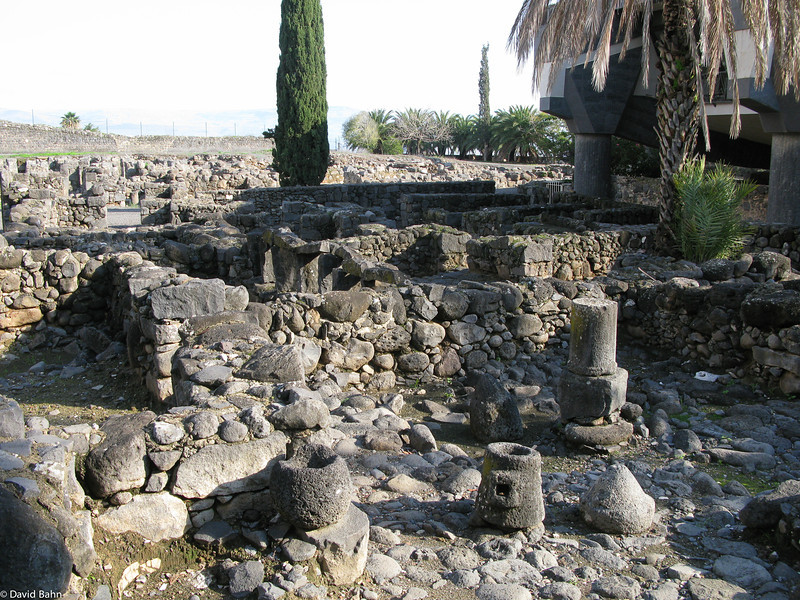
    Ruins of Capernaum where four friends brought a paralyzed man to be healed by Jesus.  Photo taken 2012

    I love this account of Jesus and the paralyzed man and his four friends. There is so much here…

    • destruction of private property for the sake of a friend in need
    • boldness of the friends assuming that Jesus would do something for their friend
    • quarrelling and grumbling of the scribes at Jesus’ assertion of forgiveness
    • insightful and challenging questions by Jesus; and
    • a formerly-paralyzed man now walking…to the amazement of everyone

    Let’s just look at the grumblers for the time being. Isn’t it remarkable that their worry is about Jesus’ authority to forgive sins, rather than the need for healing, and compassion for this paralyzed friend? They did not believe Jesus had the authority to forgive sins. They did not seem concerned about the unroofing of the roof. They didn’t talk about the intrusion into the teaching session.

    The scribes thought that Jesus was being more than presumptuous in forgiving sins. And so he would have been – presumptuous – had Jesus not been willing to back it up by going to the cross to offer himself as the atoning sacrifice for the sins of the world. They weren’t just wrong about this; they were completely wrong about Jesus authority and intent.

    How is it that we can be so wrong in our assessment of people’s motives, and needing to discredit them? That is so often because we do not really trust God – that he can take care of the deceivers, and sustain the just. If, however, we entrust ourselves to God, believe that he has justified us, and settled our hearts by his grace, we will be at greater peace no matter who seems to be getting away with what.

    We would do well to spend our time rejoicing in God’s faithfulness and goodness to us and less time looking over our fence at what others are doing.

  • That evening at sundown they brought to him all who were sick or oppressed by demons. 33 And the whole city was gathered together at the door. 34 And he healed many who were sick with various diseases, and cast out many demons. And he would not permit the demons to speak, because they knew him. – Mark 1:32-34

    The synogogue (4th Century ruins) at Capernaum
    Ruins from a 4th century synagogue, which was built on top of the foundation of the synagogue where Jesus taught as recorded in Mark 1. Photo taken in 2012

    Diane and I went to the Houston Symphony last night. It was a birthday present from her which I truly enjoyed! We heard two pieces with which I (and Diane) were familiar: Beethoven’s 5th Piano Concerto, The Emperor, and Liszt’s: Les Préludes. It was a wonderful evening. The orchestra was excellent. The conductor, James Gaffigan, born in 1979 was a delight to watch. The pianist, Behzod Abduraimov was born in 1990, and amazingly gifted! The house, however, was only pleasantly full. The whole city did not come out to see this concert. Good as it was, it seems that not everyone loves classical music, or takes the time to go to a concert such as this was.

    In the case of Jesus on this occasion, however, the whole city went out to see him, to be healed of their diseases, and to be relieved of their demon possession. It must have been quite a scene.

    Having been to the ruins of Capernaum, where all this occurred, the crowd might have been fewer than 2000 people; its population in Jesus’ day is estimated to have been 1500. And Mark might be using hyperbole by saying that the whole city was gathered at the door. But one thing is clear: Jesus, at this moment, is quite a phenomenon. Everyone wants to see him, to have the touch of his healing hand, to be rid of their demons, or to bring loved ones to experience his grace.

    Something new was happening 2000 years ago in Capernaum, and in the world itself. God was breaking in in a delightful, dramatic, and decisive manner. The rule and reign of God was being manifest in Jesus’ teaching, healing, and freeing from the devil’s tyranny.

    This Sunday there will be crowds of people gathering at various churches around the world. They will sing the praises of Jesus, the Son of God, Savior of the world, healer of diseases, giver of hope, releaser from bondage. I hope something happens there in those gatherings. I hope that the power of Jesus’ love and forgiveness, grace and kindness will touch someone’s heart so much that he or she will be ushered into the rule and reign of Christ in that believer’s heart. For where Jesus is, and where his word is found and believed, good things happen – no matter how many people gather at the door.

  • But the man went and spread the word, proclaiming to everyone what had happened. As a result, large crowds soon surrounded Jesus, and he couldn’t publicly enter a town anywhere. He had to stay out in the secluded places, but people from everywhere kept coming to him. – Mark 1:45

    20161230-04559
    This “Flower by God” was photographed at the Houston Zoo, December 2016

    A man identified only as Pastor Edward spoke at the National Press Club news conference, sponsored by Open Doors USA. He spoke about the necessity of extreme caution he and other believers need to exercise in his church in Damascus, Syria. He told about opening their church to displaced Muslim Sunni people in their small village. The next day the church and his house were targeted by artillery fire. Two people were killed. In Somalia no Christian churches are allowed to exist. Small groups of believers meet together in secret for fear of their lives.

    I cannot imagine living as a believer under such oppression and intimidation. In a letter to his parents, Martin Luther spoke of being convinced by friends not to go to his father’s sick bed for fear of those who would do him in. He had become such a threat to the Roman Catholic Church and others whose power and position were threatened by the gospel message he proclaimed, that many people wanted to kill him. He was forced into hiding for a period of time, only later returning to public life.

    Jesus’ actions, recorded here in Mark’s gospel, indicate a time when he could not go out in public as well. But the reason was a bit different. Jesus’ ultimate goal was the redemption of sinners through his death on the cross. When the time came, he faced it bravely. But the time had not yet come. His death at this point in his public ministry would not allow the message he proclaimed to be fully formed. His disciples were not yet gathered, sent, taught, and prepared for the work to which God would call them. The time was not yet.

    Perhaps we can remember this when we face challenges that are not quickly resolved, or when difficulties do not magically evaporate before our eyes, or at the moment our prayers end. In the case of the leprous man his healing was immediate. But these happenings more often punctuate a ministry and manifestation of Jesus’ mission that was a long walk of obedience in the same direction – toward God’s rule and reign in people’s hearts and minds.

    Some moments of life are of stellar importance and, like the now-healed man, we shout from the mountaintops of God’s grace in our lives. Other times we simply move forward in the day-to-day duties and experiences. In any case, our calling is to follow Jesus wherever he leads, and rejoice in his mercy, grace, faithfulness, love, and salvation.

  • And a leper came to Jesus, imploring him, and kneeling said to him, “If you will, you can make me clean.” 41 Moved with pity, he stretched out his hand and touched him and said to him, “I will; be clean.” 42 And immediately the leprosy left him, and he was made clean.43 And Jesus sternly charged him and sent him away at once, 44 and said to him, “See that you say nothing to anyone, but go, show yourself to the priest and offer for your cleansing what Moses commanded, for a proof to them.” 45 But he went out and began to talk freely about it, and to spread the news, so that Jesus could no longer openly enter a town, but was out in desolate places, and people were coming to him from every quarter. – Mark 1:35-45

    20150611-8881
    One of the beautiful scenes at Butchart Gardens in Victoria, BC. Photo taken June 2015.

    It is quite one thing to believe that God can do a great work in your life. It is quite another to believe that he will do it. Therein lies the rub. We may have no doubt that God works in people’s lives, that he is able to orchestrate the happenings of everything from the flight of a sparrow to the fall of a nation. We believe that God upholds the world with the might of his power. But when someone prays that they be spared from a natural disaster the wicket gets a bit more sticky! What is the dividing line between faith and denial of reality? There is a difference between praying “Thy will be done” in faith, and praying it in resignation: “Thy will be done…and it’s probably not going to be answering this prayer.”

    It all has to do with time. For the believer there will be a perfect healing, release, and resolution to all troubles on the Great Last Day. All disease will be cured; all discord resolved. Every vestige of sin will be utterly consumed. So when we pray, “If you will, you can make me well,” we know it is God’s will. The issue is not if but when. Perhaps our prayers could be a bit less ambivalent if we prayed for a foretaste of the perfect healing and wholeness that is the fullness of God’s rule and reign, asking for our needs to be met now.

    The time was at hand when Jesus walked the earth. He was the incarnation of Gods’ rule and reign. He sent his disciples on missions to manifest the presence of his rule and reign over all forces of sin, death, and the devil. Occasionally God lifts the veil here and now for us to see that in our time as well. One day we will see it in real time, and for all time. Until then, whenever we see God’s rule and reign in this world – whenever we experience God’s favor personally – we are free to tell others about it. In fact we will not be able to help it. It is in that moment that we see most clearly that not only can God act in our behalf, we have experienced the reality of his having done so. Thanks be to God for those glimpses of the glory that will one day be ours through Jesus Christ our Lord!

  • And rising very early in the morning, while it was still dark, he departed and went out to a desolate place, and there he prayed. And Simon and those who were with him searched for him, and they found him and said to him, “Everyone is looking for you.” And he said to them, “Let us go on to the next towns, that I may preach there also, for that is why I came out.” And he went throughout all Galilee, preaching in their synagogues and casting out demons. – Mark 1:35-39

    This beautiful small blossom was growing at the Houston Zoo. Photo taken December 2016.

    In 2013 I took a three month sabbatical. It was a great and refreshing experience for me. One of most significant things I learned was that the world could keep spinning, the church could continue to function and life could go on without me. This was more than just a theoretical truth being validated; it was an emotional realization, and an enlightening experience. That is true because, although God uses people and other means to do his work and work out his will in the world, God is still over all. Jesus himself said that not even a sparrow falls to the ground apart from his will or knowledge. 
    Jesus knows that the world can go on without him for a time – especially because he is not simply wasting his time, nor is he merely resting up from the previous day’s busy ministry load. Jesus is taking time to pray, communing with his Heavenly Father. In doing so, he is seeking the Father’s help in the mission and work to which he had been sent. He is also expressing faith in the Father to work in and through many people to accomplish his will. 

    Jesus is aware that he is the essential means by which the Father is fulfilling his eternal will for the salvation of all people. He knows no one else is able to do what he will ultimately be called on to do. But he knows also that the work of God is accomplished not only through direct action, but even more in dedicated faith and trust in God. 

    God’s work is done through people who put their faith and trust in God, and rely on him in every situation at all times. Sometimes God allows us to be actively and directly involved in his work on earth. More often we see him working through others. There will come a time when Jesus does the work of God totally alone. But for these moments he is praying, recognizing that God is at work in and through him, as well as in and through others.

  • That evening at sundown they brought to Jesus all who were sick or oppressed by demons. 33 And the whole city was gathered together at the door. 34 And he healed many who were sick with various diseases, and cast out many demons. And he would not permit the demons to speak, because they knew him. – Mark 1:32-34

    Butchart Gardens, Vancouver Island, Canada - June 2015
    An impressionistic version of Buchart Gardens in Victoria, BC, Canada. Photo taken June 2015

    I’m thinking he got it from an Adam Sandler movie. One of my four sons on one occasion made a point of shushing me as we were in a lively discussion. I was wanting to make a point, and he would put his hand in my face, close his fingers to his thumb, and vocalize a syllable that defies being put into writing. It wasn’t scatological. I am simply unable to write letters that adequately convey the sound he made. I just know he would not allow me to speak. It was a bit frustrating as you can imagine, and though it sounds disrespectful, it was at least somewhat in good-natured fun. The issues at stake were of arguable importance. We were two adults having a lively conversation.

    I’m not certain what sound Jesus made in the face of the demons, but  Jesus would not allow them to speak. It is clear, moreover, that the stakes were higher than a lively discussion about politics, politeness, or what sports team is the best. Jesus, in stopping Satan’s minions from speaking, was preventing the caustic, destructive, and deceptive outpouring of lies, accusations, and false teaching that is the devil’s stock in trade.

    We can thank God that Jesus shut down Satan, and showed him to be the thief, liar, and accuser that he is. Jesus is all about freedom, and on this occasion he is making certain that those on that day who had heard him teach, experienced his healing touch, and seen his miraculous powers at work would not have their day ruined by the demons false teachings and deceptive words.

    I’m not always as confident as Jesus is in the face of satan’s lies. But I am confident that Jesus silenced his foes for a while, and allowed those gathered there in Capernaum a moment of peace, and a time of the refreshment of healing grace. I’m thankful when he brings that into my life, and the lives of those I love as well.

    Note: I will be working through the Gospel of Mark for these next few months, paralleling the focus of our Good News series at St. John.