David Bahn – Reflections

Light from the Word and through the lens

  • But an opportunity came when Herod on his birthday gave a banquet for his nobles and military commanders and the leading men of Galilee.22 For when Herodias’s daughter came in and danced, she pleased Herod and his guests. And the king said to the girl, “Ask me for whatever you wish, and I will give it to you.” 23 And he vowed to her, “Whatever you ask me, I will give you, up to half of my kingdom.” 24 And she went out and said to her mother, “For what should I ask?” And she said, “The head of John the Baptist.” 25 And she came in immediately with haste to the king and asked, saying, “I want you to give me at once the head of John the Baptist on a platter.” 26 And the king was exceedingly sorry, but because of his oaths and his guests he did not want to break his word to her. 27 And immediately the king sent an executioner with orders to bring John’s head. He went and beheaded him in the prison 28 and brought his head on a platter and gave it to the girl, and the girl gave it to her mother. 29 When his disciples heard of it, they came and took his body and laid it in a tomb. Mark 6:21-29

    dlb-phoenix-desert-botanical-garden-04841
    These saguaro cacti were marching up the hill at the Desert Botanical Garden in Phoenix, AZ. Photo taken January 2017

    We saw it coming long before it happened; that’s the way it is with a view toward a terminal illness. There are signs. In the case of my dad, it was the inability of him to kick the tobacco habit. For years we would see cigarette butts in odd places around our house after they left: telltale signs of his nicotine addiction. Nothing could help him stop smoking. So when the chronic, nagging cough gave way to a trip to the hospital, leading to a diagnosis of lung cancer none of us were surprised. Sad. Very sad. But not surprised. By the time he was diagnosed it was only seven months until we saw him take his last breath this side of heaven.

    Herod did not suffer from cancer as far as I know, but he did have a malady that would yield a very bad outcome in his family and his own personal trajectory. Mark has already reported that Herod couldn’t either dismiss John, or embrace his preaching. Mark tells us (v. 20), “When he heard him, he was greatly perplexed, and yet he heard him gladly.” Conflicted – and compromised also by his wife who wanted to put John to death (Mark 6:19-20) – it was only a matter of time. Add to that mix festive partying, an insecurity that he sought to overcome with bravado and an arrogant show of power, and you have the makings of a very sad moment for everyone there.

    John will be killed. Herodias will be confirmed in her evil intentions and ignoring of God’s ways. Herod will violate his own conscience. Herodias’ daughter will be taught the fine art of manipulative seduction. Herod’s guests will be more jaded by the abusive show of power, corruption, and evil.

    I once heard a suicide bombing described as a ring of death stretching from the center of the explosion outward, reaching far and causing pain and destruction in an ever-widening circle of carnage; but the closer to the center you get the more terrible and violent is the ruin and pain.

    What is to be done in the face of such tragedy? John’s disciples go, take the body, and bury it. What else is to be done? Shall we say that it’ll be OK, that it’s no big deal; he will rise again? No. Sometimes we can only honor our lost loved-ones and await Jesus’ presence and look to him for hope and peace. The disciples will tell Jesus. They will retreat, attempt to regroup, and find peace in the face of these fierce facts. That won’t work out exactly as they may have supposed. We do see, however, that Jesus will continue his ministry. He will not let evil and destruction dissuade him. It will be some time before righteousness is vindicated.

    Truth, goodness, love, redemption and faith will triumph. Ours is a view toward a perfect completion of Jesus’ mission and our redemption. Thanks be to God!


  •  And Jesus called the twelve and began to send them out two by two, and gave them authority over the unclean spirits. He charged them to take nothing for their journey except a staff—no bread, no bag, no money in their belts— but to wear sandals and not put on two tunics. 10 And he said to them, “Whenever you enter a house, stay there until you depart from there. 11 And if any place will not receive you and they will not listen to you, when you leave, shake off the dust that is on your feet as a testimony against them.” 12 So they went out and proclaimed that people should repent. 13 And they cast out many demons and anointed with oil many who were sick and healed them.

    14 King Herod heard of it, for Jesus’ name had become known. Some said, “John the Baptist has been raised from the dead. That is why these miraculous powers are at work in him.” 15 But others said, “He is Elijah.” And others said, “He is a prophet, like one of the prophets of old.” 16 But when Herod heard of it, he said, “John, whom I beheaded, has been raised.” 17 For it was Herod who had sent and seized John and bound him in prison for the sake of Herodias, his brother Philip’s wife, because he had married her. 18 For John had been saying to Herod, “It is not lawful for you to have your brother’s wife.” 19 And Herodias had a grudge against him and wanted to put him to death. But she could not,20 for Herod feared John, knowing that he was a righteous and holy man, and he kept him safe. When he heard him, he was greatly perplexed, and yet he heard him gladly. – Mark 6:7-20

    dlb-phoenix-desert-botanical-garden-04759
    Photo taken at the Phoenix Desert Botanical Garden – January 2017

    I had a friend who has finally landed. He could not do it in this life; he was conflicted within, and struggled to make a simple clear statement. He always hedged. He would never say something directly. He would constantly add qualifiers, conditions, and give himself outs. I liked the guy. He was friendly. But when an acquaintance remarked of him, “He never lands,” I realized that was the case. He has ended his earthly sojourn, and is landed in the arms of God’s mercy and grace through Jesus Christ. Actually, that was the one place he had landed: entrusting himself to Jesus’ love, forgiveness, and salvation.

    Sadly, on the other hand, Herod was not able to do that – at least not about Jesus. It would get him into deep trouble later in his life. But as we see here on this occasion, he cannot decide: Is John telling him the truth? Should he listen to him? Ought he really repent? Or shall he listen to his wife and put him to death?

    The pressures to set aside God’s messengers has to do with powers and influences in our own hearts, as well as those around us who are not dedicated to following God. Then, of course, there is also the devil. The Devil, the world, and our sinful flesh are an unholy alliance, dedicated to bringing us down and thwarting the work of God in our hearts and lives. This unholy trinity is also at work in the lives of others. These all conspire to destroy Jesus’ gift of life and salvation.

    Jesus tells his disciples that there will be those who receive him when they bring the Word to them. They will hear and believe – praise be to God! But there will also be those who do not believe. They will reject the Good News of Jesus and deny his rightful place in their hearts and lives.

    It’s all too easy to align ourselves with the world, blending in and being shaped by the godless throng. I, for one, do not like to stick out, make a scene, or be the focus of ridicule or rejection. But if we take Jesus’ words to heart, we will not lose a wink of sleep over those who reject his message of love. Rather we will rejoice when we find a person of peace and have the privilege of being a part of God’s work in their lives. Those people and times may be few, but they are precious. Jesus’ followers can surely land on that.

  • Jesus went away from there and came to his hometown, and his disciples followed him. And on the Sabbath he began to teach in the synagogue, and many who heard him were astonished, saying, “Where did this man get these things? What is the wisdom given to him? How are such mighty works done by his hands? Is not this the carpenter, the son of Mary and brother of James and Joses and Judas and Simon? And are not his sisters here with us?” And they took offense at him. And Jesus said to them, “A prophet is not without honor, except in his hometown and among his relatives and in his own household.” And he could do no mighty work there, except that he laid his hands on a few sick people and healed them. And he marveled because of their unbelief.

    And he went about among the villages teaching. – Mark 6:1-6

    dlb-phoenix-desert-botanical-garden-04818
    The crown of thorns atop a cactus plant in the Desert Botanical Garden in Phoenix, AZ. Photo taken January 2017

    I have chosen not to go back for any of my high school reunions. Distance as well as reputation have played into that decision. It is a long distance from Houston, Texas to Cape Girardeau, Missouri. More than that, however, is the matter of reputation, history, and infamy I have in my own mind about going back to my high school roots. Even though I missed seeing and being with Rush Limbaugh on at least one occasion (he was a 1969 graduate of Central High School, as was I), I’m not too sorry that I did not go.

    To that extent, I can identify with Jesus’ comment, “A prophet is not without honor, except in his hometown.” Jesus’ reaction to this experience didn’t have to do with his own ego. Nor was he dealing with huge distances of travel. But his dismissal by his family and friends amounted to a denial of his true identity. He was not just a blowhard kid coming home looking for adulation, and saying I told you so. He was not there to prove anything to anyone.

    Jesus has nothing to prove to anyone. He will not spend his time or energy making a case for himself. Even though he desires deeply that the people in his home town (as well as all people everywhere) know him and believe in him. Jesus’ teaching or even his defense is never about justifying himself or just looking good in others’ eyes. He wishes people to believe in him for their justification, and their eternal well-being.

    Dismissal of Jesus as just someone who wants to make a good impression, or a self-absorbed blowhard, leads to great loss. When we put Jesus outside of any equation the answer will be profoundly unsatisfactory. No miracles – or a very few – are experienced there. Worse yet, Jesus goes on to other places and teaches other people: a great loss to those he loves.

    Don’t dismiss Jesus: he is not just the carpenter’s son. He is the Son of God. He brings life, wholeness, hope, and salvation.

  • And when evening came, the boat was out on the sea, and Jesus was alone on the land. 48 And he saw that the disciples were making headway painfully, for the wind was against them. And about the fourth watch of the night he came to them, walking on the sea. He meant to pass by them, 49 but when they saw him walking on the sea they thought it was a ghost, and cried out, 50 for they all saw him and were terrified. But immediately he spoke to them and said, “Take heart; it is I. Do not be afraid.” 51 And he got into the boat with them, and the wind ceased. And they were utterly astounded, 52 for they did not understand about the loaves, but their hearts were hardened. – Mark 6:47-52

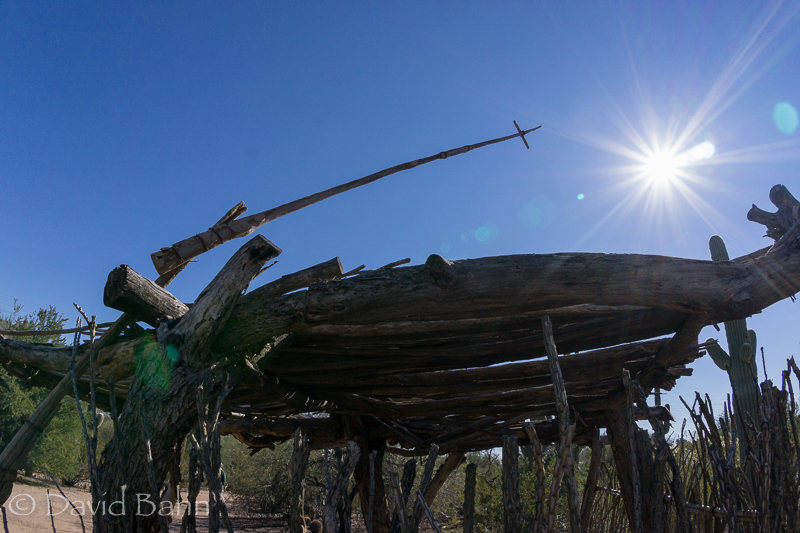
    dlb-phoenix-desert-botanical-garden-04856
    The cross pointing toward the sun caught my eye when we visited the Desert Botanical Garden in Phoenix. Photo taken January 2017

    In his book, If You Want to Walk on Water, You’ve Got to Get Out of the BoatJohn Ortberg offers a good question and some insightful observations in regard to Jesus’ water-walking appearance to the disciples:

    Why did Jesus want to “pass them by”? Did he decide to race them? Did he want to impress them with a really neat trick? …

    God put Moses in the cleft in a rock so Moses could see “‘while my glory passes by.’…The Lord passed before him.”

    God told Elijah to stand on the mountain “for the Lord is about to pass by.” …

    …when Jesus came to the disciples on the water intending “to pass them by,” he was not just doing a neat magic trick. He was revealing his divine presence and power. Only God can do such a thing: “He alone…treads on the waves of the sea.”

    It would be amusing, I suppose, to think of Jesus doing a neat trick: “Hey look, guys! I’m walking on water!” It might be a curious exercise to wonder whether Jesus was just trying to beat the disciples to the other side of the lake. But in the end (and beyond the reality of Jesus’ theophany on this occasion) we must deal with their lack of understanding and their hard hearts.

    Why would they wonder about Jesus’ miraculous powers and his divine nature? They had seen him take two fish and five loaves and feed a multitude. They had seen him heal a woman with an issue of blood. A little girl had returned to life in their presence. In Jesus “God was visiting them in the water-walking flesh.” [Ortberg]

    I’m not certain I have ever experienced the kinds of miracles and manifestations of glory that the disciples did during Jesus’ earthly lifetime. But I am certain that my heart can be just as hard as theirs. It may not be that they or I are hardhearted in rebellious disobedience. It’s not that we’re out there directly disobeying God’s commands. In fact most Christians struggle with sins of omission rather than sins of commission. But we show how hard our hearts are whenever we doubt God’s goodness, deny God’s power, or simply forget the implications of God’s presence in Jesus Christ.

    There may be times when we are legitimately scared by the events swirling around us – storms or theophanies. But Jesus’ presence brings perfect peace…even as it engenders a proper fear in our hearts. Indeed, our calling is to fear, love, and trust in God above all things.

  • Immediately he made his disciples get into the boat and go before him to the other side, to Bethsaida, while he dismissed the crowd. 46 And after he had taken leave of them, he went up on the mountain to pray. 47 And when evening came, the boat was out on the sea, and he was alone on the land. – Mark 6:45-47

    red-flower
    This small red flower was just opening up in the Desert Botanical Garden in Phoenix when we visited there in January 2017.

    I’ve taken a hiatus of late, and that for one main reason – so I thought. I shared with a sister in Christ the reality of the need:

    I’m taking a small hiatus at the moment, trying to recalculate what I’m actually trying to accomplish through my blog. It started as something for my own spiritual nourishment and growth, but has now approached being something I’m doing for the sake of others’ praise – a dangerous place for anyone. Jesus warns against that, and I believe I know why. Perhaps I’ll reflect on that soon. 

    Jesus’ example of withdrawing, spending time with his Father in prayer, and having some alone time offers some encouragement to me as well. He may well have struggled with doing things for the praise of man rather than God. After all, Jesus was tempted in every way as we are – yet without sin (cf. Hebrews 4:15). There are, however, other reasons for people to power down, withdraw, and spend time with the Father in prayer, Bible reading, and meditation. One of those reasons has to do with the shaping of our being, character, heart, and hopes that comes through time spent in the presence of God.

    My hiatus had to do with figuring out how to write this blog for the right reasons: was it for my personal spiritual growth, or for the edification of others. Somewhere along the way these two got muddled, and I focused less on spending time with God and more focused on writing something that would garner someone’s attention. A word of praise or appreciation became more important to me than it should have been. Jesus warns against “practicing [our] righteousness before other people in order to be seen by them” (Matthew 6:1) so that we are not deceived into evil practices or thoughts or beliefs. People seduce. People deceive. People lead others astray. God, on the other hand, loves, redeems, gives life, speaks truth, leads us to eternal and abundant blessings.

    I’m not settled on whether or how to write a five-day-a-week blog. I have not abandoned the idea. But I am convinced that I need to do something to follow the model of the Son of God who considered it important to spend time with his Father: alone time, prayer time, meditation time, time in the presence of God. So stay tuned. And I will seek to offer what I may as a gift from God to you, dear reader, and let that flow from my time with him: alone time, prayer time, meditation time – seeking to be shaped by him.

  • On that day, when evening had come, Jesus said to them, “Let us go across to the other side.” 36 And leaving the crowd, they took him with them in the boat, just as he was. And other boats were with him. 37 And a great windstorm arose, and the waves were breaking into the boat, so that the boat was already filling. 38 But he was in the stern, asleep on the cushion. And they woke him and said to him, “Teacher, do you not care that we are perishing?” 39 And he awoke and rebuked the wind and said to the sea, “Peace! Be still!” And the wind ceased, and there was a great calm. 40 He said to them, “Why are you so afraid? Have you still no faith?” 41 And they were filled with great fear and said to one another, “Who then is this, that even the wind and the sea obey him?” – Mark 4:35-41

    20170121-sony04737
    Very similar to the photo posted in an earlier blog post, this was taken with a different camera and lens for comparison. Brazos Bend State Park – January 2017

    I had an awakening of sorts when I was in my early years of college. Friends of mine came back from the movie Butch Cassidy and the Sundance Kid quoting lines from the movie. It was a funny and enjoyable way to remember and enjoy the movie again. Before that time I had not thought to learn that art. Now I have a arsenal of movie quotes: everything from, “Some things in here don’t react very well to bullets,” (Hunt for Red October), to “We’re fine, we’re all fine now…thank you.” (Star Wars), to “Who are those guys? Can you do that? I can’t do that? No one can track over solid rock. Who are those guys!” (Butch Cassidy…).

    Butch wasn’t quoting Jesus’ disciples by any stretch of the imagination here, but they did wonder who was in the boat with them once Jesus calmed the stormy waters on the Sea of Galilee. This was no little act on his part. Jesus was commanding the wind and waves, and he was obeying them.

    I think of God speaking to Job about setting the limits of the waters at creation (Job 38:8-11). Here Jesus was echoing the great creative power of God in his command against the wind and waves. He was prescribing the limits of the waters. He was saying, “here shall your proud waves be stayed.” It is quite appropriate to ask in response to this event: “Who is this, that even the wind and sea obey him?”

    Who falls asleep in exhaustion at the end of a long day, yet awakens to still a storm with his command? Who asks such an incredibly challenging question, “Why are you so afraid? Have you still no faith?” Who inspires such faith, fear, and love as does this Jesus? Who is this man?

    Martin Luther explains the First Commandment: We should fear, love and trust in God above all things.” Such is the proper attitude toward Jesus. He is to be feared; he is not just some religious guru offering platitudes of spiritual speech. He is to be loved; he is our Savior who sacrificed himself for our sins. He is to be trusted; he will get the disciples to the other side of the sea.

    What is your “other side” to which Jesus is calling you? Will you trust him, follow him, rejoice in his presence and fearfully love him through it all? We all have our moments of doubt and fear. In the end, however, Jesus shows himself to be One who can be trusted completely, and who is with us even when we think he doesn’t care about our wellbeing.

  • And Jesus said to them, “Is a lamp brought in to be put under a basket, or under a bed, and not on a stand? 22 For nothing is hidden except to be made manifest; nor is anything secret except to come to light. 23 If anyone has ears to hear, let him hear.” 24 And he said to them, “Pay attention to what you hear: with the measure you use, it will be measured to you, and still more will be added to you. 25 For to the one who has, more will be given, and from the one who has not, even what he has will be taken away.”

    26 And he said, “The kingdom of God is as if a man should scatter seed on the ground.27 He sleeps and rises night and day, and the seed sprouts and grows; he knows not how.28 The earth produces by itself, first the blade, then the ear, then the full grain in the ear.29 But when the grain is ripe, at once he puts in the sickle, because the harvest has come.”

    30 And he said, “With what can we compare the kingdom of God, or what parable shall we use for it? 31 It is like a grain of mustard seed, which, when sown on the ground, is the smallest of all the seeds on earth, 32 yet when it is sown it grows up and becomes larger than all the garden plants and puts out large branches, so that the birds of the air can make nests in its shade.”

    33 With many such parables he spoke the word to them, as they were able to hear it. 34 He did not speak to them without a parable, but privately to his own disciples he explained everything.  Mark 4:21-34

    20170121-sony04653
    This is no mustard tree, but these are birds of the air nesting in the branches of this tree at Brazos Bend State Park. Photo taken January 2017

    You don’t tug on Superman’s cape. You don’t curse in front of your grandmother. You don’t pick a fight with someone who is bigger than you. You don’t buy a new car just because your old one runs out of gas. What would you add to that list? Jesus asks, “Is a lamp brought in to be put under a basket, or under a bed, and not on a stand?” The obvious answer is, “No.” There are things you just don’t do.

    So why would anyone keep quiet about God’s work in their life? Why would a person not shout it from the mountaintops if Jesus has healed, saved, transformed or changed his or her world? Furthermore God deeply wants to shape your life and give you the joy of bearing fruit.

    The greatest fruit we can bear is that of passing along the Good News of God’s love in Jesus so that another lost soul believes and is saved. The most wonderful way we can honor God is by declaring before others what he has done for us. When we sow such seeds of praise, love, and witness, we are opening up the rule and reign of God to others whom God will call into his eternal glory.

    Why wouldn’t we do that? It may be that we are embarrassed; we don’t want to call attention to ourselves, or look like a fool because of God’s work in our lives. It could be that we really don’t want others to horn in on our territory – re-shaping our way of think and doing church or anything else. It may be that we believe only certain kinds of people ought to be under the rule and reign of Christ.

    Jesus, however, speaks of a growing realm from the tiniest of seeds to a large mustard tree in which the birds of the air make their nests. That is a symbol of the expansive reach of God’s grace, the breadth of his love, and the life-changing nature of his rule and reign in our hearts. There is a celebration in heaven whenever a sinner repents. That truth is worth considering, seeking to understand, and applying to our lives day by day.

  • And when he was alone, those around him with the twelve asked him about the parables. 11 And he said to them, “To you has been given the secret of the kingdom of God, but for those outside everything is in parables, 12 so that

    “‘they may indeed see but not perceive,
        and may indeed hear but not understand,
    lest they should turn and be forgiven.’”

    13 And he said to them, “Do you not understand this parable? How then will you understand all the parables? 14 The sower sows the word. 15 And these are the ones along the path, where the word is sown: when they hear, Satan immediately comes and takes away the word that is sown in them. 16 And these are the ones sown on rocky ground: the ones who, when they hear the word, immediately receive it with joy. 17 And they have no root in themselves, but endure for a while; then, when tribulation or persecution arises on account of the word, immediately they fall away. 18 And others are the ones sown among thorns. They are those who hear the word, 19 but the cares of the world and the deceitfulness of riches and the desires for other things enter in and choke the word, and it proves unfruitful. 20 But those that were sown on the good soil are the ones who hear the word and accept it and bear fruit, thirtyfold and sixtyfold and a hundredfold.” – Mark 4:10-20

    20170121-diane-0207
    Diane took this photo at Brazos Bend State Park when we visited there Jaunary 2017.

    One of my favorite Youtube videos (other than the failed rocket launch videos that I watched with my grandson last summer) is of Monty Roberts, the original Horse Whisperer. If you take the time to watch one of his join up videos you will see him taming a previously-wild horse, and having it follow him around the pen, its nose on his shoulder – all within 30 minutes! He sends the horse away for a long period of time until he sees signs of submission which very soon give way to an incredible connection between himself and the horse. It is done without any violence or forcing of the horse in any way. It is obviously an art. It is also telling: there are times to offer a sugar cube, and times to make the horse simply want to connect with you. Monty does not break horses, he connects with them.

    I don’t believe Monty got his approach from Jesus, but he might have. Certainly we can learn a thing or two about how to connect people to Jesus by watching his example. He doesn’t break people; but he does seek to bring us to a place of submission, or better yet, a place where we can admit that we are in need, and that God, not us, is in charge of all of life.

    That is at least part of the reason Jesus tells parables. There is a purpose behind his approach to people. Part of it is surely to cause a bit of intrigue; to challenge people to figure out what he is saying and what he is all about.

    There is a bit of irony, also, in Jesus’ quote of Isaiah. It is as if he is speaking for those who want nothing to do with Jesus and his word, truth, and grace. In spite of themselves they will not turn, repent, and be forgiven – even though that is truly what they need. Cutting off one’s nose to spite one’s face is a saying that comes to mind.

    But the parable offers enough intrigue to engage, making people wonder what Jesus really is saying. In studying parables of Jesus’ day, we also discover that Jesus used common themes and symbols. In the end of each story, however, he did a Crazy Ivan, and changed the meaning or moral of the story. It would leave people wondering, What, exactly did he say?!?”

    But when the word catches hold, takes root, and grows the results are beautiful to behold. This is God’s ultimate desire: that we hear the word, receive it into repentant hearts, believe the word, and bear fruit. Horse Whispering is another way of thinking about God’s invitation and challenge to us: Believe in Jesus, and bear fruit for his glory and our neighbor’s good.

  • Again he began to teach beside the sea. And a very large crowd gathered about him, so that he got into a boat and sat in it on the sea, and the whole crowd was beside the sea on the land. And he was teaching them many things in parables, and in his teaching he said to them: “Listen! Behold, a sower went out to sow. And as he sowed, some seed fell along the path, and the birds came and devoured it. Other seed fell on rocky ground, where it did not have much soil, and immediately it sprang up, since it had no depth of soil. And when the sun rose, it was scorched, and since it had no root, it withered away.Other seed fell among thorns, and the thorns grew up and choked it, and it yielded no grain. And other seeds fell into good soil and produced grain, growing up and increasing and yielding thirtyfold and sixtyfold and a hundredfold.” And he said, “He who has ears to hear, let him hear.” – Mark 4:1-9

    20170121-sony04695
    Taken at Brazos Bend State Park, January 2017

    Some people like to sow seeds of discord. We’ve seen that over the past week with people all over the nation demonstrating and protesting everything from Donald Trump’s presidency, to income inequality, to abortion rights (more on that below) and more. One Facebook post made the observation that demonstrators were destroying property of companies that aligned themselves against Donald Trump. It seems that they were just angry.

    Another post on Facebook – itself a source and field ripe for sowing seeds of discord – made another cogent observation: Today, at the Women’s March, people will be marching for almost everything under the sun. Supposedly a diverse group, they have one thing in common: they were all born. Now, that’s a right worth marching for.

    Perhaps there is a time and place to sow seeds of discord and strife. Issues that have surfaced recently do deserve to be aired, debated, challenged, and expressed. But there is a seed that brings the ultimate peace which Jesus speaks of here in this parable. It is the seed of God’s word. And when it is sown, and received into a believing heart it brings peace. James tells us that a harvest of righteousness is reaped by those who sow seeds of peace (James 3:16-18).

    Seeds of discord, unrest, anger, and resentment are all too easy to sow. When, however, the Holy Spirit is within us, and we more consciously seek to sow the seed of God’s love, forgiveness, and salvation (the seed of the Gospel), a more beautiful result ensues. That will sometimes require the seed of the law to be sown. Sometimes we must speak a word of truth, for the word of God does go to the heart. But never does God’s word seek only to alarm. Ultimately it seeks to bring people to repentance and faith. And when the seed of God’s word springs fully into faith it is a beautiful thing.

  • And the scribes who came down from Jerusalem were saying, “He is possessed by Beelzebul,” and “by the prince of demons he casts out the demons.” 23 And he called them to him and said to them in parables, “How can Satan cast out Satan? 24 If a kingdom is divided against itself, that kingdom cannot stand. 25 And if a house is divided against itself, that house will not be able to stand. 26 And if Satan has risen up against himself and is divided, he cannot stand, but is coming to an end. 27 But no one can enter a strong man’s house and plunder his goods, unless he first binds the strong man. Then indeed he may plunder his house.

    28 “Truly, I say to you, all sins will be forgiven the children of man, and whatever blasphemies they utter, 29 but whoever blasphemes against the Holy Spirit never has forgiveness, but is guilty of an eternal sin” 30 for they were saying, “He has an unclean spirit.”

    31 And his mother and his brothers came, and standing outside they sent to him and called him. 32 And a crowd was sitting around him, and they said to him, “Your mother and your brothers are outside, seeking you.” 33 And he answered them, “Who are my mother and my brothers?” 34 And looking about at those who sat around him, he said, “Here are my mother and my brothers! 35 For whoever does the will of God, he is my brother and sister and mother.” – Mark 3:22-34

    20170121-canon-0065
    East Lake at Brazos Bend State Park. Our photo club had an outing there during which we saw nearly a dozen alligators! The largest of them were far away. None are visible in this photo, taken January 21, 2017.

    I had an interesting conversation today with a woman regarding her cousin and baptism. Seems she and her cousin were in quite a discussion about baptism, raising children, and doing what pleases God. Seems, also, that there is another party to this discussion who muddies the water because of her insistence upon her way of thinking as being the only true and right way. The three are at odds with each other through all of this! It is not a family-splitting conflict, but it is concerning because it has to do with the truth of God’s word.

    In essence the question is whether baptism is a gift of God (cf. Romans 6:1-4), or a requirement for righteousness, or an un-needed option for one to be a child of God. I consider baptism to be a blessing and gift of God that is ordinarily necessary for salvation; not essential, but necessary. After all, Jesus did command that we baptize. And the only command given to the earliest converts to the Christian faith was to repent and be baptized (Acts 2:38). It is, at the same time, a gift – rich in grace and blessing from God.

    Which gets then to the question: what is necessary for salvation? What does one have to do to be saved? And what if one misses that mark? We know that faith is not just necessary but essential for salvation. For “without faith it is impossible to please God” (Hebrews 11:6). But what if someone fails to be baptized, or it is done improperly? Is this the unforgivable sin?

    Thankfully Jesus clarifies all this for us: only one sin is unforgivable: the eternal sin of blasphemy against the Holy Spirit: calling the good work of the Holy Spirit evil. That’s saying that being brought to faith, and motivated to mission is a bad thing. That is unbelief at its core.

    At the core of Jesus’ promises is his grace and love for all who believe in him, who are his mother, brothers and sisters, living out their faith, and doing the will of God. And when we fail we thank God that we not only have a brother in Christ, but a Savior who forgives our sins – big and small, and has defeated Satan once and for all.