David Bahn – Reflections

Light from the Word and through the lens

  • And when the town clerk had quieted the crowd, he said, “Men of Ephesus, who is there who does not know that the city of the Ephesians is temple keeper of the great Artemis, and of the sacred stone that fell from the sky? 36 Seeing then that these things cannot be denied, you ought to be quiet and do nothing rash. 37 For you have brought these men here who are neither sacrilegious nor blasphemers of our goddess. 38 If therefore Demetrius and the craftsmen with him have a complaint against anyone, the courts are open, and there are proconsuls. Let them bring charges against one another. 39 But if you seek anything further, it shall be settled in the regular assembly. 40 For we really are in danger of being charged with rioting today, since there is no cause that we can give to justify this commotion.” 41 And when he had said these things, he dismissed the assembly.

    Flowers by God...Photos by David2007 Calendar
    This cross is in the courtyard outside the Beijing Roman Catholic Church. Photo taken February 2004

    When we visited Beijing, China (following a mission trip to Hong Kong and southern China) we told our guide that we wanted to visit an underground church. There are many Christians in China, at least some of which worship in the registered “Three-Self Church” congregations. Some of them are also members of “underground” churches. We had visited a registered church, and found it to be quite edifying and encouraging. We had hoped to see a group of Christians who were not part of the registered (and highly watched and regulated) church.

    We ended up at a Roman Catholic church – much to our dismay. But our dismay turned into delight when through a providential convergence of events we were able to share the gospel with our guide and driver. Because we ended up in the Roman Catholic church in Beijing, and they were using the traditional mass, I was asked, and able to answer some very simple questions. Our guide asked me, during the service, “What is sin?” When we confessed the Nicene Creed in Latin we offered an annotated translation into English for him to consider.

    The people of Ephesus were agitated over the threat that the message of Jesus posed to Artemis, their pagan goddess. In the face of their near-riotous behavior, the town clerk reminds them of the “sacred stone that fell from the sky” (a meteor?) and the un-refuted fame they enjoyed relative to Artemis. There is a big difference between a superstitious fascination with a stone from the sky combined with a silversmith’s financial interests, and the message of Jesus. Too thousand years later we’re still talking about Jesus. Artemis (Diana) has been forgotten. Today Ephesus is a shadow of its former self. Meteors fall from the sky, and we are more or less impressed. No one today worships sacred stones or silver goddesses; at least not formally. 

    In fact, however, too many people do worship silver goddesses and sacred stones. Too many people bow down at the altar of finance and sexuality, seeking their salvation from deaf and mute false-gods. When their most dire hour comes, however, those gods will do them no good. Paul and his companions told them of a better God, and truer Savior. Those who embrace Jesus by faith will be saved – far better than any silver goddess or sacred stone can ever offer.


  • When they heard this they were enraged and were crying out, “Great is Artemis of the Ephesians!” 29 So the city was filled with the confusion, and they rushed together into the theater, dragging with them Gaius and Aristarchus, Macedonians who were Paul’s companions in travel. 30 But when Paul wished to go in among the crowd, the disciples would not let him. 31 And even some of the Asiarchs, who were friends of his, sent to him and were urging him not to venture into the theater. 32 Now some cried out one thing, some another, for the assembly was in confusion, and most of them did not know why they had come together. 33 Some of the crowd prompted Alexander, whom the Jews had put forward. And Alexander, motioning with his hand, wanted to make a defense to the crowd. 34 But when they recognized that he was a Jew, for about two hours they all cried out with one voice, “Great is Artemis of the Ephesians!” – Acts 19:28-34

    Hollyhock
    Hollyhock | Martinshöhe, Germany | August 2017

    The presenter – supposedly a Christian pastor or leader – was making a point about the power of words. He invited me to come forward and hold out my arm, and say out loud, “I am weak. I cannot hold my arm out against your downward pull.” I went along with his demonstration and managed to keep my arm outstretched even though he was pulling my arm downward. He was trying to say that negative speak can undercut our performance. Sounded like snake oil to me, and I wasn’t buying it.

    On this occasion the people of Ephesus were incited to riot against Paul. True to form, many people didn’t even know why they were there. The only thing they had in common was the cry, “Great is Artemis of the Ephesians.” My question: If Artemis is so great, why doesn’t she speak for herself? Why doesn’t she put a stop to Jesus’ disciples?

    That’s not the real question, however. The real question has to do with God’s true power and being. When God speaks things happen. He speaks the world into existence. He said, “Let there be light,” and there was light. When we speak things that are not true, we are playing God, trying to create a world that does not exist. In those cases it doesn’t matter what we say, or how earnestly we speak. Saying it doesn’t make it so.

    Artemis is not great. Jesus is Lord. Those who rail against Jesus and his rule and reign will on day confess, “‘Jesus Christ is Lord.” Artemis will have no help for them then; she’s not so great after all.

  • Now after these events Paul resolved in the Spirit to pass through Macedonia and Achaia and go to Jerusalem, saying, “After I have been there, I must also see Rome.” 22 And having sent into Macedonia two of his helpers, Timothy and Erastus, he himself stayed in Asia for a while.

    23 About that time there arose no little disturbance concerning the Way. 24 For a man named Demetrius, a silversmith, who made silver shrines of Artemis, brought no little business to the craftsmen. 25 These he gathered together, with the workmen in similar trades, and said, “Men, you know that from this business we have our wealth. 26 And you see and hear that not only in Ephesus but in almost all of Asia this Paul has persuaded and turned away a great many people, saying that gods made with hands are not gods. 27 And there is danger not only that this trade of ours may come into disrepute but also that the temple of the great goddess Artemis may be counted as nothing, and that she may even be deposed from her magnificence, she whom all Asia and the world worship.” – Acts 19:21-27

    Beautiful flowers at the Gartenschau in Kaiserslautern
    Yellow rose at the Gartenschau in Kaiserslautern, Germany | August 2017

    Have you ever seen an irresistible force encounter an immovable object? The closest I have come to that would be a Mythbusters episode when they utterly destroyed a massive object with a rocket-propelled sled. It was a colossal collision resulting in the utter destruction of both things.

    In the case of Paul’s plans to return to Jerusalem, and then ultimately travel to Rome, (all for the sake of preaching the Gospel) there were those who will seek to prevent him from succeeding. They didn’t like the truth he proclaimed, for he preached that Jesus Christ is the Son of God, and that all idols were no gods at all. His message threatened the financial wellbeing of the Ephesian silversmiths. They were not about to let this man upset their financial applecart. They would, marshal their colleagues and seek however they were able to discredit Paul and protect their lucrative business.

    The only trouble is that God is the irresistible force. They are not immovable objects. Stubborn maybe. Resolute and recalcitrant perhaps. But not immovable. Paul will travel to Jerusalem and then go on to Rome. He will bring the Gospel message with him wherever he goes. However, there is no longer a silversmith guild in Ephesus. The trade in silver likenesses of Artemis is nothing today. The message of Jesus Christ, however, has endured through the centuries, and carries on today.

    We might expect that God’s irresistible force would overwhelm people and lay all enemies low. Certainly one day that will be seen to be true. But until that time, we must contend with enemies of the truth of God. Most notable of those are the stubborn resistance to God’s grace, the arrogant denial of God’s true place and our accountability to him, the lack of willingness to seek justice, love mercy, and walk humbly with one another and our God. The false belief that we are stronger than God, that we can resist his will and determine for ourselves that which is good and evil is the essence of all sin.

    We pray in the Lord’s Prayer, “Thy will be done.” In so doing we are aligning ourselves with God’s good and gracious will. We might expect that all will go well in that case. But Paul’s experience and example show us that as long as we are in this world there will be those who resist God’s will and ways. We will inevitably encounter them, and they will make life difficult for us even who are following God faithfully.

    Faith calls us to follow God wherever he leads. We do so with the confidence of God’s love and salvation – won for us by the perfect life, sacrificial death, and triumphant resurrection of Jesus from death and the grave. Make no mistake: following God does not assure us of a smooth and easy path. Neither should others make the mistake, however, of believing that they can thwart God’s ways forever.

  • And God was doing extraordinary miracles by the hands of Paul, 12 so that even handkerchiefs or aprons that had touched his skin were carried away to the sick, and their diseases left them and the evil spirits came out of them. 13 Then some of the itinerant Jewish exorcists undertook to invoke the name of the Lord Jesus over those who had evil spirits, saying, “I adjure you by the Jesus whom Paul proclaims.”14 Seven sons of a Jewish high priest named Sceva were doing this. 15 But the evil spirit answered them, “Jesus I know, and Paul I recognize, but who are you?” 16 And the man in whom was the evil spirit leaped on them, mastered all of them and overpowered them, so that they fled out of that house naked and wounded. 17 And this became known to all the residents of Ephesus, both Jews and Greeks. And fear fell upon them all, and the name of the Lord Jesus was extolled. 18 Also many of those who were now believers came, confessing and divulging their practices. 19 And a number of those who had practiced magic arts brought their books together and burned them in the sight of all. And they counted the value of them and found it came to fifty thousand pieces of silver. 20 So the word of the Lord continued to increase and prevail mightily. – Acts 19:11-20

    Beautiful flowers at the Gartenschau in Kaiserslautern
    (More) Beautiful flowers at the Gartenschau in Kaiserslautern, Germany | August 2017

    My son had the opportunity to take a significant canoe trip with his scout troop through the Boundary Waters – the area between Minnesota and Ontario. The Boundary Waters is a popular destination for those wishing to enjoy camping, canoeing, fishing, as well as for those simply looking for natural scenery and relaxation. It is also an area in which there are a number of “no-see-ums” – tiny gnats or other insects that can make life rather miserable. At least that was his report to us upon returning. I think he also had a good time otherwise.

    There are certain things that we simply do not see – whether because they are small and difficult to spot, or sometimes because our eyes are not accustomed to looking for them. Sometimes we simply miss seeing something very obvious for reasons we cannot name. In our home, when that occurs, we will often simply shout, “Snake!”, referring to the saying, “If it was a snake it would have bitten you.” Obvious. Present. Simply overlooked.

    I believe we have some built-in filters in North American Christianity that prevents us from seeing some other very significant things. We simply cannot see miracles, healings, or other signs or wonders because we factor them out of our world view. In other areas of the world (less-advanced by our standards) these things are expected, appreciated, and regularly seen. We, however, filter them out; they don’t fit our paradigm of how the world works.

    In Paul’s day it was quite a different story, and the abuse they embraced about such phenomena was rather mechanical in nature. You simply said the right words, invoked the appropriate deity, and offered the proper prayer, and the miracle would materialize. So thought Sceva’s seven sons. When they invoked “Jesus whom Paul proclaims” in a magical way (apart from faith) they soon learned the power they were up against was more then they could handle. In the end, their defeat was so complete and convincing that those who practiced magic arts turned away from them – destroying their magic books as a sign of their new allegiance to Christ and his ways. They saw his true power and preeminence in a new light.

    What do you see…or refuse to acknowledge that may be keeping you from following in the ways of God?

  • A reprise today…

    So when they had come together, they asked him, “Lord, will you at this time restore the kingdom to Israel?” He said to them, “It is not for you to know times or seasons that the Father has fixed by his own authority. But you will receive power when the Holy Spirit has come upon you, and you will be my witnesses in Jerusalem and in all Judea and Samaria, and to the end of the earth.” – Acts 1:6-8

    Beautiful flowers at the Gartenschau in Kaiserslautern
    One of the many beautiful flowers at the Gartenschau in Kaiserslautern, Germany | August 2017

    In yesterday’s blogpost, after expressing appreciation for Martin Luther’s explanation to the third article of the Apostle’s Creed, I said that perhaps some day someone would write a paragraph that expresses the role and work of the Holy Spirit in the mission of God. Based on this passage and others, among them Acts 13:2: While they were worshiping the Lord and fasting, the Holy Spirit said, “Set apart for me Barnabas and Saul for the work to which I have called them.” We so often and focus on the essential work of the Holy Spirit to bring us to faith (Luther: “I believe I cannot by my own reason or strength believe in Jesus Christ my Lord, or come to him, but the Holy Spirit has called me by the Gospel…”).

    I would never place myself on the same theological or intellectual level as Martin Luther. Nor would I offer the following as any sort of final word on the work of the Holy Spirit in the Mission of God. I would love to begin a conversation and offer a paragraph that captures some of the workings of the Holy Spirit beyond conversion itself. To that end…

    The Triune God – Father, Son, and Holy Spirit – desires that all people be saved, acknowledging Jesus Christ as Lord, and living under his gracious rule and reign. Having reconciled the world to himself through the death of Jesus Christ, he sent the Holy Spirit upon his people, called and gathered them into the church, the fellowship of the redeemed. In and through that church the Holy Spirit also calls people into God’s mission, engaging them in his work and redemptive mission. To that end, the Holy Spirit moves God’s people to acts of kindness, gentleness, love, and goodness. He emboldens God’s people to speak the truth in love. He enables God’s people to recall Jesus’ words (cf. John 14:26). He moves the church to set aside certain men and women to move into places and spaces by which the rule and reign of Jesus is established in people’s hearts unto the ends of the earth, propelling and advancing the mission of God through them.

    This paragraph needs some work, but it is my start at the conversation. Perhaps someone  will know that this idea has already been expressed. If that is the case, I would love to read what others have already said. In the mean time, I am eager to hear from anyone who can offer any correction, addition, or suggested edits to this statement. This is not ready for a Lutheresque “This is most certainly true.” But it may be a start.

  • While Apollos was at Corinth, Paul took the road through the interior and arrived at Ephesus. There he found some disciples and asked them, “Did you receive the Holy Spirit when you believed?”

    They answered, “No, we have not even heard that there is a Holy Spirit.”

    So Paul asked, “Then what baptism did you receive?”

    “John’s baptism,” they replied.

    Paul said, “John’s baptism was a baptism of repentance. He told the people to believe in the one coming after him, that is, in Jesus.” On hearing this, they were baptized in the name of the Lord Jesus. When Paul placed his hands on them, the Holy Spirit came on them, and they spoke in tongues and prophesied. There were about twelve men in all.

    Paul entered the synagogue and spoke boldly there for three months, arguing persuasively about the kingdom of God. But some of them became obstinate; they refused to believe and publicly maligned the Way. So Paul left them. He took the disciples with him and had discussions daily in the lecture hall of Tyrannus. 10 This went on for two years, so that all the Jews and Greeks who lived in the province of Asia heard the word of the Lord. – Acts 19:1-10

    20170805-DSC00668
    These blossoms were blooming near Steve & Cat’s home in Martinshöhe, Germany. August 2017

    I recall being deeply touched when I first read Martin Luther’s explanation to the 3rd Article of the Apostle’s Creed. Luther writes:

    I believe that I cannot by my own reason or strength believe in Jesus Christ, my Lord, or come to Him; but the Holy Ghost has called me by the Gospel, enlightened me with His gifts, sanctified and kept me in the true faith; even as He calls, gathers, enlightens, and sanctifies the whole Christian Church on earth, and keeps it with Jesus Christ in the one true faith; in which Christian Church He forgives daily and richly all sins to me and all believers, and at the last day will raise up me and all the dead, and will give to me and to all believers in Christ everlasting life. This is most certainly true.

    I continue to be impressed at the fullness of God’s grace. Not only did he send his Son, Jesus Christ to redeem the world by his life, suffering, death and resurrection; God sent the Holy Spirit to us to bring us to faith in Jesus and enliven us as his people.

    This encounter with these disciples who had not heard of the Holy Spirit, but who apparently didn’t really understand who he was, must have been brought to faith in Jesus by the Holy Spirit – even though they didn’t know him or about him. But there was more that was to come, and Paul will bring this blessing to them through the laying on of his hands.

    Apart from questions about speaking in tongues, and whether this is an essential expression of faith in Jesus, there is another forgotten – or ignored? – role and work of the Holy Spirit. This is indicated in verse 10: “This went on for two years, so that all the Jews and Greeks who lived in the province of Asia heard the word of the Lord.”

    The Holy Spirit not only brings us to faith, he also inspires, emboldens, and sustains people in the mission of God. My appreciation of this facet of the Holy Spirit’s work is somewhat recent. That may surprise some. But our whole focus has been for years that of the Holy Spirit’s essential role in bringing people to faith in Jesus. A quick look at 1 Corinthians 12:3 shows this to be true: we cannot even say, “Jesus is Lord,” apart from the  Holy Spirit. Remember also, however, Jesus’ promise to the Apostles: “You will receive power when the Holy Spirit comes upon you, and you shall be my witness to Jerusalem, Judea, Samaria, and to the uttermost parts of the earth” (Acts 1:8). 

    The Holy Spirit propels mission (cf. Acts 13:1-3), prepares hearts to hear the Gospel, sustains believers in the faith, and inspires fruitful living: love, joy, peace, patience, goodness, gentleness, kindness, faithfulness, and self-control. That’s a fairly significant and far-ranging spread of influence and work in the mission of God and life of the believer. Luther’s explanation is a beautiful of the role of the Holy Spirit in bringing people to faith and sustaining the church. Perhaps some day someone will write a paragraph on how the Holy Spirit inspires and sustains Jesus’ followers on his mission.

  • Now a Jew named Apollos, a native of Alexandria, came to Ephesus. He was an eloquent man, competent in the Scriptures. 25 He had been instructed in the way of the Lord. And being fervent in spirit, he spoke and taught accurately the things concerning Jesus, though he knew only the baptism of John. 26 He began to speak boldly in the synagogue, but when Priscilla and Aquila heard him, they took him aside and explained to him the way of God more accurately. 27 And when he wished to cross to Achaia, the brothers encouraged him and wrote to the disciples to welcome him. When he arrived, he greatly helped those who through grace had believed, 28 for he powerfully refuted the Jews in public, showing by the Scriptures that the Christ was Jesus. – Acts 18:24-28

    Rain-kissed flower growing in front of one of the outdoor restaurants in Prague
    Rain-kissed flower growing in front of one of the outdoor restaurants in Prague

    You may remember (if you’re old enough!) a commercial for Sure® deodorant. The pitch was that if you used Sure® you would be able to remain “calm, cool, and collected” even in the most stressful situations. Today let’s talk about being “calm, cool and correctable.” If we embrace an attitude of humility and grace we will be able to receive correction in a manner that allows us to serve most effectively. In fact, a lack of humility – which would manifest itself in unwillingness to receive criticism of any kind, or presume to be above being wrong – is the single largest roadblock to God-pleasing change. A lack of humility will preempt repentance. A lack of humility (also known as pride) will lead us away from God.

    Thankfully Apollos was not driven by a pride that exempted him from embracing the correction of Priscilla and Aquila. He became an even more powerful tool of God because he received their further and more accurate explanation of the way of God.

    One of the key teachings this week at the PLI Leadership Essentials immersion at which Diane and I are team leaders is that humility is the foundation of any meaningful change. That is more true than you might imagine. The need for humility on the part of the one needing to change is obvious. Consider, moreover, how a humble spirit on the part of the one doing the correcting offers the space for such change to occur. In other words, not only Apollos needed to be humble in order to receive the correction of Priscilla and Aquila, their humility gave Apollos space to make that change. I believe Luke’s description of their action, explaining “the way of God more accurately,” reveals such humility on their part.

    The ground is level at the foot of the cross, and we all need to be there in humble adoration and genuine love.

    Here are some Bible passages that speak of humility:

  • After this, Paul stayed many days longer and then took leave of the brothers and set sail for Syria, and with him Priscilla and Aquila. At Cenchreae he had cut his hair, for he was under a vow. 19 And they came to Ephesus, and he left them there, but he himself went into the synagogue and reasoned with the Jews. 20 When they asked him to stay for a longer period, he declined. 21 But on taking leave of them he said, “I will return to you if God wills,” and he set sail from Ephesus.

    22 When he had landed at Caesarea, he went up and greeted the church, and then went down to Antioch. 23 After spending some time there, he departed and went from one place to the next through the region of Galatia and Phrygia, strengthening all the disciples. – Acts 18:18-23

    36497017153_72c5ae6b73_o
    PLI participants process their discoveries around the facets of missional leadership at the PLI Immersion in Cleveland, OH. September 2017

    We are in Chicago this week for a PLI Leadership Essentials immersion. Diane works for PLI and I am honored to partner with her for some of these learning experiences. We are team leaders for this particular cohort. The work is challenging and rewarding; especially when you see pastors, DCEs, and other church leaders and their spouses lean into some of the teachings. The potential reach of this is significant: one of the goals of PLI is that of multiplying missional leaders.

    Each day of the gathering begins with devotion time which includes a time of singing, sharing, and scripture. Most often the singing has been contemporary Christian songs accompanied by guitar or a small praise band. Here, however, we have been using the Lutheran Service Book, singing hymns as part of the devotion time. While that may not seem remarkable (and truly isn’t), it is on the same level of significance as the mention here of Paul cutting his hair, having completed his vow.

    One commentary put it this way:

    Before he left, Paul cut his hair in fulfillment of a vow that he had made, perhaps early in his stay at Corinth when he had been depressed and afraid (v. 9). These vows, based on the Nazirite vow of Numbers 6:1–21, appear to have been a common feature of Jewish piety (cf. 23:21–26; m. Nazir). Their conclusion was marked by the shaving of one’s head and the offering of sacrifice in the temple… Luke’s mention of this trivial matter may have been intended to show how unwarranted were the Jewish and even Jewish-Christian attacks upon Paul for his supposed antipathy to their traditions. – Understanding the Bible Commentary Series, by David J. Williams

    It is noteworthy that these church leaders here in Chicago – many of whom might tend toward a more contemporary expression of worship – sang the hymns with gusto and were totally engaged in doing so. We do not disregard the traditions and traditional expressions of the faith of the past; they are of great value. We delight in how God speaks to people today and how he has done so for years. Having said that, however, we also believe that the more contemporary expressions of the faith are a gift to the church, and a legitimate expression of praise to God. In this case, however, we were not trying to make a point about worship. We were simply worshiping – in the style that honored the context of our host church.

    I have a rule as pastor at St. John: No eye-rolling when we speak about the “other service” here. We don’t say, “Well you know that Majestic Grace (our traditional service) crowd; they are stuck in their box and don’t want to get out!” Nor do we say, “Those crazy NewSong people! You never know what they’ll do next!” No eye-rolling. No despising of the others. Respect for how God receives praise in whatever form it is given – in spirit and in truth.

    The topic this week is that the mission of God shapes the church. If that truly is the case, then decisions we make and changes we undertake are all done for the sake of the mission of God. Paul is perhaps the best example of one who lived that out as a follower of Jesus. His prime example was Jesus – the First Missionary, and example for whom there is no equal – who undertook the greatest mission of all and made the most dramatic change ever (becoming a man) in order to seek and save the lost. We are honored to join him on his mission. May our traditions and practices always serve that mission, and never the other way around.

  • But when Gallio was proconsul of Achaia, the Jews made a united attack on Paul and brought him before the tribunal, 13 saying, “This man is persuading people to worship God contrary to the law.”14 But when Paul was about to open his mouth, Gallio said to the Jews, “If it were a matter of wrongdoing or vicious crime, O Jews, I would have reason to accept your complaint. 15 But since it is a matter of questions about words and names and your own law, see to it yourselves. I refuse to be a judge of these things.” 16 And he drove them from the tribunal. 17 And they all seized Sosthenes, the ruler of the synagogue, and beat him in front of the tribunal. But Gallio paid no attention to any of this. – Acts 17:12-17

    Hollyhock at the Sans Souci Gardens - on the outskirts of Berlin | August 2017
    Hollyhock at the Sans Souci Gardens – on the outskirts of Berlin | August 2017

    There was a news story some time ago of a woman who was being beaten and worse in a residential neighborhood in a large city. Her cries for help went unheeded and she was eventually killed by her attacker. Such a tragedy! Perhaps you have experienced people turning a blind eye to obvious injustice and evil. Maybe you’ve done it yourself; hopefully not, however, in the manner of rude carelessness of Gallio who paid no attention to the severe mistreatment of Paul and Sosthenes.

    What matters most to some people matters little to others. But when even the ruling authorities have no care for justice, or the protection of innocent or weak people, you have the makings of a highly-unjust and dangerously-unstable society. Such was the situation in Achaia. This would not be a good place for the weak and vulnerable people to live. Who knows what kinds of injustice might be ignored by the proconsul!

    Suffice it to say, however, such injustice is not overlooked by God. The One who calls his people to “do justice, love mercy and walk humbly with your God” (Micah 6:8), watches from heaven and sees the goings-on of life here on this earth. Not one sparrow falls to the ground apart from his knowledge. He is not ignorant, impotent, aloof, or uncaring about the plight of the widow or the orphan.

    Sometimes we have examples of godly people in the Bible to inspire us to works of sacrificial love and merciful kindness. Sometimes, however, we have examples of evil men who would undercut the word and work of God – which is the case in this encounter. This may highlight people’s faithfulness in the face of suffering, or to show how God’s word does not sugar-coat the world in the Bible.

    God stands with the former and is opposed to the proud. James says it well: But God gives more grace. Therefore he says, God resists the proud, but gives grace to the humble” (James 4:6).

    I am not certain what became of Sosthenes. Did he give up his faith? It seems unlikely to me. But I do know that God continued to preserve Paul and others, and that their witness had a lasting effect – down to this day. For that we can thank God, and we can assume an attitude of humility with the confidence that God will sustain those who approach him in humility and faith.


  • After this Paul left Athens and went to Corinth. And he found a Jew named Aquila, a native of Pontus, recently come from Italy with his wife Priscilla, because Claudius had commanded all the Jews to leave Rome. And he went to see them, and because he was of the same trade he stayed with them and worked, for they were tentmakers by trade. And he reasoned in the synagogue every Sabbath, and tried to persuade Jews and Greeks.

    When Silas and Timothy arrived from Macedonia, Paul was occupied with the word, testifying to the Jews that the Christ was Jesus. And when they opposed and reviled him, he shook out his garments and said to them, “Your blood be on your own heads! I am innocent. From now on I will go to the Gentiles.” And he left there and went to the house of a man named Titius Justus, a worshiper of God. His house was next door to the synagogue. Crispus, the ruler of the synagogue, believed in the Lord, together with his entire household. And many of the Corinthians hearing Paul believed and were baptized. And the Lord said to Paul one night in a vision, “Do not be afraid, but go on speaking and do not be silent, 10 for I am with you, and no one will attack you to harm you, for I have many in this city who are my people.” 11 And he stayed a year and six months, teaching the word of God among them. – Acts 19:1-11

    20170807-DSC00779
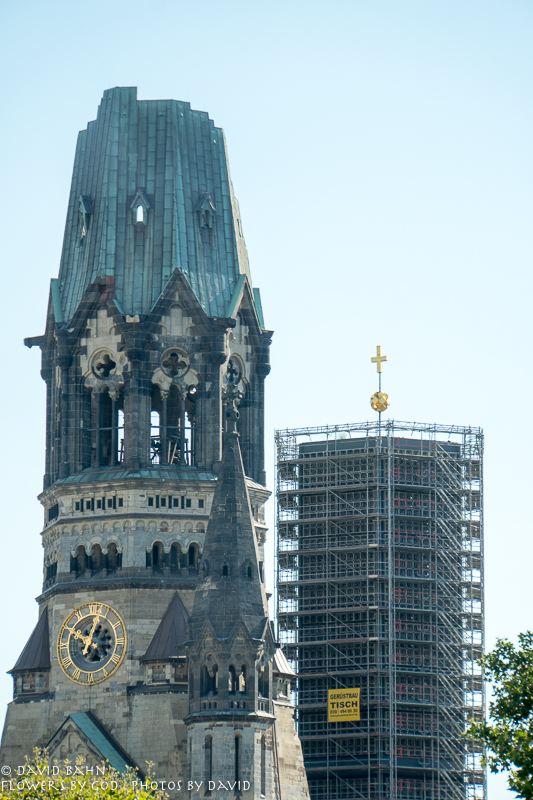
    Kaiser Wilhelm Church which was severely damaged in WW-II was also served by a pastor who was opposed to Hitler’s programs.

    Build a tower of blocks in 5 minutes. Knock it down in less than 5 seconds. Make an intricate sand castle at the seashore in 2 hours. See it taken out by a wave in 2 minutes. Spend 18 months working with people to start up a church, only to see it divided and racked with troubles so severe you consider it better if no one would gather for worship not many years later. It always amazes me how long it can take to make something good happen, and how quickly the good can be undone.

    Paul goes from Athens where he is met with minimal success to Corinth where he manages to stay for 18 months, teaching and sharing the Gospel message. Not only that, he is joined by a husband and wife team of great promise and mutual interest. Aquila and Priscilla join Paul in their tent making ministry. Later they would even help Apollos become more clear in his teaching about Jesus and the Holy Spirit.

    Not too many years later, however, Corinth will require one of the most severe letters Paul ever writes. Among the corrections he offers to them include the stunning statement, “When you come together it is not for the better when you come together it is not for the better but for the worse” (1 Corinthians 11:17). I have even said that the Corinthian church was so troubled, that if you feel as though your current church has troubles, just read 1 Corinthians. They had trouble with worship, the role of women, spiritual gifts, divisions, the Lords’ Supper, marriage, and even questions about incestuous relationships! They had it all.

    But they had the Gospel; the good news of Jesus’ love, forgiveness and salvation. In fact, however, Paul’s concerns for them in 1 Corinthians was so that they would not lose the salvation Jesus had won for them and Paul had preached there.

    I have seen my work undone in certain situations – leading me almost to the point of despair. How could I have done better? What might I have done to ensure that the gains we had achieved would not evaporate in my absence? Thankfully, however, God is faithful and manages to preserve his people and his church through all the foibles of sinful men and women.

    Sometimes I think it’s a miracle that the Christian Church exists at all. I deeply resonate with Martin Luther when in his sacristy prayer he prays:

    Lord God, You have appointed me as a Bishop and Pastor in Your Church, but you see how unsuited I am to meet so great and difficult a task. If I had lacked Your help, I would have ruined everything long ago. Therefore, I call upon You: I wish to devote my mouth and my heart to you; I shall teach the people. I myself will learn and ponder diligently upon Your Word. Use me as Your instrument — but do not forsake me, for if ever I should be on my own, I would easily wreck it all.

    God is gracious and faithful. He forgives sins, and restores broken people and revives dysfunctional churches. He even forgives sinful men and women and uses them for the cause of his kingdom. That’s a good thing; otherwise none of us would be able to serve him.