David Bahn – Reflections

Light from the Word and through the lens

  •  When he had gone out, Jesus said, “Now is the Son of Man glorified, and God is glorified in him. 32 If God is glorified in him, God will also glorify him in himself, and glorify him at once. 33 Little children, yet a little while I am with you. You will seek me, and just as I said to the Jews, so now I also say to you, ‘Where I am going you cannot come.’ 34 A new commandment I give to you, that you love one another: just as I have loved you, you also are to love one another. 35 By this all people will know that you are my disciples, if you have love for one another.”

    36 Simon Peter said to him, “Lord, where are you going?” Jesus answered him,“Where I am going you cannot follow me now, but you will follow afterward.”37 Peter said to him, “Lord, why can I not follow you now? I will lay down my life for you.” 38 Jesus answered, “Will you lay down your life for me? Truly, truly, I say to you, the rooster will not crow till you have denied me three times. –John 13:31-38
    2014 Portfolio Review @ NWHPC
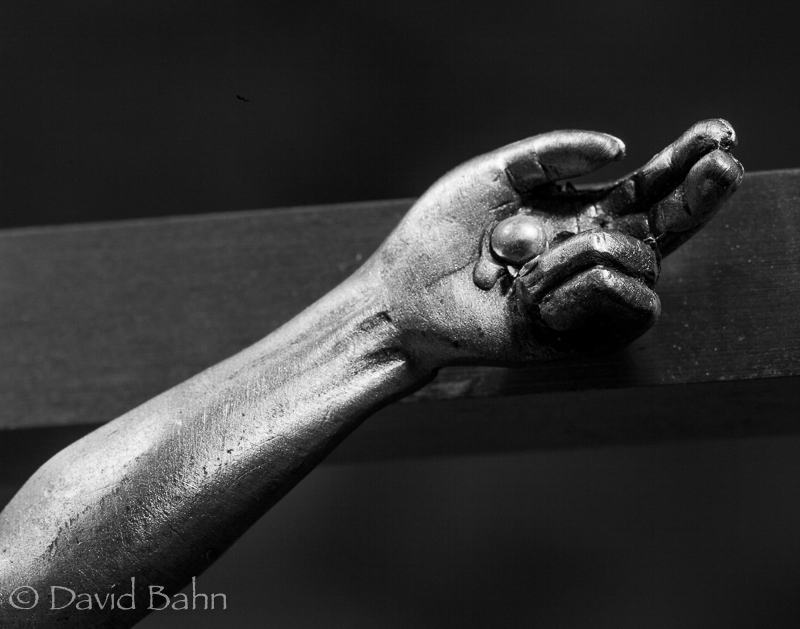
    A close-up detail of the hands of the crucifix which is in the chapel at St. John Lutheran Church, in Cypress, Texas

    Perhaps you know someone who is “all in” – as a sports fan, a golfer, a photographer, a seamstress, gardener, or quilter. He has all the gadgets. She has all the supplies. In fact, I recall seeing where a friend designed a sewing/quilting area for his wife with a level of organization and supply that made me want to take up the craft! People give their hearts and lives to things that entertain, refresh, or enlighten others.

    Jesus was all in for the glory of God. He knew what it would take for him to bring ultimate glory to God, and he sought to prepare his disciples for that as well. Part of that glory would be his obedience to the Father’s will that he would offer himself as the atoning sacrifice for the sins of the world. Another part of that glory would be that his disciples would obey his command to love one another.

    Certainly this was on Peter’s mind when he offered to be all in for Jesus, even to the point of laying down his life for Jesus. Peter, himself, was all in for Jesus as far as he was concerned. He would be willing to go the ultimate distance to show his allegiance. When he offered his bravado-inspired assurance of his “all in” bona fides, Jesus brings him up short. He wouldn’t make it through the night without denying Jesus three times.

    Of course we know the story. Peter will deny Jesus three times. The rooster will crow. Peter will weep. But this will not deter Jesus. Nor will it even remove Peter from the realm of Jesus’ love and redemption. Peter will have to be restored; we will see that in John 21. For a time, Peter is singled out, when the time comes to announce Jesus’ resurrection to his disciples: “Go tell his disciples and Peter” (Mark 16:7).

    But Jesus died for all people, precisely because we are not all in for him. We all fail at one point or another in our lives. We may have all the accoutrements of a solid Christian walk: Bibles and journals at the ready, a curriculum vitae that lists one accomplishment after another of kingdom wins and accomplishments. But we also have those dark places where fear, selfishness, willfulness, or rebellion took us out of the “all in” category. That’s why we have a Savior, for we have a God who is all in for us and for our forgiveness, redemption, and salvation. Thanks be to God!


  • Six days before the Passover, Jesus therefore came to Bethany, where Lazarus was, whom Jesus had raised from the dead. So they gave a dinner for him there. Martha served, and Lazarus was one of those reclining with him at table. Mary therefore took a pound of expensive ointment made from pure nard, and anointed the feet of Jesus and wiped his feet with her hair. The house was filled with the fragrance of the perfume. But Judas Iscariot, one of his disciples (he who was about to betray him), said, “Why was this ointment not sold for three hundred denarii and given to the poor?” He said this, not because he cared about the poor, but because he was a thief, and having charge of the moneybag he used to help himself to what was put into it. Jesus said, “Leave her alone, so that she may keep it for the day of my burial. For the poor you always have with you, but you do not always have me.”

    When the large crowd of the Jews learned that Jesus was there, they came, not only on account of him but also to see Lazarus, whom he had raised from the dead. 10 So the chief priests made plans to put Lazarus to death as well,11 because on account of him many of the Jews were going away and believing in Jesus. – John 12:1-11

    20160929-03959
    A misplaced smudge pot sits on the steps that had previously led to the entryway into a home along the Amite River outside of Baton Rouge, LA. The house is completely moved off its foundation, and the stairs lead nowhere.

    I don’t want to believe that people are that evil, mean-spirited, wrongly-motivated, and ill-willed. I don’t want to believe that people, even if they knew Jesus perfectly, would want to do away with him. Jews, disciples, chief priests(!): all will conspire to kill Jesus…and Lazarus, Jesus’ friend, having once been raised from the dead. You’d think they would learn; at least that’s what I think.

    I don’t want to believe that a person would send an email that is intentionally hurtful, accusatory, and inflammatory. I don’t want to believe that there are people in churches who want to see their pastor fail (although I served in such a church many years ago). I don’t want to believe that a co-worker will talk badly about a colleague in order to gain a better place in line for promotion. I don’t want to believe that a whole automobile company would deliberately hide the truth about some car’s shortcomings – even if those shortcomings are really significant. I don’t want to believe that a bank would have people at the very highest levels who conspire to open accounts for their own customers – even without their permission or knowledge, and to their detriment and the benefit of the bank. I don’t want to believe that people are really that evil.

    But there are truly evil people in the world. They conspired against Jesus. They brought him down…and then up on a cross, and then to the grave. I have received insulting emails. I have heard of pastors being hounded out of their churches. I have heard of pastors lording it over their people, and being unrealistic in their expectations. A major automobile company is paying multi-million dollar fines for faking emissions tests. A monster-mega-bank is under scrutiny for abusing their own customers, and their CEO has had to forfeit $42M of his bonus money so far.

    Thankfully, evil people did not thwart Jesus’ purpose and plans when they conspired to kill him. He knew what they were up to, faced his own death with unwavering faith, and ultimately triumphed over his foes in the resurrection that first Easter Sunday morning.

    The world needs a redeemer. God has provided Him for us. In the face of every evil, we believe in Jesus. Lord deliver us from evil!

  • When she had said this, she went and called her sister Mary, saying in private,“The Teacher is here and is calling for you.” 29 And when she heard it, she rose quickly and went to him. 30 Now Jesus had not yet come into the village, but was still in the place where Martha had met him. 31 When the Jews who were with her in the house, consoling her, saw Mary rise quickly and go out, they followed her, supposing that she was going to the tomb to weep there. 32 Now when Mary came to where Jesus was and saw him, she fell at his feet, saying to him, “Lord, if you had been here, my brother would not have died.” 33 When Jesus saw her weeping, and the Jews who had come with her also weeping, he was deeply moved in his spirit and greatly troubled. 34 And he said, “Where have you laid him?” They said to him, “Lord, come and see.” 35 Jesus wept. 36 So the Jews said, “See how he loved him!” 37 But some of them said, “Could not he who opened the eyes of the blind man also have kept this man from dying?” – John 11:28-37

    20160929-03953
    The devastation of recent flooding in Baton Rouge left this house completely off its foundation. We live in a fallen world.

    Perhaps you have seen the video footage of the crash of the Hindenburg, and recall Herbert Morrison’s famous words, “Oh the humanity!” He was so obviously overwrought at the sight, and human tragedy unfolding before him, he could barely speak. In fact at one point in the report, he tells his radio audience, “I can hardly breathe. I–I’m going to step inside where I cannot see it.”  An encounter with human tragedy ought to do that to a person. Today, however, we are too often inclined toward an aloofness that masks deeper feelings of distress, sadness, or horror.

    When Jesus encounters the sisters of Lazarus, experiences their mixture of grief and faith, and has a moment to take it all in, he does not remain aloof. He does not remain cool, calm, collected. Jesus wept. This is the shortest verse in the English Bible, but it is long in meaning and significance for those who reflect on these two words.

    There are several ways to understand this event. Certainly it is a glimpse into Jesus’ humanity, and the attendant emotions that are part of the human experience. These words also show Jesus’ love for these two sisters and their brother. It is clear, also that Jesus does not see death as a friend.

    I believe there is also testimony here on Jesus’ part of his great sadness over the incredibly destructive nature of sin. Death has come into the world as a result of sin. But prior to that time the world was very good. That was the work of the Word; all things were made through him. He knew the perfection of glory. He knew how life, and earth, and family were originally designed. Now Jesus, the Word made flesh, was witnessing this deeply sad moment and seeing for himself the sadness that sin brings into our lives – but from a perspective that none of us has.

    Jesus’ humanity is on display here. But it is a humanity that is mysteriously and inextricably indwelt with the divine nature of God. He sees the sadness from the perspective of the experience and understanding of eternal bliss and perfection. He knows that he will experience death as well, and that this broken world is not what God has in mind in the end. But for now Jesus weeps. Thanks be to God that isn’t his final word, nor is death our final destiny in him.

  • So Jesus again said to them, “Truly, truly, I say to you, I am the door of the sheep. All who came before me are thieves and robbers, but the sheep did not listen to them. I am the door. If anyone enters by me, he will be saved and will go in and out and find pasture. 10 The thief comes only to steal and kill and destroy. I came that they may have life and have it abundantly. 11 I am the good shepherd. The good shepherd lays down his life for the sheep. 12 He who is a hired hand and not a shepherd, who does not own the sheep, sees the wolf coming and leaves the sheep and flees, and the wolf snatches them and scatters them. 13 He flees because he is a hired hand and cares nothing for the sheep. 14 I am the good shepherd. I know my own and my own know me, 15 just as the Father knows me and I know the Father; and I lay down my life for the sheep. 16 And I have other sheep that are not of this fold. I must bring them also, and they will listen to my voice. So there will be one flock, one shepherd. 17 For this reason the Father loves me, because I lay down my life that I may take it up again. 18 No one takes it from me, but I lay it down of my own accord. I have authority to lay it down, and I have authority to take it up again. This charge I have received from my Father.” – John 10:7-18

    20160929-03952
    This beautiful bayou/river is near one of the houses we worked on in Baton Rouge. It wasn’t so beautiful 6 weeks ago!

    I have had one significant experience with sheep, and although it was decades ago, I still remember it vividly. We had been invited to visit a ranch in Wyoming where I did my vicarage (internship). The ranch sprawling – more than 100,000 acres. We were there to watch the sheep be sheared and to help cut and brand the new calves in their cattle herd. But rain loomed on the horizon and they needed to get the sheep indoors so their wool would not get too wet. But the sheep would not cooperate, refusing to go into the barn. After several attempts to get them to go through the door into the dark barn, one of the ranch hands managed to get one of the sheep through the opening. In a matter of seconds the entire herd – about 100 sheep – were inside, having followed the first one in. No thought. Just follow the herd. Sheep truly are not intelligent animals.

    How is it, therefore that Jesus is willing to call himself the Good Shepherd, likening us, therefore, to sheep? It’s not immediately obvious that this is a compliment. Add to that our willfulness. It seems that we are willful to a fault. We’re not just ignorant. We may stumble into a blessing or two over time. But too often we are willfully pursuing interests that are anything but good.

    That is why it is such Good News that Jesus is the Good Shepherd. He will never lead us astray. He will call us to follow him, even to deny our own wellbeing in order to do so. But he promises good pasture and provides an overflowing fountain of life. Others are not so good. Promising quick and easy goods, they will never stick around when we discover that they have led us astray. Consider this, furthermore, the Good Shepherd lays down his life for the sheep, but it is not a futile sacrifice. He not only lays down his life, he takes it up again, and lives as our eternal Good Shepherd leading us home to God.

    I’m not sure I can leave behind my willfulness. I’m not inclined to be in the docile mode of sheepishness. But if I can slow down enough to listen for the voice of the Good Shepherd, I will be the better for it.

  • So for the second time they called the man who had been blind and said to him,“Give glory to God. We know that this man is a sinner.” 25 He answered, “Whether he is a sinner I do not know. One thing I do know, that though I was blind, now I see.” 26 They said to him, “What did he do to you? How did he open your eyes?”27 He answered them, “I have told you already, and you would not listen. Why do you want to hear it again? Do you also want to become his disciples?” 28 And they reviled him, saying, “You are his disciple, but we are disciples of Moses. 29 We know that God has spoken to Moses, but as for this man, we do not know where he comes from.” 30 The man answered, “Why, this is an amazing thing! You do not know where he comes from, and yet he opened my eyes. 31 We know that God does not listen to sinners, but if anyone is a worshiper of God and does his will, God listens to him. 32 Never since the world began has it been heard that anyone opened the eyes of a man born blind. 33 If this man were not from God, he could do nothing.” 34 They answered him, “You were born in utter sin, and would you teach us?” And they cast him out.

    35 Jesus heard that they had cast him out, and having found him he said, “Do you believe in the Son of Man?” 36 He answered, “And who is he, sir, that I may believe in him?” 37 Jesus said to him, “You have seen him, and it is he who is speaking to you.” 38 He said, “Lord, I believe,” and he worshiped him. 39 Jesus said, “For judgment I came into this world, that those who do not see may see, and those who see may become blind.” 40 Some of the Pharisees near him heard these things, and said to him, “Are we also blind?” 41 Jesus said to them, “If you were blind, you would have no guilt; but now that you say, ‘We see,’ your guilt remains. – John 9:24-41 

    20160726-anchorage-alaska-02031
    One of the several poppies growing in a street-side flower garden in Anchorage, Alaska

    Have you ever met a person who knows so much that he knows nothing at all? He has answers to questions no one is asking. She is able to correct any slight deviance from what is most certainly true. His eyes and ears are closed to any new ideas. Her world works just as she supposes it to…no exceptions.

    It’s that whole paradigm thing. We are prisoners of our paradigms – our beliefs about the way things are and how they work. In the case of the Pharisees who encounter this man born blind but now healed, we see this so very clearly. They know – or so they think – that Jesus could not have healed the man. So if the man they see before them is now able to see, it must not be him. And if he offers the lame-to-them explanation of how his sight was restored by Jesus’ act of making mud and putting it on his eyes so that he would go wash in the pool of Siloam, they reject it out of hand. This simply can not be.

    But this is the man. And Jesus did make mud, and command him to wash, and he did and he came back seeing. He was born blind. It wasn’t his fault; he did not sin, nor did his parents. He was born blind so that the glory of God might be revealed.

    God’s glory is revealed in Jesus in at least three ways.

    1. He heals a blind man in this miraculous manner: mud on the eyes, washing in the pool of Siloam, seeing.
    2. An uneducated man confounds the Pharisees (drawing that inference from the fact that he was blind and therefore unable to go to school or to be in any kind of formal educational process).
    3. The blind man is brought to faith – this being the most wonderful miracle of all, and one which we who call Jesus Lord have experienced.

    This story is a delightful plot-twisting narrative. You and I might find ourselves somewhere in the plot. In the end the hero is Jesus and his glory is seen in the healing, and his grace is for you.

  • The Jews answered him, “Are we not right in saying that you are a Samaritan and have a demon?” 49 Jesus answered, “I do not have a demon, but I honor my Father, and you dishonor me. 50 Yet I do not seek my own glory; there is One who seeks it, and he is the judge. 51 Truly, truly, I say to you, if anyone keeps my word, he will never see death.” 52 The Jews said to him, “Now we know that you have a demon! Abraham died, as did the prophets, yet you say, ‘If anyone keeps my word, he will never taste death.’ 53 Are you greater than our father Abraham, who died? And the prophets died! Who do you make yourself out to be?” 54 Jesus answered, “If I glorify myself, my glory is nothing. It is my Father who glorifies me,of whom you say, ‘He is our God.’ 55 But you have not known him. I know him. If I were to say that I do not know him, I would be a liar like you, but I do know him and I keep his word. 56 Your father Abraham rejoiced that he would see my day. He saw it and was glad.” 57 So the Jews said to him, “You are not yet fifty years old, and have you seen Abraham?” 58 Jesus said to them, “Truly, truly, I say to you, before Abraham was, I am.” 59 So they picked up stones to throw at him, but Jesus hid himself and went out of the temple. – John 8:48-59

    20140509-3487
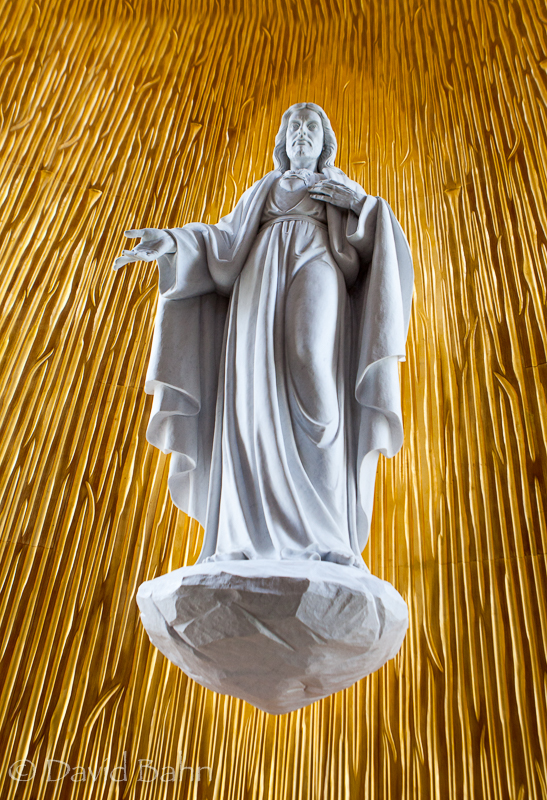
    Statue of the exalted Jesus in the Co Cathedral in downtown Houston, Texas

    There are seven or eight “I am” statements in John’s Gospel – depending on how you count them. The seven are:

    1. And Jesus said to them, “I am the bread of life. He who comes to Me shall never hunger, and he who believes in Me shall never thirst” (John 6:35).
    2. Then Jesus spoke to them again, saying, “I am the light of the world. He who follows Me shall not walk in darkness, but have the light of life” (John 8:12).
    3. “I am the door. If anyone enters by Me, he will be saved, and will go in and out and find pasture” (John 10:9).
    4. “I am the good shepherd. The good shepherd gives His life for the sheep” (John 10:11).
    5. Jesus said to her, “I am the resurrection and the life. He who believes in Me, though he may die, he shall live” (John 11:25).
    6. Jesus said to him, “I am the way, the truth, and the life. No one comes to the Father except through Me” (John 14:6).
    7. “I am the true vine, and My Father is the vinedresser” (John 15:1).

    The eighth “I am” statement is found here in John 8:58, and is the most profound of the bunch. Here Jesus makes two improbable claims that rocked the world of the Jews to whom he was speaking, and should give us pause. He said that he existed before Abraham who had died perhaps 2000 years prior to Jesus of Nazareth. He also equated himself to God, taking the holy name that God revealed to Moses in the burning bush (Exodus 3:14), and which was so holy that the people of Jesus’ day would not even utter it out loud.

    Their reaction? They pick up stones to throw at Jesus, but are thwarted in that attempt for Jesus’ time had not yet come (cf. John 7:6). Instead, Jesus hid himself and left the temple.

    Some say that the saddest verse in the Bible is Judges 2:10. Others might suggest, “Jesus wept.” Still others might suggest Genesis 3:6. I might say that the last part of John 8:59 is the saddest: Jesus leaves the temple. The Son of God, through whom the whole universe was made, comes to his own, should have been the object of their worship. He came to fulfill the whole Law. He came to be among God’s people, and he has no place in the Temple dedicated to the God who sent him.

    But Jesus is the eternal I AM. He was and is and is to come. He will leave the temple, but he will be eternally present with his people – those who call upon him in faith. This eighth “I am” statement of Jesus establishes him as our Lord and God. He is our Redeemer and Friend, the source and center of all truth.

  • When they heard these words, some of the people said, “This really is the Prophet.” 41 Others said, “This is the Christ.” But some said, “Is the Christ to come from Galilee? 42 Has not the Scripture said that the Christ comes from the offspring of David, and comes from Bethlehem, the village where David was?”43 So there was a division among the people over him. 44 Some of them wanted to arrest him, but no one laid hands on him.

    45 The officers then came to the chief priests and Pharisees, who said to them, “Why did you not bring him?” 46 The officers answered, “No one ever spoke like this man!” 47 The Pharisees answered them, “Have you also been deceived?48 Have any of the authorities or the Pharisees believed in him? 49 But this crowd that does not know the law is accursed.” 50 Nicodemus, who had gone to him before, and who was one of them, said to them, 51 “Does our law judge a man without first giving him a hearing and learning what he does?” 52 They replied, “Are you from Galilee too? Search and see that no prophet arises from Galilee.” John 7:40-52

    20160802-glacier-bay-skagway-02883
    Another fireweed plant from Alaska

    I’m watching the first 2016 Presidential Debate. It is excruciatingly difficult and stressful for me. Each of the candidates are lobbing charges and countercharges back and forth at each other. I have my own biases and beliefs about the various political issues before us. But I digress…

    Jesus was not in a political debate. He was not running for office. But people were divided in their opinions about him. Some said he was a prophet. Others wondered if he really was the Christ. Still others wanted to arrest Jesus. Opinions were divided. And – much like the fervor around the presidential candidates – people were greatly divided about Jesus…with passionate convictions all around.

    Into all this row comes a man who first shows up in the third chapter of John’s Gospel. Nicodemus pleads Jesus’ case in an apparently dispassionate manner. Is it right to judge a man before giving him a hearing? Sadly he is quickly dismissed by the Pharisees – keepers of theological orthodoxy in their day. Nothing good can come from Galilee, they assure the people, and Nicodemus’ call for a fair and balanced investigation of the facts goes unheeded.

    Sadly there are still those who would silence and dismiss Jesus. There are those who have no use for his teaching or the values he stands for. We need a Nicodemus today who will say let’s give Jesus a fair hearing. Let’s let his word speak to our hearts. Let’s not assume that everyone has it right about Jesus. He is the Prophet, but so much more. He is the Christ, the Son of God. He is the Savior of the world. He speaks grace and truth. Thanks, Nicodemus, for speaking up for him. Is there a Nicodemus in the house?

  • When many of his disciples heard it, they said, “This is a hard saying; who can listen to it?” 61 But Jesus, knowing in himself that his disciples were grumbling about this, said to them, “Do you take offense at this? 62 Then what if you were to see the Son of Man ascending to where he was before? 63 It is the Spirit who gives life; the flesh is no help at all. The words that I have spoken to you are spirit and life. 64 But there are some of you who do not believe.” (For Jesus knew from the beginning who those were who did not believe, and who it was who would betray him.) 65 And he said, “This is why I told you that no one can come to me unless it is granted him by the Father.”

    66 After this many of his disciples turned back and no longer walked with him.67 So Jesus said to the twelve, “Do you want to go away as well?” 68 Simon Peter answered him, “Lord, to whom shall we go? You have the words of eternal life,69 and we have believed, and have come to know, that you are the Holy One of God.” John 6:60-69

    20160808-untitled03510
    Flowers growing in Stanley Park, Vancouver, BC

    If you have seen Monty Roberts you might know a little about horse whispering. It’s the art of taming horses without force or harsh breaking tactics, rather by a series of moves by which in 20 minutes time he can have a formerly wild horse following him around a horse pen muzzle to shoulder. Check out his You Tube videos for a look at this fascinating practice.

    As Jesus speaks to the people of Capernaum and surrounds, he is engaging in the first part of this unusual practice. He is pushing people farther and farther away from any form of easy-believism, challenging them to think seriously about his true claims and proper place in their hearts. Jesus is no spiritual adornment; he is the Son of God, and you don’t just half-believe in him if you are to be his disciple. These are challenging words. But his challenging words are for a greater purpose than pushing people away. Jesus desires a full commitment to his ways, and an abandonment of anything that would compromise his full impact in the lives of his followers.

    I believe this applies especially to a somewhat misguided approach to mission and evangelism by which we seek to offer a very low threshold of belief, with little challenge to take Jesus’ words seriously. If we are content simply to be Jesus’ friends, we will not experience the fullness of his redemptive love and life-changing presence. If, however, we acknowledge that only Jesus has the words of eternal life, and that we must follow him, we will experience abundant eternal life.

    Know this well: when Jesus’ hard words challenge you, his desire is to bring you to the end of yourself so that you find your true life and salvation in him and him alone.

  • After this there was a feast of the Jews, and Jesus went up to Jerusalem.Now there is in Jerusalem by the Sheep Gate a pool, in Aramaic called Bethesda, which has five roofed colonnades. In these lay a multitude of invalids—blind, lame, and paralyzed. One man was there who had been an invalid for thirty-eight years. When Jesus saw him lying there and knew that he had already been there a long time, he said to him, “Do you want to be healed?” The sick man answered him, “Sir, I have no one to put me into the pool when the water is stirred up, and while I am going another steps down before me.” Jesus said to him, “Get up, take up your bed, and walk.” And at once the man was healed, and he took up his bed and walked. – John 5:1-9

    Thanks to David Steele for this photo of one of the amazing flowers of Australia.

    Three people have left the most significant impression on me of simple, child-like faith. One was a man whose name I do not recall, another to whom I made a promise, and another who taught me a lesson. One thing each of these people have in common is that they would be called invalids.

    The man whose name I cannot recall lived in a nursing home in Springfield, Illinois. He had a severe case of cerebral palsy, was drawn up in his hands, arms and legs, unable to get out of bed, and unable to speak clearly. I visited him regularly as a part of my seminary field education. I recall him saying, everytime I visited, “There ain’t nothin’ God can’t do.” Poor grammar, but great theology. A faith that looked beyond his bed and bent legs, arms, hands, and fingers to the promises of God and the hope of the resurrection. I don’t recall his name, but God knows him by name, and he is with Jesus now. On the Great Last Day, I hope to see him whole strong and glorified – invalid no more.

    The second man is also now with Jesus, and in the New Heavens and New Earth I promised him that we would have a foot race. He was wheel-chair bound, with a condition much like my friend in Springfield, nearly impossible to understand, but faith-filled, and smart beyond anyone’s expectation. He is his wheel chair and me, at the time suffering greatly with an arthritic hip which has since been replaced.

    The Texas Medical Center is the world’s largest medical center, with more than 50 million developed square feet. The day I encountered the third person of remarkable faith, she was a patient in one of the 21 hospitals there. I had a terrible attitude that day – made worse by my own arrogance, bad choice of parking spaces and wrong choice of hospitals. There is a difference between Jones Tower and Jones Pavilion, and I tried to find her in the wrong one. I called a colleague who was very familiar with the area, and he told me, “Get in your car, drive around to entrance 3, go to the third level of the parking garage…” The trip was a 10 minute drive. The instructions were perfect. And my arrival in her room was in the atmosphere of a very frustrated pastor. Her attitude, however, was a brush of grace that I didn’t deserve: “Oh Pastor Bahn! It’s so nice of you to come see me. I was hoping and praying that you would come…” I began a silent prayer of earnest repentance.

    This woman would qualify for the term invalid, but she was anything but invalid in my heart that day. So, too, the others whose faith pointed me toward a greater hope than a life of comfort and ease. So when I read this passage, I always think of the term invalid. I don’t like it, for it makes me think of people who are thought to be less than valid by too many others. But not Jesus! He healed the man at the pool of Bethesda. He asked him if he wanted to get well, then told him to take up his bed and walk.

    We may be weak now, struggle with getting out of bed on some days, or overcome with a poor attitude, and beset with illness and disease. But in God’s eyes we all are valid people, graced by his love, and redeemed by his blood. In Jesus none are invalid, one day we will dance and celebrate for joy in God’s grace, salvation, and perfect healing!

  • Jesus answered, “If you knew the generosity of God and who I am, you would be asking me for a drink, and I would give you fresh, living water.”

    11-12 The woman said, “Sir, you don’t even have a bucket to draw with, and this well is deep. So how are you going to get this ‘living water’? Are you a better man than our ancestor Jacob, who dug this well and drank from it, he and his sons and livestock, and passed it down to us?”

    13-14 Jesus said, “Everyone who drinks this water will get thirsty again and again. Anyone who drinks the water I give will never thirst—not ever. The water I give will be an artesian spring within, gushing fountains of endless life.” John 4:10-14 The Message

    20160808-untitled03505
    Butterfly on Flowers at Stanley Park, Vancouver, BC


    Sometimes well-worn phrases get in the way of deeper and fuller understanding. Words trip off our tongues, or tunnel through our brains without connecting with the inner folds of deeper understanding. Such is the case in regard to this wonderful encounter between Jesus and the woman at the well. This is one of my favorite Bible stories, and I have always enjoyed mining the truths and implications that unfold in it. But yesterday when I read it in The Message version, these words caught my attention:

    “If you knew the generosity of God and who I am, you would be asking me for a drink, and I would give you fresh, living water.”

    That, somehow, was a new thought, and I realized the implications of Jesus’ statement were deep and worthy of exploring. “If you knew,… you would ask…” That makes me wonder how many times I take God’s generosity for granted, or better yet, how many times I ignore it altogether. For if I did know how generous he is, I would ask more boldly and more often.

    Somehow we forget that God is generous. And that’s truly our bad all around. We lose out on his gifts. We sell him short of his true glory. We ignore opportunities to witness his grace and power. We go on about our way, stuck in our ruts, blind to his intervention, lost in our self-absorption.

    But then comes Jesus and his comment, “If you knew…you would ask.” I’m wondering how many times he is right here beside me, ready to help, waiting to be asked. This encounter helps me to ponder that today. How about you?

    Note: It’s been a crazy couple of days so, although I have kept up with the 21 Day Challenge to read a chapter of the Gospel of John each day, I did not post a blog devotion for yesterday, and have not done so yet for today. This remedies the former. Followers of this blog will see the fruits of my engagement with John 5 tomorrow. I usually don’t post on Saturdays or Sundays, but this will be an exception. Also, I will post on Sundays and will try to keep that up through the 21 Day Challenge. That will remain to be seen next week when I will be in Baton Rouge for a mission trip work project, helping flood victims. I hope you are engaging in this challenge – whether or not I am able to post each day!