David Bahn – Reflections

Light from the Word and through the lens

  • That evening after sunset, many sick and demon-possessed people were brought to Jesus. 33 The whole town gathered at the door to watch. 34 So Jesus healed many people who were sick with various diseases, and he cast out many demons. But because the demons knew who he was, he did not allow them to speak.

    35 Before daybreak the next morning, Jesus got up and went out to an isolated place to pray. 36 Later Simon and the others went out to find him. 37 When they found him, they said, “Everyone is looking for you.”

    38 But Jesus replied, “We must go on to other towns as well, and I will preach to them, too. That is why I came.” 39 So he traveled throughout the region of Galilee, preaching in the synagogues and casting out demons.

    40 A man with leprosy came and knelt in front of Jesus, begging to be healed. “If you are willing, you can heal me and make me clean,” he said.

    41 Moved with compassion, Jesus reached out and touched him. “I am willing,” he said. “Be healed!” 42 Instantly the leprosy disappeared, and the man was healed. 43 Then Jesus sent him on his way with a stern warning: 44 “Don’t tell anyone about this. Instead, go to the priest and let him examine you. Take along the offering required in the law of Moses for those who have been healed of leprosy. This will be a public testimony that you have been cleansed.”

    45 But the man went and spread the word, proclaiming to everyone what had happened. As a result, large crowds soon surrounded Jesus, and he couldn’t publicly enter a town anywhere. He had to stay out in the secluded places, but people from everywhere kept coming to him. – Mark 1:32-45

    20200625-DSC03811-HDR
    Creekside Tree | Wimberly, Texas | June 2020

    If wishes were horses beggars would ride. That was a favorite saying of my mother-in-law. I’m guessing her mother had said the same to her. What a great reminder against wishing our lives away!

    Mr. Hoeppel was the produce manager at Shopper’s Big Star grocery store in Cape Girardeau, where I worked as a bagboy and as a produce helper. We would have some great conversations, the two of us. I’d tell him I couldn’t wait to be finished with school, or until summer, or until the next pay day. He’d tell me, “Don’t wish your life away.”

    These days it’s a challenge not to do just that. I wish this pandemic was over. I wish we could get together with our friends. I wish we could see our grandchildren. I wish, I wish…on and on it goes. I’m guessing I might not be the only one with similar wishes.

    Then comes the time to pray. Dear Father in heaven, look upon us with your mercy and end this disease. For the sake of Jesus Christ and for his glory, heal us we pray! We can so easily identify with the man who came to Jesus asking to be healed from his leprosy. If you are willing, you can heal us all. You can take away this dread disease. 

    In the case of the man with leprosy Jesus was willing. Then and there. Done. Healed. And in this case told the man to tell no one about that encounter. Instead he was to go to the priest, make the offering and be declared publicly to be clean.

    Something extraordinary happened 2000 years ago when God visited our planet. Jesus, God’s Son, showed the mighty power of God over sin, sickness, and death. That power is still at work, and in much the same way it was in Jesus’ day. And it is important to understand what Jesus did and what Jesus did not do during his time on earth.

    Jesus was not on earth for 33 years in order to bring a quick fix to the challenges, sicknesses, troubles, and brokenness of the world. Jesus was on earth to save the world eternally. That would happen only by means of his sacrificial death and his innocent suffering. But that’s exactly what Jesus did. And he gave a foretaste of that restoration and salvation to a few as a sign of God’s rule and reign. Jesus’ touch changes everything.

    And until that Great Last day we will call out for his help and mercy. Once in a while – just as in his day – one of us will see that in bold relief. Let’s never mistake the foretaste for the main course. But let’s never abandon hope that Jesus is willing to be in our lives and touch us with his healing grace. That’s much more than just a wish.

  • That evening after sunset, many sick and demon-possessed people were brought to Jesus. 33 The whole town gathered at the door to watch. 34 So Jesus healed many people who were sick with various diseases, and he cast out many demons. But because the demons knew who he was, he did not allow them to speak.

    35 Before daybreak the next morning, Jesus got up and went out to an isolated place to pray. 36 Later Simon and the others went out to find him. 37 When they found him, they said, “Everyone is looking for you.”

    38 But Jesus replied, “We must go on to other towns as well, and I will preach to them, too. That is why I came.” 39 So he traveled throughout the region of Galilee, preaching in the synagogues and casting out demons.

    40 A man with leprosy came and knelt in front of Jesus, begging to be healed. “If you are willing, you can heal me and make me clean,” he said.

    41 Moved with compassion, Jesus reached out and touched him. “I am willing,” he said. “Be healed!” 42 Instantly the leprosy disappeared, and the man was healed. 43 Then Jesus sent him on his way with a stern warning: 44 “Don’t tell anyone about this. Instead, go to the priest and let him examine you. Take along the offering required in the law of Moses for those who have been healed of leprosy. This will be a public testimony that you have been cleansed.”

    45 But the man went and spread the word, proclaiming to everyone what had happened. As a result, large crowds soon surrounded Jesus, and he couldn’t publicly enter a town anywhere. He had to stay out in the secluded places, but people from everywhere kept coming to him. – Mark 1:32-45

    20200625-DSC03810
    Blue Wildflowers | Wimberly, Texas | June 2020

    During one of our virtual workouts our trainer wanted to show us how long we could go before we had to stop. When we were at the point of muscle failure he urged us to keep going. He contended that we could go 40% longer than we thought we could. I’m not sure I went 40% longer, but I did manage to go longer than I thought I could. 

    When it comes to the Christian life, there are times we come to the end of our rope. We can’t go on. We need to power down. We have not been able to summon any more compassion for our neighbors who have suffered a loss. We lose our temper when our kids don’t obey as they should. We give into temptation to envy or lust. How do we keep going?

    Jesus offers us a great example and reminder. We can’t go it alone. We need God’s power and help to keep on the path and finish the race of faith. When Jesus has finished a day of healing and casting out demons he has in mind more work to be done. He will retreat – and early in the morning for that matter. But he goes out to pray not simply to reflect, but to power up for further ministry.

    There are some people who will lead all the others. He will run faster. She will last longer. But even the best athlete needs to rest. A marathon runner eventually has to stop and rest – even if only at the end of the race. Jesus will run for three years, but he does so only under the power of God. Even Jesus will need to rest (cf. John 4:6). 

    So Jesus is for us an example and a reminder. His example is that of prayer. He doesn’t take on the mission for which he came without seeking God’s help, insight, and power. There is much to be said here about Jesus as God in the flesh. It is a mystery that at the same time he is God in the flesh, he is fully and truly human. We learn that he emptied himself and laid aside his divine prerogatives in order to redeem us. As such he sought God’s strength and never sought to do anything apart from God’s power and guidance (cf. John 5:19).

    Jesus seeks God’s guidance in prayer. This is a good example for us. Jesus also offers us a reminder. Don’t go this alone. Don’t try to do the work of God on your own strength. Seek God’s help, guidance, and strength in prayer. This honors God and aligns us with his will. This is a timely reminder for us all.

    This is also a reminder that our prayers ought not to be totally centered only on our own needs. During times like these our needs and challenges are sure to focus our prayers. But perhaps this reminder will serve to focus our prayers also on how God wants to bless others through us. 

  • That evening after sunset, many sick and demon-possessed people were brought to Jesus. 33 The whole town gathered at the door to watch. 34 So Jesus healed many people who were sick with various diseases, and he cast out many demons. But because the demons knew who he was, he did not allow them to speak.

    35 Before daybreak the next morning, Jesus got up and went out to an isolated place to pray. 36 Later Simon and the others went out to find him. 37 When they found him, they said, “Everyone is looking for you.”

    38 But Jesus replied, “We must go on to other towns as well, and I will preach to them, too. That is why I came.” 39 So he traveled throughout the region of Galilee, preaching in the synagogues and casting out demons.

    40 A man with leprosy came and knelt in front of Jesus, begging to be healed. “If you are willing, you can heal me and make me clean,” he said.

    41 Moved with compassion, Jesus reached out and touched him. “I am willing,” he said. “Be healed!” 42 Instantly the leprosy disappeared, and the man was healed. 43 Then Jesus sent him on his way with a stern warning: 44 “Don’t tell anyone about this. Instead, go to the priest and let him examine you. Take along the offering required in the law of Moses for those who have been healed of leprosy. This will be a public testimony that you have been cleansed.”

    45 But the man went and spread the word, proclaiming to everyone what had happened. As a result, large crowds soon surrounded Jesus, and he couldn’t publicly enter a town anywhere. He had to stay out in the secluded places, but people from everywhere kept coming to him. – Mark 1:32-45

    Foundations of houses outside of the synogogue at Capernaum
    Foundations of some houses outside the synagogue in Capernaum | 2012

    It’s called the Crux Theologrum, question of why some are saved, and not others. Some have answered by saying that some are simply more receptive to the Gospel message and come to faith cooperatively. That’s called synergism. We can do nothing to save ourselves. Others – though very few others – speak of God’s sovereign choice of some to salvation and others to damnation. That would put God acting against his revealed will that “all be saved.” The Lutheran answer to the question of Why Some and Not Others is “I don’t know.”

    “I don’t know” isn’t a very satisfying answer to most questions, but in this case it is the only answer to this important question. We do not have the mind of God.

    Take a look at Jesus’ ministry on this occasion. He is beginning his ministry with a flourish of healings and miracles. People are coming from all around to see him, hear him teach, and be healed. But the next day he is nowhere to be found. He has gone out to pray. Before daybreak. Unannounced. No permission. No explanation before he leaves. And when his disciples come and find him, expressing their exasperation with him, he simply says that they’ve got to go. He’s going to preach in other places. That is why he has come.

    Jesus did not come to heal a group of people only in one place. His ministry was not to be confined to one locale. He is not on a campaign trail. He is not worried about gathering constituents from various interest groups. But he is on a mission. He has come to heal the sick, raise the dead, teach about God, suffer, and die. He must let people know that he is doing this for all people. He’s going elsewhere to remind people that they have no exclusive claim on him.

    Jesus is our Lord, but we do not own him. He is Lord. He calls us to repent and believe. He heals diseases. He teaches the truth about God. He does this for all people. He won’t stay put. He won’t be our special live-in guest.

    But this is actually good news for us. He did not confine his ministry to the people in Capernaum. He went even to the Samaritans and Gentiles. Why some and not others? Because Jesus’ main ministry was not just to heal the people of his day. His mission was to provide eternal healing and life to all who believe in him. If he’s not working in your life in an obvious manner, be sure of this: He is working. And he wants you to believe in him and do whatever you can to point others to him as well.

  • That evening after sunset, many sick and demon-possessed people were brought to Jesus. 33 The whole town gathered at the door to watch. 34 So Jesus healed many people who were sick with various diseases, and he cast out many demons. But because the demons knew who he was, he did not allow them to speak.

    35 Before daybreak the next morning, Jesus got up and went out to an isolated place to pray. 36 Later Simon and the others went out to find him. 37 When they found him, they said, “Everyone is looking for you.”

    38 But Jesus replied, “We must go on to other towns as well, and I will preach to them, too. That is why I came.” 39 So he traveled throughout the region of Galilee, preaching in the synagogues and casting out demons.

    40 A man with leprosy came and knelt in front of Jesus, begging to be healed. “If you are willing, you can heal me and make me clean,” he said.

    41 Moved with compassion, Jesus reached out and touched him. “I am willing,” he said. “Be healed!” 42 Instantly the leprosy disappeared, and the man was healed. 43 Then Jesus sent him on his way with a stern warning: 44 “Don’t tell anyone about this. Instead, go to the priest and let him examine you. Take along the offering required in the law of Moses for those who have been healed of leprosy. This will be a public testimony that you have been cleansed.”

    45 But the man went and spread the word, proclaiming to everyone what had happened. As a result, large crowds soon surrounded Jesus, and he couldn’t publicly enter a town anywhere. He had to stay out in the secluded places, but people from everywhere kept coming to him. – Mark 1:32-45

    20200625-DSC03797
    Yucca | Wimberly, Texas | June 2020

    Do you know your achilles heel? Do you know where the chink in your armor is located?  When Jesus was tempted by the devil (cf. Matthew 4:1-11), there were three distinct ways he was approached. He could satisfy his appetite (turn the stones to bread), seek affirmation (throw yourself down from the temple so the angels will come to your aid), or make good on his ambition (bow down and worship me and all the glory of the world would be his).

    Then as now – when people are coming from all around in response to his miracles – Jesus shows that he is not about notoriety. He has no need for celebrity status. He will not seek the affirmation of others. He has a mission to accomplish and will set off from one place to another to embody and proclaim the presence of the reign and rule of God. His appetite is to fulfill the will of the Father. His affirmation will always be from God.

    Jesus will not seek the praise of men. He will leave the place where people were coming in droves to see him in order to be healed. He is not interested in being a celebrity. He is dedicated to being our Savior.

    We pastors want to be needed (at least this one does). Even though sometimes the needs of others can border on unhealthy over-dependance, it’s nice to be needed and appreciated. Affirmation is a good thing, like any medicine. But you can easily overdose on it.

    Think of the religious sideshows that seek more attention to the event than to the Lord who is healing, renewing, calling people to repentance, and forgiving their sins. Not every tent revival or televangelist is caught up in this web of celebrity (think Billy Graham here). But it is a dangerous trap (think Jimmy Swaggart).

    Jesus sought to avoid the limelight and hoopla around his miracles and preaching because he had a greater mission even than healing diseases. He did heal; of that there is no doubt. But when he leaves, he goes to pray. He seeks God’s approval. He delights in the affirmation of his Father in heaven (cf. Mark 1:11). His ambition is to do the Father’s will, not simply to gather a large crowd.

    Great crowds did follow Jesus, and he taught them. He did not reject large numbers of people, he just didn’t live for them. Jesus died for them. He came to seek and save the sick and diseased, the forgotten and sinner, the confused and even the criminal. That was Jesus’ mission. He will not be sidetracked into being a sideshow. And we can thank God for that.

  • Psalm 19:1

    The heavens declare the glory of God,
        and the sky above proclaims his handiwork.

    Psalm 49:16-20

    Be not afraid when a man becomes rich,
        when the glory of his house increases.
    17 For when he dies he will carry nothing away;
        his glory will not go down after him.
    18 For though, while he lives, he counts himself blessed
        —and though you get praise when you do well for yourself—
    19 his soul will go to the generation of his fathers,
        who will never again see light.
    20 Man in his pomp yet without understanding is like the beasts that perish.

    Psalm 79:8-9

    Do not remember against us our former iniquities;
        let your compassion come speedily to meet us,
        for we are brought very low.
    Help us, O God of our salvation,
        for the glory of your name;
    deliver us, and atone for our sins,
        for your name’s sake!

    Psalm 109:30-31

    With my mouth I will give great thanks to the Lord;
        I will praise him in the midst of the throng.
    31 For he stands at the right hand of the needy one,
        to save him from those who condemn his soul to death.

    Psalm 139:1-6

     Lord, you have searched me and known me!
    You know when I sit down and when I rise up;
        you discern my thoughts from afar.
    You search out my path and my lying down
        and are acquainted with all my ways.
    Even before a word is on my tongue,
        behold, O Lord, you know it altogether.
    You hem me in, behind and before,
        and lay your hand upon me.
    Such knowledge is too wonderful for me;
        it is high; I cannot attain it.

  • Public worship has been a hallmark of the Christian church from the beginning. Jesus’ example was to gather with others for worship. But now in the face of the COVID-19 crisis, many churches are suspending public, in-person worship services. It seems a wise and loving thing to do in light of the dangers of the virus. And, it goes without saying that our suspension of public worship is a great loss. But it needs to be lamented. Too often people are extolling the blessings of this new normal and speaking of how the church’s mission continues without acknowledging the loss that is part of the picture.

    I urge us to truly lament the fact that we’re not able to gather for worship. This is a very difficult time and our properly self-imposed retreat from public gathering for worship has hit us hard on many levels. It hurts emotionally. It leaves a hole physically because of the lack of human contact. It stymies us spiritually because we don’t experience the mutual encouragement we receive through the Sunday morning interaction in worship. Online live stream worship is a poor substitute and isn’t connecting as many people as we had hoped. It makes me sad even to write this.

    Cessation of public worship is a major loss and it cripples our Christian life. I pray that the Church will be just like when Mao removed all the missionaries from China and took away their Bibles: the believers went underground and continued to meet (in smaller groups), and grew beyond anyone’s expectation. We can pray that God’s people will find ways to express what is recorded in Acts of the new believers:

    The disciples were devoted to the teachings of the apostles, to fellowship, to the breaking of bread, and to prayer. 43 A feeling of fear came over everyone as many amazing things and miraculous signs happened through the apostles. 44 All the believers kept meeting together, and they shared everything with each other. 45 From time to time, they sold their property and other possessions and distributed the money to anyone who needed it. 46 The believers had a single purpose and went to the temple every day. They were joyful and humble as they ate at each other’s homes and shared their food. 47 At the same time, they praised God and had the good will of all the people. Every day the Lord saved people, and they were added to the group.  – Acts 2:42-47

    2014 Portfolio Review @ NWHPC
    2014 Portfolio Review @ NWHPC

    Let’s pray for the day when we can do all these things without restriction, and in the meantime pray that God’s people will stay faithful in prayer, loving acts of kindness, witness, and give as they are able. Let’s do all we can to defeat this disease and return to public worship when it’s all over. Let’s also lament the very real loss we’re experiencing and call out to God for mercy! I fear we’re ignoring the loss in our efforts to put a positive spin on the things we are able to do. I don’t want to be only a wailing prophet, but there is a time to mourn. As we do so, may we remember Jesus’ words, “Blessed are those who mourn, for they shall be comforted.” May it be so!

  • Jesus and his companions went to the town of Capernaum. When the Sabbath day came, he went into the synagogue and began to teach. 22 The people were amazed at his teaching, for he taught with real authority—quite unlike the teachers of religious law.

    23 Suddenly, a man in the synagogue who was possessed by an evil spirit cried out, 24 “Why are you interfering with us, Jesus of Nazareth? Have you come to destroy us? I know who you are—the Holy One of God!”

    25 But Jesus reprimanded him. “Be quiet! Come out of the man,” he ordered. 26 At that, the evil spirit screamed, threw the man into a convulsion, and then came out of him.

    27 Amazement gripped the audience, and they began to discuss what had happened. “What sort of new teaching is this?” they asked excitedly. “It has such authority! Even evil spirits obey his orders!” 28 The news about Jesus spread quickly throughout the entire region of Galilee.

    29 After Jesus left the synagogue with James and John, they went to Simon and Andrew’s home. 30 Now Simon’s mother-in-law was sick in bed with a high fever. They told Jesus about her right away. 31 So he went to her bedside, took her by the hand, and helped her sit up. Then the fever left her, and she prepared a meal for them. – Mark 1:21-31

    20200624-DSC03711
    Pride of Barbados | Wimberly, Texas | June 2020

    I’m pretty jazzed about The Chosen, a video series about the life and ministry of Jesus. Through the 7 episodes we’ve seen, the producers have put the ministry of Jesus in imaginative and creative contexts. They seem to be faithful to the times and places Jesus called his disciples and began his public ministry. The words and miracles of Jesus are played out very accurately.

    Realizing, however, that this is historical imagining, we must not put too much stock in the back story of Jesus’ miracles. Having said that the rendering of Jesus healing Simon Peter’s mother-in-law is truly delightful. She is awakened from her fever-induced sleep, and taken by the hand. She gets up and heads for the kitchen to provide some food for her guests. She doesn’t listen as Simon and the others tell her not to do so much. She gets up and gets them some food.

    How do you respond to Jesus’ touch of mercy, kindness, healing, or grace? If you’ve seen it up close and personal in the way Simon’s mother-in-law did what do you do? You say you haven’t experienced that kind of direct and immediate healing touch? Neither did many many others – even in the days of Jesus’ earthly life.

    We may wonder why we haven’t had this kind of experience. We might even question whether or not Jesus still does things like that any longer. Maybe the gig is up. There are no more healings, miracles, or signs and wonders today. 

    Before we come to that conclusion, recall the response of the people here: “What sort of new teaching is this?” they asked excitedly. “It has such authority! Even evil spirits obey his orders!” Obviously this was a very unusual event. Jesus even teaches about the particularity of his healing. 

    “Certainly there were many needy widows in Israel in Elijah’s time, when the heavens were closed for three and a half years, and a severe famine devastated the land. Yet Elijah was not sent to any of them. He was sent instead to a foreigner—a widow of Zarephath in the land of Sidon.  – Luke 4:25-26

    I believe praying for sick people. I pray for God’s protection when we travel. I ask God for help when I face daily challenges great and small. Sometimes God works miracles. Sometimes. More often God moves quietly behind the curtain of this visible world. But make no mistake. God is at work. Healing. Freeing. Forgiving. Encouraging. Emboldening. Humbling. Inspiring. And when he does that in your life, you do well to get up and be about serving. 

  • The Good News about Jesus Christ according to Mark

    A Bible Study by David Steele
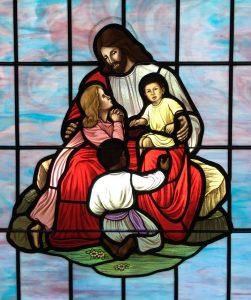
    Jesus and the children

    Lesson 3: Mark 2:1-3:6

    Jesus the Son of God and Son of Man

    In the second chapter, Mark introduces another title for Jesus, the Son of Man.  These titles are used in specific contexts in the scripture even though we tend to think of the titles interchangeably.  Son of God describes Jesus’ deity with the Father, as the Christ, and as King.   Jesus is the Son of God, a title proclaimed first by the angel Gabriel, then by Peter, Martha, his disciples, and the Centurion at the cross.  Son of God was the title used by Satan to tempt Jesus in the wilderness, it was the testimony of demons, and was the title for Jesus the Pharisees used as a death sentence by crucifixion.

    Son of Man was the title Jesus used most often for himself.  The Son of Man was born of woman to serve, to suffer, to be rejected, killed, buried, to rise from the dead, and will return again with power and glory.  Jesus was the fulfillment of scripture the Messiah would be from David’s line and of Daniel’s vision of the son of man who was led into the presence of the Ancient of Days to be given authority, glory, sovereign power, and to be worshipped by nations and people of every language.  His kingdom will be everlasting.

    Read Mark 2:1-12 Jesus Heals a Paralytic, The Son of Man has Authority to Forgive Sin

    Mk 2:1 A few days later, when Jesus again entered Capernaum, the people heard that he had come home.

    [Lk 5:17 One day as he was teaching, Pharisees and teachers of the law, who had come from every village of Galilee and from Judea and Jerusalem, were sitting there. And the power of the Lord was present for him to heal the sick.]

    Mk 2:2 So many gathered that there was no room left, not even outside the door, and he preached the word to them.

    Mk 2:3 Some men came, bringing to him a paralytic, carried by four of them.

    Mk 2:4 Since they could not get him to Jesus because of the crowd, they made an opening in the roof above Jesus and, after digging through it, lowered the mat the paralyzed man was lying on.

    Mk 2:5 When Jesus saw their faith, he said to the paralytic, “Son, your sins are forgiven.”

    Mk 2:6 Now some teachers of the law were sitting there, thinking to themselves,

    Mk 2:7 “Why does this fellow talk like that? He’s blaspheming! Who can forgive sins but God alone?”

    Mk 2:8 Immediately Jesus knew in his spirit that this was what they were thinking in their hearts, and he said to them, “Why are you thinking these things?

    Mk 2:9 Which is easier: to say to the paralytic, ‘Your sins are forgiven,’ or to say, ‘Get up, take your mat and walk’?

    Mk 2:10 But that you may know that the Son of Man has authority on earth to forgive sins. . . .” He said to the paralytic,

    Mk 2:11 “I tell you, get up, take your mat and go home.”

    Mk 2:12 He got up, took his mat and walked out in full view of them all. This amazed everyone and they praised God, saying, “We have never seen anything like this!”

    1. Luke 5:17 includes the detail that Pharisees from all over Galilee and Judea had come to see Jesus’ miracles. Not surprisingly Jesus chose this time to challenge their thinking and actions by forgiving the paralyzed man’s sins.  Compare their reaction to the other people who were witnesses.


    1. The Pharisees spoke a great truth – only God can forgive sin. See the following references from the Law, Psalms, and Prophets. In addition to forgiveness, what are some other attributes of God and discuss how Jesus possessed those attributes too:

    Exodus 34:6 And he [the LORD] passed in front of Moses, proclaiming, “The LORD, the LORD, the compassionate and gracious God, slow to anger, abounding in love and faithfulness, maintaining love to thousands, and forgiving wickedness, rebellion and sin.


    Psalm 103:2 Praise the LORD, O my soul, and forget not all his benefits— 3 who forgives all your sins and heals all your diseases, 4 who redeems your life from the pit and crowns you with love and compassion, 5 who satisfies your desires with good things so that your youth is renewed like the eagle’s.


    Isaiah 43:25 “I, even I, am he who blots out your transgressions, for my own sake, and remembers your sins no more.


    Micah 7:18 Who is a God like you, who pardons sin and forgives the transgression of the remnant of his inheritance? You do not stay angry forever but delight to show mercy.


    1. How does Jesus address the paralyzed man’s spiritual needs before his physical needs?


    1. The healing of the paralytic man occurs in Matthew, Mark and Luke. What makes this healing so significant?


    Read Mark 2:14-17 The Calling of Levi

    Mk 2:13 Once again Jesus went out beside the lake. A large crowd came to him, and he began to teach them.

    Mk 2:14 As he walked along, he saw Levi son of Alphaeus sitting at the tax collector’s booth. “Follow me,” Jesus told him, and Levi got up and followed him.

    [Luke adds] Lk 5:29 Then Levi held a great banquet for Jesus at his house, and a large crowd of tax collectors and others were eating with them.

    Mk 2:15 While Jesus was having dinner at Levi’s house, many tax collectors and “sinners” were eating with him and his disciples, for there were many who followed him.

    Mk 2:16 When the teachers of the law who were Pharisees saw him eating with the “sinners” and tax collectors, they asked his disciples: “Why does he eat with tax collectors and ‘sinners’?”

    Mk 2:17 On hearing this, Jesus said to them, “It is not the healthy who need a doctor, but the sick. I have not come to call the righteous, but sinners.”


    1. How is Levi’s response to Jesus’ call similar to other accounts we have read in Mark?


    1. What can we infer about Matthew’s wealth and education as a tax collector and what he left behind to follow Jesus?


    1. The Pharisees arose as a distinct Jewish sect after the Jewish exile from Babylon. Their intent was to live in complete obedience to the Law and to the 400 years of traditions established since the exile.  Pharisee means “Separate One”.  Compare Jesus’ ministry style to the Pharisees.


    Read Mark 2:18-22 Jesus Questioned About Fasting

    Mk 2:18 Now John’s disciples and the Pharisees were fasting.  Some people came and asked Jesus, “How is it that John’s disciples and the disciples of the Pharisees are fasting, but yours are not”?” [yours go on eating and drinking, Lk 5:33]

    Mk 2:19 Jesus answered, “How can the guests of the bridegroom fast while he is with them? They cannot, so long as they have him with them.  20 But the time will come when the bridegroom will be taken from them, and on that day they will fast. 21 “No one sews a patch of unshrunk cloth on an old garment. If he does, the new piece will pull away from the old, making the tear worse.  22 And no one pours new wine into old wineskins. If he does, the wine will burst the skins, and both the wine and the wineskins will be ruined. No, he pours new wine into new wineskins.”


    1. Fasting was a common practice.  Fasting was required by the Law on one day of the year, the Day of Atonement for the forgiveness of sin.  On other occasions, fasting was for mourning, sorrow, and repentance, and was associated with wearing sack cloth and ashes.  Fasting was also a sign of humility, seeking God’s provision, or a supplication to escape God’s wrath or pending judgement.  Fasting can be a sign of true repentance: “Even now,” declares the LORD, “return to me with all your heart, with fasting and weeping and mourning,” (Joel 2:13).  By their tradition, the Pharisees fasted twice a week.  What issue did Jesus have with regards to fasting?


    1. Compare Jesus’ comments to other verses on fasting:

    Joel 2:13 “Even now,” declares the LORD, “return to me with all your heart, with fasting and weeping and mourning.”


    Joel 2:13 Rend your heart and not your garments.


    Isaiah 58:5 Is this the kind of fast I have chosen, only a day for a man to humble himself? Is it only for bowing one’s head like a reed and for lying on sackcloth and ashes? Is that what you call a fast, a day acceptable to the LORD?


    Isa 58:6 “Is not this the kind of fasting I have chosen: to loose the chains of injustice and untie the cords of the yoke, to set the oppressed free and break every yoke?

    Isa 58:7 Is it not to share your food with the hungry and to provide the poor wanderer with shelter — when you see the naked, to clothe him, and not to turn away from your own flesh and blood?


    1. The parables of the patch and wineskins are the source of speculation. Discuss the basic ideas of the following interpretations:
      1. The Law/Legalism and Grace
      2. Old Covenant and New Covenant
      3. A spiritual outlook of keeping laws and traditions compared to a new spiritual outlook led by the Holy Spirit.


    Read Mark 2:23-3:6 Lord of the Sabbath (Merged with additions from Matthew)


    Mk 2:23 One Sabbath Jesus was going through the grainfields, and as his disciples walked along, they began to pick some heads of grain.

    Mk 2:24 The Pharisees said to him, “Look, why are they doing what is unlawful on the Sabbath?”

    Mk 2:25 He answered, “Have you never read what David did when he and his companions were hungry and in need?  26 In the days of Abiathar the high priest, he entered the house of God and ate the consecrated bread, which is lawful only for priests to eat. And he also gave some to his companions.”  [Matthew12:4-7 —which was not lawful for them to do, but only for the priests.

    Mt 12:5 Or haven’t you read in the Law that on the Sabbath the priests in the temple desecrate the day and yet are innocent? 6 I tell you that one greater than the temple is here.

    Mt 12:7 If you had known what these words mean, ‘I desire mercy, not sacrifice,’ you would not have condemned the innocent. (Hosea 6:2)].

    27 Then he said to them, “The Sabbath was made for man, not man for the Sabbath.  28 So the Son of Man is Lord even of the Sabbath.”

    Mk 3:1 Another time he went into the synagogue, and a man with a shriveled hand was there. 2 Some of them were looking for a reason to accuse Jesus, so they watched him closely to see if he would heal him on the Sabbath.

    Mk 3:3 Jesus said to the man with the shriveled hand, “Stand up in front of everyone.”

    Mk 3:4 Then Jesus asked them, “Which is lawful on the Sabbath: to do good or to do evil, to save life or to kill?”

    [Mt 12:11 He said to them, “If any of you has a sheep and it falls into a pit on the Sabbath, will you not take hold of it and lift it out?]

    But they remained silent. 5 He looked around at them in anger and, deeply distressed at their stubborn hearts, said to the man, “Stretch out your hand.” He stretched it out, and his hand was completely restored.

    Mk 3:6 Then the Pharisees went out and began to plot with the Herodians how they might kill Jesus.

    1. Picking grain along the margins of a field was a provision for the poor and hungry in the Law of Moses (Deuteronomy 23:25). The Pharisees had 613 laws and 39 categories of Sabbath laws – and picking grain for food was not on the approved list! Jesus confronted them with the account of David and Abithar.  What concept did Abithar the priest understand with respect to bread of Presence and David’s starving men?


    1. Mathew includes another response to the Pharisees from Jesus who quoted Hosea 6:2: ‘I desire mercy, not sacrifice.’ Hosea was a prophet from the northern kingdom who wrote to Judah following the fall of Israel. See Hosea 6:1-3 and discuss the broader meaning of Jesus’ quote


    Hos 6:1 “Come, let us return to the LORD. He has torn us to pieces but he will heal us; he has injured us but he will bind up our wounds. Hos 6:2 After two days he will revive us; on the third day he will restore us, that we may live in his presence.

    Hos 6:3 Let us acknowledge the LORD; let us press on to acknowledge him. As surely as the sun rises, he will appear; he will come to us like the winter rains, like the spring rains that water the earth.”


    1. Already by the beginning of the third chapter of Mark, the Pharisees are plotting to murder Jesus.  What were some of the things Mark has mentioned they could not abide from Jesus?


    Closing

     

  • Jesus and his companions went to the town of Capernaum. When the Sabbath day came, he went into the synagogue and began to teach. 22 The people were amazed at his teaching, for he taught with real authority—quite unlike the teachers of religious law.

    23 Suddenly, a man in the synagogue who was possessed by an evil spirit cried out, 24 “Why are you interfering with us, Jesus of Nazareth? Have you come to destroy us? I know who you are—the Holy One of God!”

    25 But Jesus reprimanded him. “Be quiet! Come out of the man,” he ordered. 26 At that, the evil spirit screamed, threw the man into a convulsion, and then came out of him.

    27 Amazement gripped the audience, and they began to discuss what had happened. “What sort of new teaching is this?” they asked excitedly. “It has such authority! Even evil spirits obey his orders!” 28 The news about Jesus spread quickly throughout the entire region of Galilee.

    29 After Jesus left the synagogue with James and John, they went to Simon and Andrew’s home. 30 Now Simon’s mother-in-law was sick in bed with a high fever. They told Jesus about her right away. 31 So he went to her bedside, took her by the hand, and helped her sit up. Then the fever left her, and she prepared a meal for them. – Mark 1:21-31

    20200528-DSC03508
    Sunrise | Galveston, Texas | May 2020

    Max Lucado said it well: “I’ve never been surprised by God’s judgment—but I’m still stunned by his grace!” But we are so jaded these days, it seems like nothing amazes us. We’ve been fooled by the barker’s call one too many times. We’ve been disappointed by the Cracker Jack prize all too often. The cereal boxes have yielded one too many fake decoder rings. There is no long-lost multi-millionaire uncle in Nigeria ready to give you his fortune. Every trick has a solution. Penn and Teller R Us!

    We steel ourselves against such deceptions so we are not too easily fooled again,

    Maybe the people of Jesus’ day were a bit less jaded. Perhaps they didn’t know better. Maybe they hadn’t been fooled one too many times. They surely might have been more easily enthralled by the latest visiting celebrity. They were surely not as sophisticated.

    Reminds me of the bungling counterfeiters who print “perfect” 15 dollar bills. They decide to pass them off on an unsuspecting backwater rube. They ask him for change and he replies, “Sure. How about 2 $6’s and a $3?”

    Too many people have been ambushed by underestimating their adversary. We’re not served best by dismissing the responses and reactions of the people of Jesus’ day. They were there. They saw the evil spirit being subdued. They saw the man now released. They saw an amazing thing and they were gripped with amazement.

    When’s the last time you’ve been amazed? Have you seen the work of God? Hearts being changed? Self-destruction turned to clean and sober? Stingy turned to generous? Shame turned to confidence? Sin overcome by grace? Or is it too old hat? Have you grown too sated by God’s goodness?

    God’s mercies are new every morning. Great is his faithfulness. He forgives sins. He redeems lives from the pit. He is patient with us, in hopes of our repentance. And faith. Faith allows us to be amazed by God’s grace without fear of being taken advantage of.

  • Jesus and his companions went to the town of Capernaum. When the Sabbath day came, he went into the synagogue and began to teach. 22 The people were amazed at his teaching, for he taught with real authority—quite unlike the teachers of religious law.

    23 Suddenly, a man in the synagogue who was possessed by an evil spirit cried out, 24 “Why are you interfering with us, Jesus of Nazareth? Have you come to destroy us? I know who you are—the Holy One of God!”

    25 But Jesus reprimanded him. “Be quiet! Come out of the man,” he ordered. 26 At that, the evil spirit screamed, threw the man into a convulsion, and then came out of him.

    27 Amazement gripped the audience, and they began to discuss what had happened. “What sort of new teaching is this?” they asked excitedly. “It has such authority! Even evil spirits obey his orders!” 28 The news about Jesus spread quickly throughout the entire region of Galilee.

    29 After Jesus left the synagogue with James and John, they went to Simon and Andrew’s home. 30 Now Simon’s mother-in-law was sick in bed with a high fever. They told Jesus about her right away. 31 So he went to her bedside, took her by the hand, and helped her sit up. Then the fever left her, and she prepared a meal for them. – Mark 1:21-31

    20200527-DSC03503
    Shelf Cloud | Bolivar Peninsula | May 2020

    It’s difficult for me to understand why people don’t want to believe in Jesus. He is eminently good. He speaks truth from the core of his being. He takes on the religious self-promoters, and lifts up downtrodden and broken people. He performed miracles not for notoriety but for the blessing of those to whom he ministered.

    As far as I can tell, for many people it isn’t about belief as much as submission to his will and acknowledgement of his sovereignty that stands in the way of their faith. They don’t want anyone telling them what to do or how to live or what is truly good or evil, right or wrong.

    Jesus kind of disrupts that false dream. His reign and rule over all things and peoples is supreme and absolute. Some people don’t want to submit to him. Some people see him as one who has come to torment and destroy, rather than build up, save, and restore.

    This is played out in vivid terms as Jesus casts the demon from the man in the synagogue. The evil spirit wants nothing to do with following Jesus. He has no desire to believe in Jesus. He wants nothing of what Jesus might teach him or of the kind of life Jesus would call him. So Jesus gives him no choice. The evil spirit is cast out. The once-possessed man is freed. Good is sustained. Evil is thwarted.

    I’m thinking of people who are living their lives far from God. They want nothing to do with his call to repentance and faith. They wish only to make their kingdoms the best they can for themselves. They will do it their way. They will chart their own course. They will retain the right to captain their own ship.

    Until that day when this scene is played out for all to see. Evil will be called to account. Every knee will bow. Every tongue will confess that Jesus is Lord. Some will do it under duress. Others will do it in delight.

    We call Jesus Lord because he has redeemed us. He is our Savior, Redeemer and Friend. I’m willing to let him determine what is good and evil, right and wrong. I will look to him for life, hope, and salvation. If you join me you will not be disappointed. I shudder to think of what it will be like on the Day of Reckoning for those who refuse to repent and believe in the Good News of Jesus.