David Bahn – Reflections

Light from the Word and through the lens

  • Now when they had passed through Amphipolis and Apollonia, they came to Thessalonica, where there was a synagogue of the Jews. And Paul went in, as was his custom, and on three Sabbath days he reasoned with them from the Scriptures, explaining and proving that it was necessary for the Christ to suffer and to rise from the dead, and saying, “This Jesus, whom I proclaim to you, is the Christ.” And some of them were persuaded and joined Paul and Silas, as did a great many of the devout Greeks and not a few of the leading women. But the Jews were jealous, and taking some wicked men of the rabble, they formed a mob, set the city in an uproar, and attacked the house of Jason, seeking to bring them out to the crowd. And when they could not find them, they dragged Jason and some of the brothers before the city authorities, shouting, “These men who have turned the world upside down have come here also, and Jason has received them, and they are all acting against the decrees of Caesar, saying that there is another king, Jesus.” And the people and the city authorities were disturbed when they heard these things. And when they had taken money as security from Jason and the rest, they let them go.

    10 The brothers immediately sent Paul and Silas away by night to Berea, and when they arrived they went into the Jewish synagogue. 11 Now these Jews were more noble than those in Thessalonica; they received the word with all eagerness, examining the Scriptures daily to see if these things were so. 12 Many of them therefore believed, with not a few Greek women of high standing as well as men. 13 But when the Jews from Thessalonica learned that the word of God was proclaimed by Paul at Berea also, they came there too, agitating and stirring up the crowds. 14 Then the brothers immediately sent Paul off on his way to the sea, but Silas and Timothy remained there. 15 Those who conducted Paul brought him as far as Athens, and after receiving a command for Silas and Timothy to come to him as soon as possible, they departed.

    Frangipani Plumeria | Tulum, Mexico | February 2024

    “There are only two religions in the world,” I learned. “One is God’s religion. The other is man’s religion.” It was in one of my first classes at the seminary back in 1975. Revelation and Scripture was taught by Dr. Fred Kramer, a gracious and thoughtful man of God. I learned a lot in that class. The difference between natural revelation and special revelation (scripture). That we do rightly equate the Bible with the Word of God, although the Word of God is truly Jesus Christ. That Jesus alluded to all parts of the Old Testament from the Books of Moses to the minor prophets, even the apocryphal books of the Old Testament (Ezekiel and Daniel). He occasionally also let us see behind the curtain of the seminary faculty. Once he told about a faculty member talking about a group of brothers in our church body, describing them in unkind terms. He simply said [paraphrasing here], “Do you really mean that? I think a kinder and more gracious regard for them would better serve us all.”

    All this to say that when Paul and Silas told the people in Berea about Jesus, they did the only thing a responsible Jew would do: they searched the Scripture to see if what Paul and Silas was saying was true. Where did they go? What Scriptures did they look at? The New Testament had not been constituted at this time. The teachings of Jesus and some very early hymns and creeds may have been formulated. But the Bereans would not look at those. They were self-attesting witnesses.

    They would look at these passages:

    Genesis 3:15 God says to the serpent (Satan), “I will put enmity between you and the woman, and between your seed and her seed. He shall crush your head, and you will bruise his heel.”

    Psalm 22 gives a vivid description of someone being crucified – even though crucifixion was not a known form of execution in David’s day. It also has those powerful words, “My God, my God, why have you forsaken me?”

    By far the most rich expression of Jesus’ ministry may be found in Isaiah 53. Isaiah writes about Jesus dying with sinners, and being buried by a rich man. It also has this powerful promise:

    Yet it was the will of the Lord to crush him;
        he has put him to grief;
    when his soul makes an offering for guilt,
        he shall see his offspring; he shall prolong his days;
    the will of the Lord shall prosper in his hand. – Isaiah 53:10

    Paul and Silas taught that it was necessary for Jesus to suffer and die, and be raised from the dead. The little Greek word, ἔδει (edei) means it was necessary. Gotta happen. Plan of God. Promised by God. Delivered by Jesus. Necessary because of our sin and God’s abiding love. He did not flinch from this rescue. He has done it. We have been saved. The seeds of that salvation were sown in the Old Testament. They came to full bloom in the life and ministry of Jesus. They will be fully harvested on the Great Last Day. This is the witness of Scripture.


  • Now when they had passed through Amphipolis and Apollonia, they came to Thessalonica, where there was a synagogue of the Jews. And Paul went in, as was his custom, and on three Sabbath days he reasoned with them from the Scriptures, explaining and proving that it was necessary for the Christ to suffer and to rise from the dead, and saying, “This Jesus, whom I proclaim to you, is the Christ.” And some of them were persuaded and joined Paul and Silas, as did a great many of the devout Greeks and not a few of the leading women. But the Jews were jealous, and taking some wicked men of the rabble, they formed a mob, set the city in an uproar, and attacked the house of Jason, seeking to bring them out to the crowd. And when they could not find them, they dragged Jason and some of the brothers before the city authorities, shouting, “These men who have turned the world upside down have come here also, and Jason has received them, and they are all acting against the decrees of Caesar, saying that there is another king, Jesus.” And the people and the city authorities were disturbed when they heard these things. And when they had taken money as security from Jason and the rest, they let them go.

    10 The brothers immediately sent Paul and Silas away by night to Berea, and when they arrived they went into the Jewish synagogue. 11 Now these Jews were more noble than those in Thessalonica; they received the word with all eagerness, examining the Scriptures daily to see if these things were so. 12 Many of them therefore believed, with not a few Greek women of high standing as well as men. 13 But when the Jews from Thessalonica learned that the word of God was proclaimed by Paul at Berea also, they came there too, agitating and stirring up the crowds. 14 Then the brothers immediately sent Paul off on his way to the sea, but Silas and Timothy remained there. 15 Those who conducted Paul brought him as far as Athens, and after receiving a command for Silas and Timothy to come to him as soon as possible, they departed.

    Sea Hibiscus Leaves | Tulum, Mexico | February 2024

    I’m in the midst of learning about Kairos.edu, a consortium of colleges and seminaries of which – as I understand it – the Luther House of Study is a part. Don’t quote me on this, because I’m still learning, but it seems to be an innovative and creative way in which seminary education may be well provided – contextually. Here’s a quote from one of the White Papers they provide to perspective Faculty Mentors:

    While the various components of a story are important, it is the wider narrative provided by the story as a whole that reveals the true meaning. Professor Snape when viewed through the wider story of Harry Potter is much different than Professor Snape when viewed through an early book in the series. The life, death, resurrection, and reign of Jesus described in the gospels carry meaning within each book but that meaning is enriched when the wider story of God’s people and the promise to Abram in Genesis 12:1-3 can be seen.

    This is so true in regard to this snippet of Paul and Silas’ encounter with the people of Berea and Thessalonica. There is a little win in the conversion of the people of Berea and their more noble character which turned them toward Scripture and ultimately to faith in Jesus. It was a big win for those who were brought to faith. 

    But that big win is only part of the story of God. And even Jesus’ life, suffering, death, and resurrection is only part of the story of God. Most obvious you might think is Jesus’ second coming. And that is surely a major part of God’s story. But don’t forget the beginning. And although Genesis begins with In the beginning, there is also the witness of Ephesians 1:3-4, “Blessed be the God and Father of our Lord Jesus Christ, who has blessed us in Christ with every spiritual blessing in the heavenly places, even as he chose us in him before the foundation of the world, that we should be holy and blameless before him.”

    The story of God starts before the foundation of time and goes on through eternity in the life of the world to come. Paul and Silas are very important parts of that story, for they bear witness to Jesus Christ – the center of it all. And because of their witness, the message of Jesus has gone on to the ends of the earth.

    There will be squirmishes, battles, troubles, and hardships along the way. Those are part of the story as well. But they will come to nothing – unlike the witness of Paul and Silas. You and I are also part of that story. Our prayers, acts of kindness, love, grace, and mercy bear witness to the truth of the Good News of Jesus. They are the fruit that will last through eternity (cf. John 15:16). Sometimes we may even have the opportunity to declare this Good News explicitly. That itself is a part of the story of God.

  • Now when they had passed through Amphipolis and Apollonia, they came to Thessalonica, where there was a synagogue of the Jews. And Paul went in, as was his custom, and on three Sabbath days he reasoned with them from the Scriptures, explaining and proving that it was necessary for the Christ to suffer and to rise from the dead, and saying, “This Jesus, whom I proclaim to you, is the Christ.” And some of them were persuaded and joined Paul and Silas, as did a great many of the devout Greeks and not a few of the leading women. But the Jews were jealous, and taking some wicked men of the rabble, they formed a mob, set the city in an uproar, and attacked the house of Jason, seeking to bring them out to the crowd. And when they could not find them, they dragged Jason and some of the brothers before the city authorities, shouting, “These men who have turned the world upside down have come here also, and Jason has received them, and they are all acting against the decrees of Caesar, saying that there is another king, Jesus.” And the people and the city authorities were disturbed when they heard these things. And when they had taken money as security from Jason and the rest, they let them go.

    10 The brothers immediately sent Paul and Silas away by night to Berea, and when they arrived they went into the Jewish synagogue. 11 Now these Jews were more noble than those in Thessalonica; they received the word with all eagerness, examining the Scriptures daily to see if these things were so. 12 Many of them therefore believed, with not a few Greek women of high standing as well as men. 13 But when the Jews from Thessalonica learned that the word of God was proclaimed by Paul at Berea also, they came there too, agitating and stirring up the crowds. 14 Then the brothers immediately sent Paul off on his way to the sea, but Silas and Timothy remained there. 15 Those who conducted Paul brought him as far as Athens, and after receiving a command for Silas and Timothy to come to him as soon as possible, they departed.

    Plumeria | Tulum, Mexico | February 2024

    I can sometimes be so gullible that it is embarrassing. It’s so embarrassing that I have put it out of my memory, so I can’t even share an example. Suffice it to say that in the moment, it sounds like, “Really?” Then come the snickers – and I don’t mean the candy bar variety. It’s embarrassing. Like I said…

    But there is an equally dangerous posture toward ideas and reports of various kinds. Rejecting things out of hand because they don’t conform to your idea of what should be is dangerous. If a terrible tsunami is heading your way and you disbelieve it’s imminent arrival just because you’ve never seen one before, that could be deadly. Just as believing one is on its way when it is not can cause you to abandon valuables in your hurry to escape.

    Those may not be the greatest examples, but the reality of the Thessalonians’ out-of-hand dismissal of Paul and Silas’ message is an example of a dangerous and destructive skepticism. On the other hand, the Bereans’ example of examining the teachings of Paul and Silas is laudable. They will neither reject out-of-hand, nor accept their message naively. They will study the Scriptures for themselves to see if these claims are true.

    Is Jesus the Christ, the Son of the Living God? Is he the fulfillment of the Old Testament prophets and promises? Do the prophets actually say that the Christ must suffer and die and then rise from the dead? These are important and far-reaching claims. If they are true, the whole of life and faith must change. If they are false, Paul and Silas should be beaten and jailed. 

    They say that a person convinced against his will is of the same opinion still. In other words, someone may parrot agreement with a manipulative teacher (or politician?). But under the surface of outward agreement lies a heart still unconvinced.

    Sadly, also, someone whose mind is made up – no matter what you say – can too easily turn into a manipulative member of the thought police. The Thessalonians who come to Berea are those thought police. The people of Berea are, sadly, going to have to endure their coercive threats and innuendos. 

    The paradox of being of more noble character is that to be of noble character means that you are not easily swayed from convictions firmly founded. But it also means that you’re constantly willing to reexamine your beliefs in light of Scripture. It’s said that if you don’t stand for anything, you’ll fall for everything. On the other hand, if you refuse to change your stand, you may find you are standing for the wrong thing. The only way I know of to avoid that is to search the Scriptures in a constant effort to conform to what God has revealed there.

  • Now when they had passed through Amphipolis and Apollonia, they came to Thessalonica, where there was a synagogue of the Jews. And Paul went in, as was his custom, and on three Sabbath days he reasoned with them from the Scriptures, explaining and proving that it was necessary for the Christ to suffer and to rise from the dead, and saying, “This Jesus, whom I proclaim to you, is the Christ.” And some of them were persuaded and joined Paul and Silas, as did a great many of the devout Greeks and not a few of the leading women. But the Jews were jealous, and taking some wicked men of the rabble, they formed a mob, set the city in an uproar, and attacked the house of Jason, seeking to bring them out to the crowd. And when they could not find them, they dragged Jason and some of the brothers before the city authorities, shouting, “These men who have turned the world upside down have come here also, and Jason has received them, and they are all acting against the decrees of Caesar, saying that there is another king, Jesus.” And the people and the city authorities were disturbed when they heard these things. And when they had taken money as security from Jason and the rest, they let them go.

    10 The brothers immediately sent Paul and Silas away by night to Berea, and when they arrived they went into the Jewish synagogue. 11 Now these Jews were more noble than those in Thessalonica; they received the word with all eagerness, examining the Scriptures daily to see if these things were so. 12 Many of them therefore believed, with not a few Greek women of high standing as well as men. 13 But when the Jews from Thessalonica learned that the word of God was proclaimed by Paul at Berea also, they came there too, agitating and stirring up the crowds. 14 Then the brothers immediately sent Paul off on his way to the sea, but Silas and Timothy remained there. 15 Those who conducted Paul brought him as far as Athens, and after receiving a command for Silas and Timothy to come to him as soon as possible, they departed.

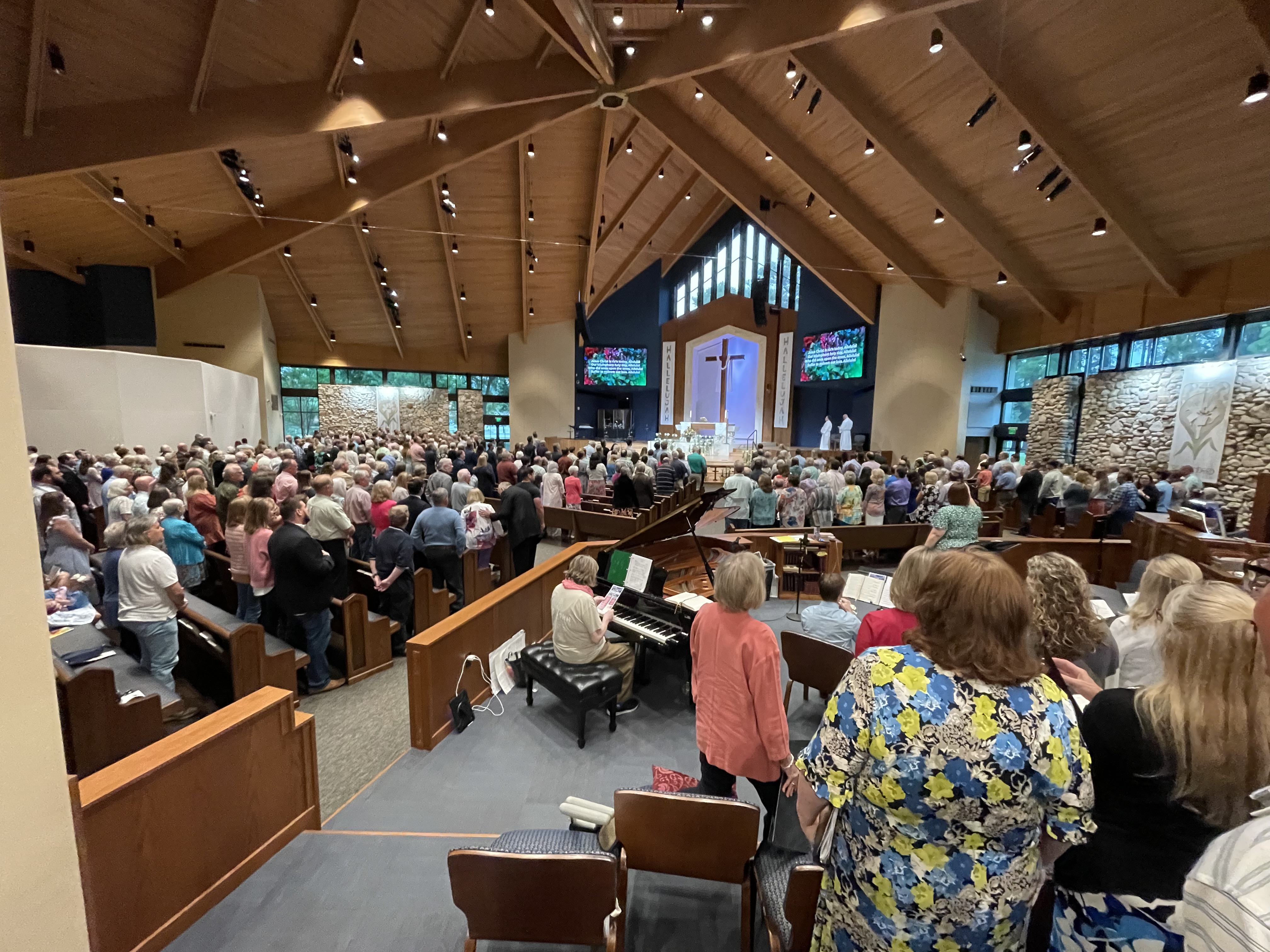
    My View from the Choir Loft on Easter Sunday 2024 | St. John Lutheran Church, Cypress, Texas

    Jesus Christ is Risen! He is Risen, Indeed. Alleluia!

    Easter Sunday was a multi-exclamation point day. Beautiful hymns. A powerful message. Joyful Lord’s Supper Celebration. Then delightful time with family. For 2000 years the message of Jesus’ resurrection from the grave has been the cornerstone of the Christian faith. It forms the foundation for God’s Good News of life and salvation through faith in Jesus of Nazareth. Without the resurrection we have no hope. With the resurrection we have people who for centuries have witnessed to this remarkable truth: Jesus Christ is risen!

    In Thessalonica Paul was doing just that. And with some degree of success to be sure. Luke tells us that Paul and Silas went to the synagogues sharing the gospel with the people there. Some of them were persuaded and joined Paul and Silas, as did a great many of the devout Greeks and not a few of the leading women.

    But success does not always equate with peace and harmony. Just as always, the success of the spread of the gospel was met with conflict, envy, and challenge. They were accused of turning the world upside down. And that was not a compliment. But it was the truth. And not everyone was convinced that the world needed to be upturned. Many powerful and influential people were happy for things to remain just like they are.

    Before we’re too quick to point the finger at them, consider how that might be true for you and me. We may know we need to make a change in our lives, but we’re too hesitant. We’re often too comfortable in our misery rather than making the changes that would put things in order. From messy closets to messy minds, to messy relationships, to messy words, our sinful flesh gets in the way of making the changes that would bring true peace.

    We may never completely conquer these messes. But what we are unable to do, Jesus has done. He is our righteousness, our joy and our crown. Convincing the Jews that Jesus is the fulfillment of the Old Testament prophecies was important to the spread of the Gospel. Our need is less for such convincing and more of the Holy Spirit’s influence in our daily lives.

    The reality of Jesus’ resurrection is tied to a new life in Christ. God connects us with Jesus’ resurrection so that we may live a new life (cf. Romans 6:1-4). That’s why the resurrection is so vital. Jesus conquered death. His resurrection is proof of his victory and the power of our new life.

  •  

    John 20:1-18

    Now on the first day of the week Mary Magdalene came to the tomb early, while it was still dark, and saw that the stone had been taken away from the tomb. So she ran and went to Simon Peter and the other disciple, the one whom Jesus loved, and said to them, “They have taken the Lord out of the tomb, and we do not know where they have laid him.” So Peter went out with the other disciple, and they were going toward the tomb. Both of them were running together, but the other disciple outran Peter and reached the tomb first. And stooping to look in, he saw the linen cloths lying there, but he did not go in. Then Simon Peter came, following him, and went into the tomb. He saw the linen cloths lying there, and the face cloth, which had been on Jesus’ head, not lying with the linen cloths but folded up in a place by itself. Then the other disciple, who had reached the tomb first, also went in, and he saw and believed; for as yet they did not understand the Scripture, that he must rise from the dead. 10 Then the disciples went back to their homes.

    11 But Mary stood weeping outside the tomb, and as she wept she stooped to look into the tomb. 12 And she saw two angels in white, sitting where the body of Jesus had lain, one at the head and one at the feet. 13 They said to her, “Woman, why are you weeping?” She said to them, “They have taken away my Lord, and I do not know where they have laid him.” 14 Having said this, she turned around and saw Jesus standing, but she did not know that it was Jesus. 15 Jesus said to her, “Woman, why are you weeping? Whom are you seeking?” Supposing him to be the gardener, she said to him, “Sir, if you have carried him away, tell me where you have laid him, and I will take him away.” 16 Jesus said to her, “Mary.” She turned and said to him in Aramaic, “Rabboni!” (which means Teacher). 17Jesus said to her, “Do not cling to me, for I have not yet ascended to the Father; but go to my brothers and say to them, ‘I am ascending to my Father and your Father, to my God and your God.’” 18 Mary Magdalene went and announced to the disciples, “I have seen the Lord”—and that he had said these things to her.

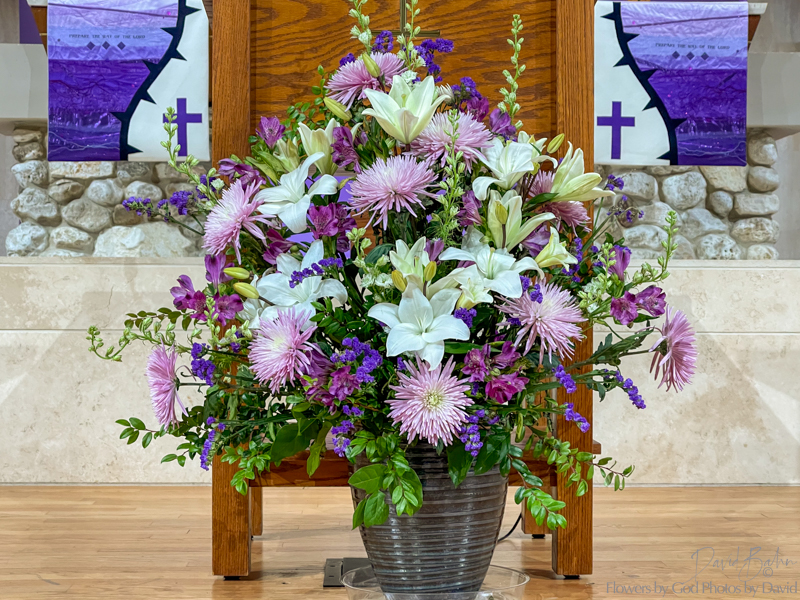
    St. John Sunday Flowers | March 2024 | Cypress, Texas

    We celebrate the resurrection of Jesus from the dead today. Let the name of the Lord be praised!

    Three Observations

    Mary is the first to see the empty tomb, the first to tell the disciples, the first to see the Risen Savior, Jesus.

    Peter and John don’t understand the Scripture that Jesus would rise from the dead. Yet that did not stop Jesus from rising from the dead.

    Jesus calls Mary by name. Imagine that: Jesus calling you by name in the most distressed, broken, disappointed, worried and broken-hearted moment of your life. Hearing him call you by name with a heart of kindness and mercy. Hearing him call you by name. Imagine the healing moment.

    Jesus Christ is risen! He is risen indeed! Alleluia!

    PS: It is said that Hemingway managed to write his impressive literary works using less than 60 exclamation points. But today is a mult-exclamation point day! Obviously I’ve used most of my quota for the day!

  • Matthew 27:62-66

    The next day, that is, after the day of Preparation, the chief priests and the Pharisees gathered before Pilate 63 and said, “Sir, we remember how that impostor said, while he was still alive, ‘After three days I will rise.’ 64 Therefore order the tomb to be made secure until the third day, lest his disciples go and steal him away and tell the people, ‘He has risen from the dead,’ and the last fraud will be worse than the first.” 65 Pilate said to them, “You have a guard of soldiers. Go, make it as secure as you can.” 66 So they went and made the tomb secure by sealing the stone and setting a guard.

    Mark 16:1

    When the Sabbath was past, Mary Magdalene, Mary the mother of James, and Salome bought spices, so that they might go and anoint him.

    Luke 23:56

    Then they returned and prepared spices and ointments.

    On the Sabbath they rested according to the commandment.

    John 19:40

    So they took the body of Jesus and bound it in linen cloths with the spices, as is the burial custom of the Jews.

    Waiting | Tulum, Mexico | February 2024

    Saturday of Holy Week is a day of preparation and waiting. Jesus’ enemies make his tomb as secure as they know how, posting a guard to keep him in the tomb.

    Mary and the other women prepare spices and make the initial arrangements to anoint Jesus’ body.

    Jesus rests in the tomb.

    His disciples rest and wait.

    We know how this story ends. And as surely as Jesus was raised from the dead, he will come again at the end of all time and take his own to be with him in eternal joy in the life of the world to come.

    But for now, let us rest and wait.

  • Jesus’ Seven Words From the Cross

    “Father, forgive them, for they know not what they do” (Luke 23:34)

    “Truly, I say to you, today you will be with me in paradise” (Luke 23:43)

    “Woman, behold your son. Son, behold your mother” (John 19:26-27)

    “My God, my God, why have you forsaken me?” (Matthew 27:46, Mark 15:34)

    “I thirst” (John 19:28)

    “It is finished” (John 19:30)

    “Father, into your hands I commend my spirit” (Luke 23:46)

    Into Your Hands | Tulum, Mexico | February 2024

    Each of the seven words of Jesus hold a special place in my heart.

    Yes, when I sin, I really don’t know what I’m doing – even if I do know what I’m doing. The profound and deadly impact of sin goes far beyond our personal awareness. Sin’s tentacles reach deep into the soul and spread far into the world around us. In ways we can never imagine our sin hurts our spouse, family, friends, and neighbors. Forgive us, Lord, for we do not know what we are doing. But just as Jesus prayed for those who nailed him to the cross, let that prayer be for us as well.

    I can only imagine what paradise will be. But I do get a glimpse in the beautiful Butchart Gardens of British Columbia, or Kew Gardens of Great Britain, Mercer Arboretum in Houston, or the flowers blooming outside my window. It’s a glimpse of paradise. And Jesus has promised we will be with him there. 

    I didn’t have the best relationship with my mother – especially when I was in high school and college. But there came a time when I realized how I must love her, and care for her as best I could – though we were separated by many miles. I’m thankful that she is now in Abraham’s bosom in the care of Jesus. 

    When Jesus cried, “My God, my God, why have you forsaken me?” it must have been a horrific moment. But in that literally God-forsaken moment, Jesus still calls him, “my God.” Jesus was surely distressed by God’s forsaking. But he kept faith and looked to God for an answer. Jesus is my righteousness, and true author of true faith.

    Sometimes I’ve been really thirsty. But never to the extent that Jesus endured. Thank God he offers the priceless water of life as his gift. He invites us to come and drink of it and never thirst again. 

    His cry, “It is finished,” is a cry of victory. Debt discharged. Death done. Devil defeated. Thanks be to God. 

    When I die, I pray I can say – as did Jesus, “Father, into your hands I commend my spirit.” 

  • Click here for an audio version of this blog post.

    John 13:1-17; 15:12; 16:33

    Now before the Feast of the Passover, when Jesus knew that his hour had come to depart out of this world to the Father, having loved his own who were in the world, he loved them to the end. During supper, when the devil had already put it into the heart of Judas Iscariot, Simon’s son, to betray him, Jesus, knowing that the Father had given all things into his hands, and that he had come from God and was going back to God, rose from supper. He laid aside his outer garments, and taking a towel, tied it around his waist. Then he poured water into a basin and began to wash the disciples’ feet and to wipe them with the towel that was wrapped around him. He came to Simon Peter, who said to him, “Lord, do you wash my feet?” Jesus answered him, “What I am doing you do not understand now, but afterward you will understand.” Peter said to him, “You shall never wash my feet.” Jesus answered him, “If I do not wash you, you have no share with me.” Simon Peter said to him, “Lord, not my feet only but also my hands and my head!” 10 Jesus said to him, “The one who has bathed does not need to wash, except for his feet, but is completely clean. And you are clean, but not every one of you.” 11 For he knew who was to betray him; that was why he said, “Not all of you are clean.”

    12 When he had washed their feet and put on his outer garments and resumed his place, he said to them, “Do you understand what I have done to you? 13 You call me Teacher and Lord, and you are right, for so I am. 14 If I then, your Lord and Teacher, have washed your feet, you also ought to wash one another’s feet. 15 For I have given you an example, that you also should do just as I have done to you. 16 Truly, truly, I say to you, a servant is not greater than his master, nor is a messenger greater than the one who sent him. 17 If you know these things, blessed are you if you do them.

    15:12 “This is my commandment, that you love one another as I have loved you. 13 Greater love has no one than this, that someone lay down his life for his friends.

    16:33 I have said these things to you, that in me you may have peace. In the world you will have tribulation. But take heart; I have overcome the world.”

    Mark 14:22-25

    And as they were eating, he took bread, and after blessing it broke it and gave it to them, and said, “Take; this is my body.” 23 And he took a cup, and when he had given thanks he gave it to them, and they all drank of it. 24 And he said to them, “This is my blood of the covenant, which is poured out for many. 25 Truly, I say to you, I will not drink again of the fruit of the vine until that day when I drink it new in the kingdom of God.”

    Luke 22:39-53

    And he came out and went, as was his custom, to the Mount of Olives, and the disciples followed him. 40 And when he came to the place, he said to them, “Pray that you may not enter into temptation.” 41 And he withdrew from them about a stone’s throw, and knelt down and prayed, 42 saying, “Father, if you are willing, remove this cup from me. Nevertheless, not my will, but yours, be done.” 43 And there appeared to him an angel from heaven, strengthening him. 44 And being in agony he prayed more earnestly; and his sweat became like great drops of blood falling down to the ground. 45 And when he rose from prayer, he came to the disciples and found them sleeping for sorrow, 46 and he said to them, “Why are you sleeping? Rise and pray that you may not enter into temptation.”

    47 While he was still speaking, there came a crowd, and the man called Judas, one of the twelve, was leading them. He drew near to Jesus to kiss him, 48 but Jesus said to him, “Judas, would you betray the Son of Man with a kiss?” 49 And when those who were around him saw what would follow, they said, “Lord, shall we strike with the sword?” 50 And one of them struck the servant of the high priest and cut off his right ear. 51 But Jesus said, “No more of this!” And he touched his ear and healed him. 52 Then Jesus said to the chief priests and officers of the temple and elders, who had come out against him, “Have you come out as against a robber, with swords and clubs? 53 When I was with you day after day in the temple, you did not lay hands on me. But this is your hour, and the power of darkness.”

    Judas Departed | Tulum, Mexico | February 2024

    Many major events occur on Maundy Thursday the Day of Unleavened Bread, the day on which the Passover lamb had to be sacrificed. Jesus washes the disciples’ feet and gives them a “new command.” He institutes the Lord’s Supper. He prays in the garden. He is arrested, taken away, and tortured.

    These things happened on the night he was betrayed. I love the tender teaching moment when Jesus washes the disciples’ feet. I love the new command Jesus gives, “Love one another.” I love the care and grace he extends – even to Judas.

    I am deeply struck by the words of Jesus to those who arrest him, “But this is your hour, and the power of darkness.” (Luke 22:53) 

    Jesus’ institution of the Lord’s Supper this night is an act of glorious grace. “Do this,” he says, “in remembrance of me.” I am reminded of a refrain in Martin Luther’s Small Catechism, “…given and shed for you for the forgiveness of sins.” That phrase is found four times in his brief explanation of the Sacrament of the Altar. His body and blood, given and shed. For you. For the forgiveness of sins.

    St. John will have a post-Easter sermon series on envy, anger, and peace. Their publicity for the series spoke about how powerful these three emotions, spiritual attitudes, and mindsets are in our lives. The end of the brief paragraph said, “Admit it. You need this.”

    We need a Savior who will endure the suffering, cross, and shame for us. Admit it. But remember also, and rejoice that he did that: for you. For you.

    I must make one more observation in regard to the Lord’s Supper. There is a movement of which I am not a part within our church body that wishes to limit access to this sacred meal. I don’t get it. I would rather be part of those who are urging people to come to receive this gift from God – to their blessing and joy. I know it’s not that simple, but I cannot help but wish for a more engaging and inviting approach to the celebration of Jesus’ supper.

  • Click here for an audio version of this blog post.

    John 12:36b-42

    When Jesus had said these things, he departed and hid himself from them. 37 Though he had done so many signs before them, they still did not believe in him, 38 so that the word spoken by the prophet Isaiah might be fulfilled:

    “Lord, who has believed what he heard from us,
        and to whom has the arm of the Lord been revealed?”

    39 Therefore they could not believe. For again Isaiah said,

    40 “He has blinded their eyes
        and hardened their heart,
    lest they see with their eyes,
        and understand with their heart, and turn,
        and I would heal them.”

    41 Isaiah said these things because he saw his glory and spoke of him. 42 Nevertheless, many even of the authorities believed in him, but for fear of the Pharisees they did not confess it, so that they would not be put out of the synagogue; 43 for they loved the glory that comes from man more than the glory that comes from God.

    Plumeria | Tulum, Mexico | February 2024

    It is not clear just what Jesus did on the Wednesday of Holy Week. Perhaps he was staying in the home of Mary and Martha and Lazarus. It would be nearby Jerusalem, and they would be gracious hosts. But the Bible does not tie any particular action or words of Jesus to Wednesday. So I am meditating on these thoughts from John’s gospel. They are a sad refrain of unbelief and rejection.

    John says it well in 1:11, “He came to his own but his own did not receive him.” Isaiah had said it long before in the passages quoted here. These are hard words. Isaiah has some beautiful and comforting words such as, “Comfort, comfort my people, says the Lord.” And, “Fear not, I have redeemed you. I have called you by name. You are mine.” But these words reveal a truth about fallen mankind we would rather ignore. People do not naturally believe in Jesus.

    There is, furthermore, the sad reality and troubling idea that God hardens hearts so that people will not believe in Jesus. This is especially applicable to people inside the church (or nation of Israel in Isaiah’s case). This is a verdict toward those who should know better. I’m thinking this might explain Paul’s caveat about receiving forgiveness because he acted ignorantly and in unbelief (cf. 1 Timothy 1:13). God wants all people to be saved and come to the knowledge of the truth. Those inside the church have no excuse. Those who know and reject will or have had their hearts hardened. Sad. So very, very sad.

    That’s one quibble I have with the idea that people today don’t believe in God because of God’s people. I’ve heard it said if people only knew Jesus they would believe in him. Perhaps that is true for the poor and needy, the weak and hurting. But it certainly wasn’t true of the most religious people in Jesus’ day. They knew Jesus first hand and rejected him out of hand. Their willfulness and pride stood in the way of repentance and faith.

    Martin Luther speaks about Holy Week in these terms: Here there is no violence, no armor, no power, no anger, no wrath… Here there are only kindness, justice, salvation, mercy, and every good thing. Would that all would see that and under the wooing of God’s love repent and believe this Good News. Such faith will bring glory to God and great blessings to those who believe.

  • Click here for an audio version of this blog post.

    Mark 11:20-33

    As they passed by in the morning, they saw the fig tree withered away to its roots. 21 And Peter remembered and said to him, “Rabbi, look! The fig tree that you cursed has withered.” 22 And Jesus answered them, “Have faith in God. 23 Truly, I say to you, whoever says to this mountain, ‘Be taken up and thrown into the sea,’ and does not doubt in his heart, but believes that what he says will come to pass, it will be done for him. 24 Therefore I tell you, whatever you ask in prayer, believe that you have received it, and it will be yours. 25 And whenever you stand praying, forgive, if you have anything against anyone, so that your Father also who is in heaven may forgive you your trespasses.”

    27 And they came again to Jerusalem. And as he was walking in the temple, the chief priests and the scribes and the elders came to him, 28 and they said to him, “By what authority are you doing these things, or who gave you this authority to do them?” 29 Jesus said to them, “I will ask you one question; answer me, and I will tell you by what authority I do these things. 30 Was the baptism of John from heaven or from man? Answer me.” 31 And they discussed it with one another, saying, “If we say, ‘From heaven,’ he will say, ‘Why then did you not believe him?’ 32 But shall we say, ‘From man’?”—they were afraid of the people, for they all held that John really was a prophet. 33 So they answered Jesus, “We do not know.” And Jesus said to them, “Neither will I tell you by what authority I do these things.”


    Matthew 21:42-46; 26:14-16

    Jesus said to them, “Have you never read in the Scriptures:

    “‘The stone that the builders rejected
        has become the cornerstone;
    this was the Lord’s doing,
        and it is marvelous in our eyes’?

    43 Therefore I tell you, the kingdom of God will be taken away from you and given to a people producing its fruits. 44 And the one who falls on this stone will be broken to pieces; and when it falls on anyone, it will crush him.”

    45 When the chief priests and the Pharisees heard his parables, they perceived that he was speaking about them. 46 And although they were seeking to arrest him, they feared the crowds, because they held him to be a prophet.

    26:14 …one of the twelve, whose name was Judas Iscariot, went to the chief priests 15 and said, “What will you give me if I deliver him over to you?” And they paid him thirty pieces of silver. 16 And from that moment he sought an opportunity to betray him.

    Oleander | Tulum, Mexico | February 2024

    Most people think of Maundy Thursday and Good Friday as the days of the major events of Holy Week. Indeed those two days are pivotal and greatly important. But there are lots of things happening on Tuesday. Jesus visits the temple, explains the cursing of the fig tree, takes on the Pharisees, and teaches on the Mount of Olives, and Judas makes the deal to betray Jesus.

    But let me unpack the issue of the cursing of the fig tree. Mark’s account seems perhaps to be chronological while Matthew connects the cursing with the disciples’ questioning and Jesus’ answer. It is clear that the fig tree was cursed and withered. It is clear that the disciples questioned Jesus about it. It is also clear that the disciples don’t really bother themselves with questions of Jesus’ motives. They want to know only how Jesus did it. They really don’t seem to care why.

    I wonder about the why because Mark tells us that it was not the season for figs. So it seems quite unfair or arbitrary on Jesus’ part. It’s like me throwing my shoe across the room because I stub my toe on it. It’s not the shoe’s fault. Nor it is the fault of the fig tree that there is no fruit. It wasn’t the season for figs. But the gospel writers all agree: it was done. The disciples ask about it, and Jesus uses the occasion to talk to them about the power of prayer. I’ll have to let Scripture shape my curiosity’s quest.

    Prayer can change things if it is aligned with God’s will and fervently faithful. That’s Jesus’ teaching. In two days Jesus will pray fervently and faithfully, and under the will of God that, if possible the bitter cup of suffering he was about to drink (his death on the cross) would be taken from him. We can ask God for anything according to his will. There may be times when our prayers are so faith-filled that they are immediately answered. Sometimes we must wait for God’s answer to become apparent. In any case God’s promise to answer our prayers is not his offer to be our heavenly gofer. He gives good gifts. Some of them will come in the life of the world to come.

    So many of the events of this week must have tugged on Jesus’ emotions. He knew he was facing his last days. The conflict between him and the Pharisees is reaching a climax. He will instruct his disciples before he is betrayed. Then will come the betrayal, the scourging, beating, crucifixion, and death. These events loom before him and his disciples.

    One of them – for reasons known only to God – takes matters into his own hands and decides to betray Jesus. Judas will sell his soul for 30 pieces of silver. The Jewish leaders will agree to this bargain. They will question Jesus’ authority. But as great of an emotional and dramatic vortex this is, none of it is happening apart from God’s will. This is his plan – for our good and his glory.