David Bahn – Reflections

Light from the Word and through the lens

  • Please pray these psalms with me on this Lord’s Day

    Psalm 14:1-3

    The fool says in his heart, “There is no God.”
        They are corrupt, they do abominable deeds;
        there is none who does good.

    The Lord looks down from heaven on the children of man,
        to see if there are any who understand,
        who seek after God.

    They have all turned aside; together they have become corrupt;
        there is none who does good,
        not even one.

    Psalm 44:23-26

    Awake! Why are you sleeping, O Lord?
        Rouse yourself! Do not reject us forever!
    24 Why do you hide your face?
        Why do you forget our affliction and oppression?
    25 For our soul is bowed down to the dust;
        our belly clings to the ground.
    26 Rise up; come to our help!
        Redeem us for the sake of your steadfast love!

    Psalm 74:9-21

    We do not see our signs;
        there is no longer any prophet,
        and there is none among us who knows how long.
    10 How long, O God, is the foe to scoff?
        Is the enemy to revile your name forever?
    11 Why do you hold back your hand, your right hand?
        Take it from the fold of your garment and destroy them!

    12 Yet God my King is from of old,
        working salvation in the midst of the earth.
    13 You divided the sea by your might;
        you broke the heads of the sea monsters on the waters.
    14 You crushed the heads of Leviathan;
        you gave him as food for the creatures of the wilderness.
    15 You split open springs and brooks;
        you dried up ever-flowing streams.
    16 Yours is the day, yours also the night;
        you have established the heavenly lights and the sun.
    17 You have fixed all the boundaries of the earth;
        you have made summer and winter.

    18 Remember this, O Lord, how the enemy scoffs,
        and a foolish people reviles your name.
    19 Do not deliver the soul of your dove to the wild beasts;
        do not forget the life of your poor forever.

    20 Have regard for the covenant,
        for the dark places of the land are full of the habitations of violence.
    21 Let not the downtrodden turn back in shame;
        let the poor and needy praise your name.

    Psalm 104:1-4, 24-35

    Bless the Lord, O my soul!
        O Lord my God, you are very great!
    You are clothed with splendor and majesty,
        covering yourself with light as with a garment,
        stretching out the heavens like a tent.
    He lays the beams of his chambers on the waters;
    he makes the clouds his chariot;
        he rides on the wings of the wind;
    he makes his messengers winds,
        his ministers a flaming fire.

    24 O Lord, how manifold are your works!
        In wisdom have you made them all;
        the earth is full of your creatures.
    25 Here is the sea, great and wide,
        which teems with creatures innumerable,
        living things both small and great.
    26 There go the ships,
        and Leviathan, which you formed to play in it.

    27 These all look to you,
        to give them their food in due season.
    28 When you give it to them, they gather it up;
        when you open your hand, they are filled with good things.
    29 When you hide your face, they are dismayed;
        when you take away their breath, they die
        and return to their dust.
    30 When you send forth your Spirit, they are created,
        and you renew the face of the ground.

    31 May the glory of the Lord endure forever;
        may the Lord rejoice in his works,
    32 who looks on the earth and it trembles,
        who touches the mountains and they smoke!
    33 I will sing to the Lord as long as I live;
        I will sing praise to my God while I have being.
    34 May my meditation be pleasing to him,
        for I rejoice in the Lord.
    35 Let sinners be consumed from the earth,
        and let the wicked be no more!
    Bless the Lord, O my soul!
    Praise the Lord!

    Psalm 134

    Come, bless the Lord, all you servants of the Lord,
        who stand by night in the house of the Lord!
    Lift up your hands to the holy place
        and bless the Lord!

    May the Lord bless you from Zion,
        he who made heaven and earth!

    English Standard Version (ESV)
    The Holy Bible, English Standard Version. ESV® Text Edition: 2016.
    Copyright © 2001 by Crossway Bibles, a publishing ministry of Good News Publishers.

  • Now while Paul was waiting for them at Athens, his spirit was provoked within him as he saw that the city was full of idols. 17 So he reasoned in the synagogue with the Jews and the devout persons, and in the marketplace every day with those who happened to be there. 18 Some of the Epicurean and Stoic philosophers also conversed with him. And some said, “What does this babbler wish to say?” Others said, “He seems to be a preacher of foreign divinities”—because he was preaching Jesus and the resurrection. 19 And they took him and brought him to the Areopagus, saying, “May we know what this new teaching is that you are presenting? 20 For you bring some strange things to our ears. We wish to know therefore what these things mean.” 21 Now all the Athenians and the foreigners who lived there would spend their time in nothing except telling or hearing something new.

    22 So Paul, standing in the midst of the Areopagus, said: “Men of Athens, I perceive that in every way you are very religious. 23 For as I passed along and observed the objects of your worship, I found also an altar with this inscription: ‘To the unknown god.’ What therefore you worship as unknown, this I proclaim to you. 24 The God who made the world and everything in it, being Lord of heaven and earth, does not live in temples made by man, 25 nor is he served by human hands, as though he needed anything, since he himself gives to all mankind life and breath and everything. 26 And he made from one man every nation of mankind to live on all the face of the earth, having determined allotted periods and the boundaries of their dwelling place, 27 that they should seek God, and perhaps feel their way toward him and find him. Yet he is actually not far from each one of us, 28 for

    “‘In him we live and move and have our being’;

    as even some of your own poets have said,

    “‘For we are indeed his offspring.’

    29 Being then God’s offspring, we ought not to think that the divine being is like gold or silver or stone, an image formed by the art and imagination of man. 30 The times of ignorance God overlooked, but now he commands all people everywhere to repent, 31 because he has fixed a day on which he will judge the world in righteousness by a man whom he has appointed; and of this he has given assurance to all by raising him from the dead.”

    32 Now when they heard of the resurrection of the dead, some mocked. But others said, “We will hear you again about this.” 33 So Paul went out from their midst. 34 But some men joined him and believed, among whom also were Dionysius the Areopagite and a woman named Damaris and others with them.

    Bursting Bloom | Cypress, TX | April 2024

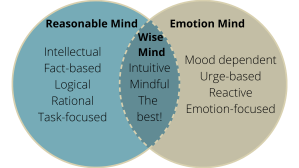
    My friend showed me a diagram once. It was a rectangle that was bisected with a line from the upper left to the lower right. One end was labeled “Reason” the other “Emotion.” The idea was the the more emotion that was engaged in a person’s thinking, the less reason would prevail. A quick search of the internet provided many more nuanced diagrams. One caught my eye. I like it because it offers a middle ground, where the reasonable mind and the emotional mind intersect. There the Wise Mind is to be found.

    So you don’t have to choose between the two. You don’t have to be purely rational, nor given to emotion. You can let these two interplay and find wisdom.



    There has also been some brain research that ties emotional reactions to the lower part of the brain – that part of the brain that centers on reactivity. If we function only from that part of our brains, we will be mood-dependent, urge-based, reactive, and emotion focused. While that may not be desirable, neither is the opposite. Being purely intellectual, fact-based, logical, rational, and task-focused allows us to get things done. But so does a computer. We are not just human robots.

    Nice as it seems in this diagram, being intuitive and mindful is not the best. There is a critical part absent in this paradigm. It has to do with wisdom itself. “The fear of the Lord is the beginning of wisdom,” (Proverbs 9:10). Biblical wisdom includes understanding, discernment, and humility. Jesus is the embodiment of spiritual wisdom. He taught and modeled love, compassion, forgiveness, and the pursuit of spiritual truths over worldly possessions. Biblical wisdom involves aligning one’s life with God’s purposes, not merely acquiring knowledge. And that seems to be what the Epicurean and Stoic philosophers were all about. 

    Scripture instructs us to be transformed by the renewing of our minds, knowing the will of God and doing it (cf. Romans 12). Paul corrects the people on Mars Hill regarding their understanding of God’s essence. He tells them that they “ought not to think that the divine being is like gold or silver or stone, an image formed by the art and imagination of man.” This was their way of thinking about God.

    But we are called to think of themselves with sober judgement, and to think about God as one to be feared, loved, and trusted. This is a far better way to think.

  • Now while Paul was waiting for them at Athens, his spirit was provoked within him as he saw that the city was full of idols. 17 So he reasoned in the synagogue with the Jews and the devout persons, and in the marketplace every day with those who happened to be there. 18 Some of the Epicurean and Stoic philosophers also conversed with him. And some said, “What does this babbler wish to say?” Others said, “He seems to be a preacher of foreign divinities”—because he was preaching Jesus and the resurrection. 19 And they took him and brought him to the Areopagus, saying, “May we know what this new teaching is that you are presenting? 20 For you bring some strange things to our ears. We wish to know therefore what these things mean.” 21 Now all the Athenians and the foreigners who lived there would spend their time in nothing except telling or hearing something new.

    22 So Paul, standing in the midst of the Areopagus, said: “Men of Athens, I perceive that in every way you are very religious. 23 For as I passed along and observed the objects of your worship, I found also an altar with this inscription: ‘To the unknown god.’ What therefore you worship as unknown, this I proclaim to you. 24 The God who made the world and everything in it, being Lord of heaven and earth, does not live in temples made by man, 25 nor is he served by human hands, as though he needed anything, since he himself gives to all mankind life and breath and everything. 26 And he made from one man every nation of mankind to live on all the face of the earth, having determined allotted periods and the boundaries of their dwelling place, 27 that they should seek God, and perhaps feel their way toward him and find him. Yet he is actually not far from each one of us, 28 for

    “‘In him we live and move and have our being’;

    as even some of your own poets have said,

    “‘For we are indeed his offspring.’

    29 Being then God’s offspring, we ought not to think that the divine being is like gold or silver or stone, an image formed by the art and imagination of man. 30 The times of ignorance God overlooked, but now he commands all people everywhere to repent, 31 because he has fixed a day on which he will judge the world in righteousness by a man whom he has appointed; and of this he has given assurance to all by raising him from the dead.”

    32 Now when they heard of the resurrection of the dead, some mocked. But others said, “We will hear you again about this.” 33 So Paul went out from their midst. 34 But some men joined him and believed, among whom also were Dionysius the Areopagite and a woman named Damaris and others with them.

    Plumeria | Tulum, Mexico | February 2024

    One of my favorite Bible passages contains at least four superlatives. “God is able to make all grace abound to you so having all sufficiency in all things at all times you may abound in every good work” (2 Corinthians 9:8). The breadth of God’s love, his provision, and his grace, is to be reflected not just in an attitude of gratitude – good as that may be. It is to be reflected in a life of good works. These blessings of God are not to be damned up in stagnant selfishness. That which flows from the heart of a generous God must flow then from the hearts of we who have been enriched by his grace.

    But we don’t do that as we should. We line our own pockets. We lean on our wealth. We lose sight of what is truly good, excellent, and noble. We need to repent. And that applies to all of us – if you take seriously what Paul says to the people on Mars Hill: “The times of ignorance God overlooked, but now he commands all people everywhere to repent” (17:30).

    There are those superlatives again: “all people everywhere.” There is no wiggle room there. That’s because,he will judge the world in righteousness by a man whom he has appointed” (17:31). This is certain to happen, for “he has given assurance to all by raising him [Jesus] from the dead” (17:31). 

    We rightly celebrate Easter, rejoicing that our Lord and Savior was raised from the dead. In fact, if he was not raised from the dead, we’re still in our sins; we are of all people most to be pitied (cf. 1 Corinthians 15). Jesus died for all people everywhere. He rose to prove our debt was paid. That’s the joy side of Jesus’ resurrection.

    Here we are reminded that not only was Jesus vindicated by his resurrection, but he will come to judge the living and the dead. Our need for his salvation is exceeded only by his grace and forgiveness to all who repent and believe. “All people everywhere should repent,” says Paul. Luther said that the entire life of a Christian should be one of repentance. We drown the old nature by daily repentance and faith. That’s a good message for all people everywhere.

  • Now while Paul was waiting for them at Athens, his spirit was provoked within him as he saw that the city was full of idols. 17 So he reasoned in the synagogue with the Jews and the devout persons, and in the marketplace every day with those who happened to be there. 18 Some of the Epicurean and Stoic philosophers also conversed with him. And some said, “What does this babbler wish to say?” Others said, “He seems to be a preacher of foreign divinities”—because he was preaching Jesus and the resurrection. 19 And they took him and brought him to the Areopagus, saying, “May we know what this new teaching is that you are presenting? 20 For you bring some strange things to our ears. We wish to know therefore what these things mean.” 21 Now all the Athenians and the foreigners who lived there would spend their time in nothing except telling or hearing something new.

    22 So Paul, standing in the midst of the Areopagus, said: “Men of Athens, I perceive that in every way you are very religious. 23 For as I passed along and observed the objects of your worship, I found also an altar with this inscription: ‘To the unknown god.’ What therefore you worship as unknown, this I proclaim to you. 24 The God who made the world and everything in it, being Lord of heaven and earth, does not live in temples made by man, 25 nor is he served by human hands, as though he needed anything, since he himself gives to all mankind life and breath and everything. 26 And he made from one man every nation of mankind to live on all the face of the earth, having determined allotted periods and the boundaries of their dwelling place, 27 that they should seek God, and perhaps feel their way toward him and find him. Yet he is actually not far from each one of us, 28 for

    “‘In him we live and move and have our being’;

    as even some of your own poets have said,

    “‘For we are indeed his offspring.’

    29 Being then God’s offspring, we ought not to think that the divine being is like gold or silver or stone, an image formed by the art and imagination of man. 30 The times of ignorance God overlooked, but now he commands all people everywhere to repent, 31 because he has fixed a day on which he will judge the world in righteousness by a man whom he has appointed; and of this he has given assurance to all by raising him from the dead.”

    32 Now when they heard of the resurrection of the dead, some mocked. But others said, “We will hear you again about this.” 33 So Paul went out from their midst. 34 But some men joined him and believed, among whom also were Dionysius the Areopagite and a woman named Damaris and others with them.

    Plumeria | Tulum, Mexico | February 2024

    Paul wrote to the church in Philippi, I have learned in whatever situation I am to be content. I know how to be brought low, and I know how to abound. In any and every circumstance, I have learned the secret of facing plenty and hunger, abundance and need. I can do all things through him who strengthens me.” (Philippians 4:11-13)

    It’s interesting to me that he learned this secret. For he was decidedly not content when walking through Athens. Pagan gods. Stoic and Epicurean philosophers. Idols. The Jewish believers and devout persons were bombarded on every side. I’m thinking walking down Bourbon Street in New Orleans on a Friday night. Lots there to make a follower of Jesus uncomfortable.

    I suppose there is a distinction between contentment and comfort, discontent and a provoked spirit. I  understand the feeling of godly discontent, or kingdom discomfort. Sometimes it can be a community that is wealthy but soulless – without any sense of a need for God. Other times it has been the obvious ungodly immoralities hyped on Bourbon Street, YouTube, or NetFlix. Whenever I encounter a world without God, a vapid immorality, or any obvious anti-Kingdom of God value-system, I feel that knot in my stomach. This isn’t right.

    Paul’s response was twofold. He engages the philosophers in conversation, and goes into the synagogue to connect with God’s people there. Paul was singularly gifted in this area. He was so obviously compelled by the love of Christ, and aware of being Christ’s ambassador. He was willing to talk with anyone. He knew, also, that those living in that culture were facing challenges daily of slipping into the false ways of the world.

    Godly contentment is a good thing. It is essential to living in the fullness of God’s peace. We are soon paralyzed with anxiety if we live in a state of discontent. Paul tells the Philippians years later that he learned the secret of contentment. That state of contentment surely helped him to write those reflective thoughts to the church there. But for now he has a holy discontent that people do not know the source of true life, love, grace, and peace. Perhaps we should feel a little bit of that godly discontent whenever we encounter the broken world around us.

  • Acts 17:16-31

     Now while Paul was waiting for them at Athens, his spirit was provoked within him as he saw that the city was full of idols. 17 So he reasoned in the synagogue with the Jews and the devout persons, and in the marketplace every day with those who happened to be there. 18 Some of the Epicurean and Stoic philosophers also conversed with him. And some said, “What does this babbler wish to say?” Others said, “He seems to be a preacher of foreign divinities”—because he was preaching Jesus and the resurrection. 19 And they took him and brought him to the Areopagus, saying, “May we know what this new teaching is that you are presenting? 20 For you bring some strange things to our ears. We wish to know therefore what these things mean.” 21 Now all the Athenians and the foreigners who lived there would spend their time in nothing except telling or hearing something new.

    22 So Paul, standing in the midst of the Areopagus, said: “Men of Athens, I perceive that in every way you are very religious. 23 For as I passed along and observed the objects of your worship, I found also an altar with this inscription: ‘To the unknown god.’ What therefore you worship as unknown, this I proclaim to you. 24 The God who made the world and everything in it, being Lord of heaven and earth, does not live in temples made by man, 25 nor is he served by human hands, as though he needed anything, since he himself gives to all mankind life and breath and everything. 26 And he made from one man every nation of mankind to live on all the face of the earth, having determined allotted periods and the boundaries of their dwelling place, 27 that they should seek God, and perhaps feel their way toward him and find him. Yet he is actually not far from each one of us, 28 for

    “‘In him we live and move and have our being’;

    as even some of your own poets have said,

    “‘For we are indeed his offspring.’

    29 Being then God’s offspring, we ought not to think that the divine being is like gold or silver or stone, an image formed by the art and imagination of man. 30 The times of ignorance God overlooked, but now he commands all people everywhere to repent, 31 because he has fixed a day on which he will judge the world in righteousness by a man whom he has appointed; and of this he has given assurance to all by raising him from the dead.”

    Prairie Verbena | Gatesville, TX | April 2024

    My college professor of New Testament studies said more than once, “All truth is God’s truth.” His point was that wherever we learn something that is true – whether from a philosopher, teacher, or even the internet – if it’s true, it’s true. And God is the owner of all truth. Jesus himself said, “I am the way, the truth, and the life.” He is identified as being full of grace and truth (John 1:14).

    So when Paul preaches on Mars Hill, and quotes from a hymn to Zeus, and the Stoic poet Aratus, he is making use of pagan writings even though he does not subscribe to the rest of their teachings. It’s true: in God we do live and move and have our being. We are his offspring. These things are true.

    But when it comes time to conclude his teachings and anchor all he is claiming, he points to Jesus and his resurrection from the grave. While all truth is God’s truth, not all teachings are true. And the establishment of truth is not in anything other than the embodiment of truth itself: the Word made flesh.

    Jesus, the Word made flesh, full of grace and truth, also said, “If you continue in my word, you are truly disciples of mine. You will know the truth and the truth will set you free. All truth may be God’s truth. But not all truth will free you. That happens only when truth is partnered with grace.

    This is the grace Paul was proclaiming on Mars Hill, pointing the Greek intelligentsia to the One who has made himself known in Jesus of Nazareth. He was also telling them that they did not have to serve him or placate him. He didn’t live in temples. He was truly alive.

    The turning point of Paul’s teaching comes when Paul mentions the resurrection. This will dramatically separate the message of Paul from that of the pagan Greeks. They’ll have to chew on that with great consideration. This is the God’s honest truth: Jesus is the One to whom all people will give an account. Thank God he has revealed that truth to us.

  •  Now while Paul was waiting for them at Athens, his spirit was provoked within him as he saw that the city was full of idols. 17 So he reasoned in the synagogue with the Jews and the devout persons, and in the marketplace every day with those who happened to be there. 18 Some of the Epicurean and Stoic philosophers also conversed with him. And some said, “What does this babbler wish to say?” Others said, “He seems to be a preacher of foreign divinities”—because he was preaching Jesus and the resurrection. 19 And they took him and brought him to the Areopagus, saying, “May we know what this new teaching is that you are presenting? 20 For you bring some strange things to our ears. We wish to know therefore what these things mean.” 21 Now all the Athenians and the foreigners who lived there would spend their time in nothing except telling or hearing something new.

    22 So Paul, standing in the midst of the Areopagus, said: “Men of Athens, I perceive that in every way you are very religious. 23 For as I passed along and observed the objects of your worship, I found also an altar with this inscription: ‘To the unknown god.’ What therefore you worship as unknown, this I proclaim to you. 24 The God who made the world and everything in it, being Lord of heaven and earth, does not live in temples made by man, 25 nor is he served by human hands, as though he needed anything, since he himself gives to all mankind life and breath and everything. 26 And he made from one man every nation of mankind to live on all the face of the earth, having determined allotted periods and the boundaries of their dwelling place, 27 that they should seek God, and perhaps feel their way toward him and find him. Yet he is actually not far from each one of us, 28 for

    “‘In him we live and move and have our being’;

    as even some of your own poets have said,

    “‘For we are indeed his offspring.’

    29 Being then God’s offspring, we ought not to think that the divine being is like gold or silver or stone, an image formed by the art and imagination of man. 30 The times of ignorance God overlooked, but now he commands all people everywhere to repent, 31 because he has fixed a day on which he will judge the world in righteousness by a man whom he has appointed; and of this he has given assurance to all by raising him from the dead.”

    Hidden Beauty | Tulum, Mexico | February 2024

    He became unglued. “These people come here and are trying to change our laws and the whole country!” I thought he was talking about foreign immigrants. But he was talking about people coming from California to Texas, and wanting to change things in Texas to be more like California – the very place they had come from. You can guess what I think about that – but that is not the issue at stake here. Nor is it my point.

    In fact, the whole point is quite unrelated to people usurping our rights, or changing our culture. It is actually about the exact opposite. It’s about God bringing people to us, so that we can have an impact on them. This is not easy challenge. But it is our calling and commission. Our responsibility. God, Paul says, “made from one man every nation of mankind to live on all the face of the earth, having determined allotted periods and the boundaries of their dwelling place, that they should seek God, and perhaps feel their way toward him and find him.” 

    It’s actually a two-way street. Not only is it our responsibility to reach out to others, but he puts people into places he has designed for them, so that they would reach out to him, and find him, and worship him, and acknowledge him as creator of all, and the one in whom we live and move and have our being.

    My unglued friend who was railing against those Californians, might well have simply asked, “Do you have any idea why you are here in Texas?” They might say, “We decided to come here because we got jobs in Tesla, or Dell, or Samsung.” And to that we might say, “I believe there is another reason. A more important one.” Who knows where the conversation might go from there.

    Paul’s witness intrigued the philosophers on Mars Hill. We’ll see where that went next week as we follow this story forward. But for now, suffice it to say that he used the opportunity at hand to share the Good News of Jesus, and pointing people to him who will judge the living and the dead.

  • Please pray these psalms with me on this Lord’s Day

    Psalm 7:1-2, 17

    O Lord my God, in you do I take refuge;
        save me from all my pursuers and deliver me,
    lest like a lion they tear my soul apart,
        rending it in pieces, with none to deliver.

    17 I will give to the Lord the thanks due to his righteousness,
        and I will sing praise to the name of the Lord, the Most High.17 I will give to the Lord the thanks due to his righteousness,
        and I will sing praise to the name of the Lord, the Most High.

    Psalm 37:1-7

    Fret not yourself because of evildoers;
        be not envious of wrongdoers!
    For they will soon fade like the grass
        and wither like the green herb.

    Trust in the Lord, and do good;
        dwell in the land and befriend faithfulness.
    Delight yourself in the Lord,
        and he will give you the desires of your heart.

    Commit your way to the Lord;
        trust in him, and he will act.
    He will bring forth your righteousness as the light,
        and your justice as the noonday.

    Be still before the Lord and wait patiently for him;
        fret not yourself over the one who prospers in his way,
        over the man who carries out evil devices!

    Psalm 67

    May God be gracious to us and bless us
        and make his face to shine upon us, Selah
    that your way may be known on earth,
        your saving power among all nations.
    Let the peoples praise you, O God;
        let all the peoples praise you!

    Let the nations be glad and sing for joy,
        for you judge the peoples with equity
        and guide the nations upon earth. Selah
    Let the peoples praise you, O God;
        let all the peoples praise you!

    The earth has yielded its increase;
        God, our God, shall bless us.
    God shall bless us;
        let all the ends of the earth fear him!

    Psalm 97

    The Lord reigns, let the earth rejoice;
        let the many coastlands be glad!
    Clouds and thick darkness are all around him;
        righteousness and justice are the foundation of his throne.
    Fire goes before him
        and burns up his adversaries all around.
    His lightnings light up the world;
        the earth sees and trembles.
    The mountains melt like wax before the Lord,
        before the Lord of all the earth.

    The heavens proclaim his righteousness,
        and all the peoples see his glory.
    All worshipers of images are put to shame,
        who make their boast in worthless idols;
        worship him, all you gods!

    Zion hears and is glad,
        and the daughters of Judah rejoice,
        because of your judgments, O Lord.
    For you, O Lord, are most high over all the earth;
        you are exalted far above all gods.

    10 O you who love the Lord, hate evil!
        He preserves the lives of his saints;
        he delivers them from the hand of the wicked.
    11 Light is sown for the righteous,
        and joy for the upright in heart.
    12 Rejoice in the Lord, O you righteous,
        and give thanks to his holy name!

    Psalm 127

    Unless the Lord builds the house,
        those who build it labor in vain.
    Unless the Lord watches over the city,
        the watchman stays awake in vain.
    It is in vain that you rise up early
        and go late to rest,
    eating the bread of anxious toil;
        for he gives to his beloved sleep.

    Behold, children are a heritage from the Lord,
        the fruit of the womb a reward.
    Like arrows in the hand of a warrior
        are the children of one’s youth.
    Blessed is the man
        who fills his quiver with them!
    He shall not be put to shame
        when he speaks with his enemies in the gate.

    English Standard Version (ESV)
    The Holy Bible, English Standard Version. ESV® Text Edition: 2016.
    Copyright © 2001 by Crossway Bibles, a publishing ministry of Good News Publishers.

  • Now when they had passed through Amphipolis and Apollonia, they came to Thessalonica, where there was a synagogue of the Jews. And Paul went in, as was his custom, and on three Sabbath days he reasoned with them from the Scriptures, explaining and proving that it was necessary for the Christ to suffer and to rise from the dead, and saying, “This Jesus, whom I proclaim to you, is the Christ.” And some of them were persuaded and joined Paul and Silas, as did a great many of the devout Greeks and not a few of the leading women. But the Jews were jealous, and taking some wicked men of the rabble, they formed a mob, set the city in an uproar, and attacked the house of Jason, seeking to bring them out to the crowd. And when they could not find them, they dragged Jason and some of the brothers before the city authorities, shouting, “These men who have turned the world upside down have come here also, and Jason has received them, and they are all acting against the decrees of Caesar, saying that there is another king, Jesus.” And the people and the city authorities were disturbed when they heard these things. And when they had taken money as security from Jason and the rest, they let them go.

    10 The brothers immediately sent Paul and Silas away by night to Berea, and when they arrived they went into the Jewish synagogue. 11 Now these Jews were more noble than those in Thessalonica; they received the word with all eagerness, examining the Scriptures daily to see if these things were so. 12 Many of them therefore believed, with not a few Greek women of high standing as well as men. 13 But when the Jews from Thessalonica learned that the word of God was proclaimed by Paul at Berea also, they came there too, agitating and stirring up the crowds. 14 Then the brothers immediately sent Paul off on his way to the sea, but Silas and Timothy remained there. 15 Those who conducted Paul brought him as far as Athens, and after receiving a command for Silas and Timothy to come to him as soon as possible, they departed.

    Ti Plant | Tulum, Mexico | February 2024

    It’s clear that the New Testament world was dominated by men. That’s not to say women didn’t play a part in the mission of God by any means. I’m thinking of notable women like Lydia, Priscilla, and of course Mary, JoAnna, Martha, Mary Magdalen, and others. I suspect Lydia was a source of great financial support for Paul and the church in Philippi. But it is clear that on mission trips it was the men who carried the message and who supported one another in that mission. Paul, Silas and Timothy are examples of that. But so are the “brothers” who sent Paul away while Silas and Timothy stayed behind in Berea – until they were called to join Paul in Athens.

    Paul will not go it alone. And, it seems, Paul will not lead or pursue his mission efforts in willful and stubborn commitment to his personal agenda. He calls for Timothy and Silas once he’s in Athens. He apparently needs their support in his efforts there. What’s more, this is in keeping with Jesus’ practice, sending out the 12 and the 72 two-by-two. That even shows up on Palm Sunday when Jesus sends two of his disciples into town to get a donkey for his triumphant procession into Jerusalem. Jesus is all about teamwork. So was Paul. Many of his letters mention others who were with him at their writing. Whether partners in the Gospel or secretaries for his letters, Paul had other men with him in his mission work and even imprisonment.

    Today’s world is different to be sure. Women have a more prominent role in the church and in society. Some have taken that so far as to alter the pronouns “they” instead of “he” in Bible translations. Others add the words “and sisters,” to passages – some of which legitimately would refer also to women. In this case it was “brothers” who helped Paul to get out of the city and on to Athens. More important than the fact that it was brothers or men, however, is what it sets up for Paul there in Athens. Silas and Timothy will join him once he gets to Corinth. But he will not stop sharing the message of Jesus – even if he’s on his own in Athens. But in Corinth (spoiler alert!), Paul will join up with Aquila and Priscilla -husband and wife. They will be a band of brothers and sister(s) spreading the word of God.

    I once attended a workshop for pastors and church leaders. John Maxwell was the presenter and gave this advice to pastors doing ministry or mission, “Take someone along,” he said. We’re better together – whether that is a band of brothers or the body of Christ, brothers and sisters in Christ who partner with one another for the sake of the Gospel.

  • Click here for an audio version of this blog post.

    I incorrectly identified the books of Ezekiel and Daniel as apocryphal. Wrong word! The word is apocalyptic.  Apocalyptic refers to a genre of literature, particularly found in certain biblical books like Daniel and Revelation, characterized by vivid visions, symbolism, and predictions about divine judgment, the end times, and the ultimate triumph of good over evil. Apocalyptic writings often feature cosmic battles, angelic beings, and elaborate imagery depicting the future and the supernatural realm. These texts typically convey messages of hope, encouragement, and divine intervention amidst times of turmoil and suffering.

    Acts 17:1-15

    Now when they had passed through Amphipolis and Apollonia, they came to Thessalonica, where there was a synagogue of the Jews. And Paul went in, as was his custom, and on three Sabbath days he reasoned with them from the Scriptures, explaining and proving that it was necessary for the Christ to suffer and to rise from the dead, and saying, “This Jesus, whom I proclaim to you, is the Christ.” And some of them were persuaded and joined Paul and Silas, as did a great many of the devout Greeks and not a few of the leading women. But the Jews were jealous, and taking some wicked men of the rabble, they formed a mob, set the city in an uproar, and attacked the house of Jason, seeking to bring them out to the crowd. And when they could not find them, they dragged Jason and some of the brothers before the city authorities, shouting, “These men who have turned the world upside down have come here also, and Jason has received them, and they are all acting against the decrees of Caesar, saying that there is another king, Jesus.” And the people and the city authorities were disturbed when they heard these things. And when they had taken money as security from Jason and the rest, they let them go.

    10 The brothers immediately sent Paul and Silas away by night to Berea, and when they arrived they went into the Jewish synagogue. 11 Now these Jews were more noble than those in Thessalonica; they received the word with all eagerness, examining the Scriptures daily to see if these things were so. 12 Many of them therefore believed, with not a few Greek women of high standing as well as men. 13 But when the Jews from Thessalonica learned that the word of God was proclaimed by Paul at Berea also, they came there too, agitating and stirring up the crowds. 14 Then the brothers immediately sent Paul off on his way to the sea, but Silas and Timothy remained there. 15 Those who conducted Paul brought him as far as Athens, and after receiving a command for Silas and Timothy to come to him as soon as possible, they departed.

    Frangipani Plumeria | Tulum, Mexico | February 2024

    “There are only two religions in the world,” I learned. “One is God’s religion. The other is man’s religion.” It was in one of my first classes at the seminary back in 1975. Revelation and Scripture was taught by Dr. Fred Kramer, a gracious and thoughtful man of God. I learned a lot in that class. The difference between natural revelation and special revelation (scripture). That we do rightly equate the Bible with the Word of God, although the Word of God is truly Jesus Christ. That Jesus alluded to all parts of the Old Testament from the Books of Moses to the minor prophets, even the apocalyptic books of the Old Testament (Ezekiel and Daniel). He occasionally also let us see behind the curtain of the seminary faculty. Once he told about a faculty member talking about a group of brothers in our church body, describing them in unkind terms. He simply said [paraphrasing here], “Do you really mean that? I think a kinder and more gracious regard for them would better serve us all.”

    All this to say that when Paul and Silas told the people in Berea about Jesus, they did the only thing a responsible Jew would do: they searched the Scripture to see if what Paul and Silas was saying was true. Where did they go? What Scriptures did they look at? The New Testament had not been constituted at this time. The teachings of Jesus and some very early hymns and creeds may have been formulated. But the Bereans would not look at those. They were self-attesting witnesses.

    They would look at these passages:

    Genesis 3:15 God says to the serpent (Satan), “I will put enmity between you and the woman, and between your seed and her seed. He shall crush your head, and you will bruise his heel.”

    Psalm 22 gives a vivid description of someone being crucified – even though crucifixion was not a known form of execution in David’s day. It also has those powerful words, “My God, my God, why have you forsaken me?”

    By far the most rich expression of Jesus’ ministry may be found in Isaiah 53. Isaiah writes about Jesus dying with sinners, and being buried by a rich man. It also has this powerful promise:

    Yet it was the will of the Lord to crush him;
        he has put him to grief;
    when his soul makes an offering for guilt,
        he shall see his offspring; he shall prolong his days;
    the will of the Lord shall prosper in his hand. – Isaiah 53:10

    Paul and Silas taught that it was necessary for Jesus to suffer and die, and be raised from the dead. The little Greek word, ἔδει (edei) means it was necessary. Gotta happen. Plan of God. Promised by God. Delivered by Jesus. Necessary because of our sin and God’s abiding love. He did not flinch from this rescue. He has done it. We have been saved. The seeds of that salvation were sown in the Old Testament. They came to full bloom in the life and ministry of Jesus. They will be fully harvested on the Great Last Day. This is the witness of Scripture.

  • Now when they had passed through Amphipolis and Apollonia, they came to Thessalonica, where there was a synagogue of the Jews. And Paul went in, as was his custom, and on three Sabbath days he reasoned with them from the Scriptures, explaining and proving that it was necessary for the Christ to suffer and to rise from the dead, and saying, “This Jesus, whom I proclaim to you, is the Christ.” And some of them were persuaded and joined Paul and Silas, as did a great many of the devout Greeks and not a few of the leading women. But the Jews were jealous, and taking some wicked men of the rabble, they formed a mob, set the city in an uproar, and attacked the house of Jason, seeking to bring them out to the crowd. And when they could not find them, they dragged Jason and some of the brothers before the city authorities, shouting, “These men who have turned the world upside down have come here also, and Jason has received them, and they are all acting against the decrees of Caesar, saying that there is another king, Jesus.” And the people and the city authorities were disturbed when they heard these things. And when they had taken money as security from Jason and the rest, they let them go.

    10 The brothers immediately sent Paul and Silas away by night to Berea, and when they arrived they went into the Jewish synagogue. 11 Now these Jews were more noble than those in Thessalonica; they received the word with all eagerness, examining the Scriptures daily to see if these things were so. 12 Many of them therefore believed, with not a few Greek women of high standing as well as men. 13 But when the Jews from Thessalonica learned that the word of God was proclaimed by Paul at Berea also, they came there too, agitating and stirring up the crowds. 14 Then the brothers immediately sent Paul off on his way to the sea, but Silas and Timothy remained there. 15 Those who conducted Paul brought him as far as Athens, and after receiving a command for Silas and Timothy to come to him as soon as possible, they departed.

    Frangipani Plumeria | Tulum, Mexico | February 2024

    “There are only two religions in the world,” I learned. “One is God’s religion. The other is man’s religion.” It was in one of my first classes at the seminary back in 1975. Revelation and Scripture was taught by Dr. Fred Kramer, a gracious and thoughtful man of God. I learned a lot in that class. The difference between natural revelation and special revelation (scripture). That we do rightly equate the Bible with the Word of God, although the Word of God is truly Jesus Christ. That Jesus alluded to all parts of the Old Testament from the Books of Moses to the minor prophets, even the apocryphal books of the Old Testament (Ezekiel and Daniel). He occasionally also let us see behind the curtain of the seminary faculty. Once he told about a faculty member talking about a group of brothers in our church body, describing them in unkind terms. He simply said [paraphrasing here], “Do you really mean that? I think a kinder and more gracious regard for them would better serve us all.”

    All this to say that when Paul and Silas told the people in Berea about Jesus, they did the only thing a responsible Jew would do: they searched the Scripture to see if what Paul and Silas was saying was true. Where did they go? What Scriptures did they look at? The New Testament had not been constituted at this time. The teachings of Jesus and some very early hymns and creeds may have been formulated. But the Bereans would not look at those. They were self-attesting witnesses.

    They would look at these passages:

    Genesis 3:15 God says to the serpent (Satan), “I will put enmity between you and the woman, and between your seed and her seed. He shall crush your head, and you will bruise his heel.”

    Psalm 22 gives a vivid description of someone being crucified – even though crucifixion was not a known form of execution in David’s day. It also has those powerful words, “My God, my God, why have you forsaken me?”

    By far the most rich expression of Jesus’ ministry may be found in Isaiah 53. Isaiah writes about Jesus dying with sinners, and being buried by a rich man. It also has this powerful promise:

    Yet it was the will of the Lord to crush him;
        he has put him to grief;
    when his soul makes an offering for guilt,
        he shall see his offspring; he shall prolong his days;
    the will of the Lord shall prosper in his hand. – Isaiah 53:10

    Paul and Silas taught that it was necessary for Jesus to suffer and die, and be raised from the dead. The little Greek word, ἔδει (edei) means it was necessary. Gotta happen. Plan of God. Promised by God. Delivered by Jesus. Necessary because of our sin and God’s abiding love. He did not flinch from this rescue. He has done it. We have been saved. The seeds of that salvation were sown in the Old Testament. They came to full bloom in the life and ministry of Jesus. They will be fully harvested on the Great Last Day. This is the witness of Scripture.