David Bahn – Reflections

Light from the Word and through the lens

  • Please pray these Psalms with me today, on this Lord’s Day

    Psalm 6

    LORD, rebuke me not in your anger,
        nor discipline me in your wrath.
    Be gracious to me, O LORD, for I am languishing;
        heal me, O LORD, for my bones are troubled.
    My soul also is greatly troubled.
        But you, O LORD—how long?

    Turn, O LORD, deliver my life;
        save me for the sake of your steadfast love.
    For in death there is no remembrance of you;
        in Sheol who will give you praise?

    I am weary with my moaning;
        every night I flood my bed with tears;
        I drench my couch with my weeping.
    My eye wastes away because of grief;
        it grows weak because of all my foes.

    Depart from me, all you workers of evil,
        for the LORD has heard the sound of my weeping.
    The LORD has heard my plea;
        the LORD accepts my prayer.
    10 All my enemies shall be ashamed and greatly troubled;
        they shall turn back and be put to shame in a moment.

    Psalm 36

    Transgression speaks to the wicked
        deep in his heart;
    there is no fear of God
        before his eyes.
    For he flatters himself in his own eyes
        that his iniquity cannot be found out and hated.
    The words of his mouth are trouble and deceit;
        he has ceased to act wisely and do good.
    He plots trouble while on his bed;
        he sets himself in a way that is not good;
        he does not reject evil.

    Your steadfast love, O LORD, extends to the heavens,
        your faithfulness to the clouds.
    Your righteousness is like the mountains of God;
        your judgments are like the great deep;
        man and beast you save, O LORD.

    How precious is your steadfast love, O God!
        The children of mankind take refuge in the shadow of your wings.
    They feast on the abundance of your house,
        and you give them drink from the river of your delights.
    For with you is the fountain of life;
        in your light do we see light.

    10 Oh, continue your steadfast love to those who know you,
        and your righteousness to the upright of heart!
    11 Let not the foot of arrogance come upon me,
        nor the hand of the wicked drive me away.
    12 There the evildoers lie fallen;
        they are thrust down, unable to rise.

    Psalm 66

    Shout for joy to God, all the earth;
        sing the glory of his name;
        give to him glorious praise!
    Say to God, “How awesome are your deeds!
        So great is your power that your enemies come cringing to you.
    All the earth worships you
        and sings praises to you;
        they sing praises to your name.” Selah

    Come and see what God has done:
        he is awesome in his deeds toward the children of man.
    He turned the sea into dry land;
        they passed through the river on foot.
    There did we rejoice in him,
        who rules by his might forever,
    whose eyes keep watch on the nations—
        let not the rebellious exalt themselves. Selah

    Bless our God, O peoples;
        let the sound of his praise be heard,
    who has kept our soul among the living
        and has not let our feet slip.
    10 For you, O God, have tested us;
        you have tried us as silver is tried.
    11 You brought us into the net;
        you laid a crushing burden on our backs;
    12 you let men ride over our heads;
        we went through fire and through water;
    yet you have brought us out to a place of abundance.

    13 I will come into your house with burnt offerings;
        I will perform my vows to you,
    14 that which my lips uttered
        and my mouth promised when I was in trouble.
    15 I will offer to you burnt offerings of fattened animals,
        with the smoke of the sacrifice of rams;
    I will make an offering of bulls and goats. Selah

    16 Come and hear, all you who fear God,
        and I will tell what he has done for my soul.
    17 I cried to him with my mouth,
        and high praise was on my tongue.
    18 If I had cherished iniquity in my heart,
        the LORD would not have listened.
    19 But truly God has listened;
        he has attended to the voice of my prayer.

    20 Blessed be God,
        because he has not rejected my prayer
        or removed his steadfast love from me!

    Psalm 96

    Oh sing to the LORD a new song;
        sing to the LORD, all the earth!
    Sing to the LORD, bless his name;
        tell of his salvation from day to day.
    Declare his glory among the nations,
        his marvelous works among all the peoples!
    For great is the LORD, and greatly to be praised;
        he is to be feared above all gods.
    For all the gods of the peoples are worthless idols,
        but the LORD made the heavens.
    Splendor and majesty are before him;
        strength and beauty are in his sanctuary.

    Ascribe to the LORD, O families of the peoples,
        ascribe to the LORD glory and strength!
    Ascribe to the LORD the glory due his name;
        bring an offering, and come into his courts!
    Worship the LORD in the splendor of holiness;
        tremble before him, all the earth!

    10 Say among the nations, “The LORD reigns!
        Yes, the world is established; it shall never be moved;
        he will judge the peoples with equity.”

    11 Let the heavens be glad, and let the earth rejoice;
        let the sea roar, and all that fills it;
    12     let the field exult, and everything in it!
    Then shall all the trees of the forest sing for joy
    13     before the LORD, for he comes,
        for he comes to judge the earth.
    He will judge the world in righteousness,
        and the peoples in his faithfulness.

    Psalm 126

    When the LORD restored the fortunes of Zion,
        we were like those who dream.
    Then our mouth was filled with laughter,
        and our tongue with shouts of joy;
    then they said among the nations,
        “The LORD has done great things for them.”
    The LORD has done great things for us;
        we are glad.

    Restore our fortunes, O LORD,
        like streams in the Negeb!
    Those who sow in tears
        shall reap with shouts of joy!
    He who goes out weeping,
        bearing the seed for sowing,
    shall come home with shouts of joy,
        bringing his sheaves with him.

    The Holy Bible, English Standard Version.
    ESV® Text Edition: 2016. Copyright © 2001 by
    Crossway Bibles, a publishing ministry of Good News Publishers.

  • How Faithfulness and Gratitude Show in a Life of Discipleship

    Click here for an audio version of this podcast

    I am using St. John’s Luke Lent Reading Plan for these devotions.

    Luke 17:1-19

    And Jesus said to his disciples, “Temptations to sin are sure to come, but woe to the one through whom they come! It would be better for him if a millstone were hung around his neck and he were cast into the sea than that he should cause one of these little ones to sin. Pay attention to yourselves! If your brother sins, rebuke him, and if he repents, forgive him, and if he sins against you seven times in the day, and turns to you seven times, saying, ‘I repent,’ you must forgive him.”

    The apostles said to the Lord, “Increase our faith!” And the Lord said, “If you had faith like a grain of mustard seed, you could say to this mulberry tree, ‘Be uprooted and planted in the sea,’ and it would obey you.

    “Will any one of you who has a servant plowing or keeping sheep say to him when he has come in from the field, ‘Come at once and recline at table’? Will he not rather say to him, ‘Prepare supper for me, and dress properly, and serve me while I eat and drink, and afterward you will eat and drink’? 9 Does he thank the servant because he did what was commanded? 10 So you also, when you have done all that you were commanded, say, ‘We are unworthy servants; we have only done what was our duty.’”

    11 On the way to Jerusalem he was passing along between Samaria and Galilee. 12 And as he entered a village, he was met by ten lepers, who stood at a distance 13 and lifted up their voices, saying, “Jesus, Master, have mercy on us.” 14 When he saw them he said to them, “Go and show yourselves to the priests.” And as they went they were cleansed. 15 Then one of them, when he saw that he was healed, turned back, praising God with a loud voice; 16 and he fell on his face at Jesus’ feet, giving him thanks. Now he was a Samaritan. 17 Then Jesus answered, “Were not ten cleansed? Where are the nine? 18 Was no one found to return and give praise to God except this foreigner?” 19 And he said to him, “Rise and go your way; your faith has made you well.”

    Curious Log in the Weeds | Palo Duro Canyon | January 2025

    The Christian faith is anything other than one-dimensional. It’s beyond two-dimensions. It is multi-faceted, multi-dimensional, and multi-textured, weaving together theology, community, and personal experience. In these verses from Luke 17, we have an interesting interplay between faith, forgiveness, humility, and gratitude.

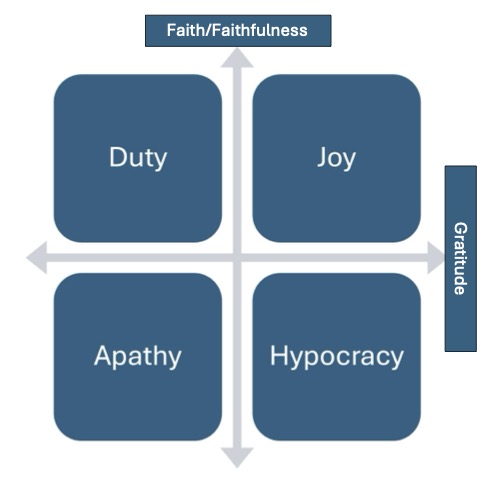
    I want to focus today on the interplay between faith/faithfulness and gratitude. It’s possible to have one of a sort without the other. Consider people who have great supposed faith but no gratitude. They would see the Christian life as mere duty. There is no fullness of heart in their service or worship. They do what they’re supposed to do because they’re supposed to do it.

    There are also those people, sadly, who have no sense of gratitude nor any true faith. Theirs is a life of meaningless apathy. They don’t really care about how God is leading them nor do they recognize him as the giver of every good gift. Some people live with lots of gratitude. But it’s not focused on God. It’s merely a desirable character attribute. It goes nowhere. But those who live lives of faithful gratitude are filled with true joy. Their worship is rich and authentic. Their service is free and gracious. They know their sins have been forgiven, rejoice in that grace of God, and seek to serve him with good and thankful hearts.

    We have people recognizing their need for greater faith, and then being challenged to recognize it’s not the size of the faith but the strength of faith’s object that matters. We have Jesus calling his followers to a life of humble service. And we have 9 out of 10 lepers who exhibit only faith and no gratitude.

    But the one! One of the lepers who called out to Jesus in faith also returns to him in gratitude. His is the fullest and purest joy. The other 9 may have joy in the moment of their healing. But this one will have an eternal joy having been dismissed by Jesus with the incredible blessing: “Rise and go your way; your faith has made you well.”

    The fullness of joy is found in a life of faithful gratitude. I’m thankful to God for his faithfulness, and grateful to him even as I pray, “Lord, increase my faith.”

    PS: Here’s my diagram of the interplay between faith and gratitude. What do you think?

  • The Rich Man and Lazarus: A Lesson on Compassion

    Click here for an audio version of this podcast

    I am using St. John’s Luke Lent Reading Plan for these devotions.

    Luke 16:19-31

    “There was a rich man who was clothed in purple and fine linen and who feasted sumptuously every day. 20 And at his gate was laid a poor man named Lazarus, covered with sores, 21 who desired to be fed with what fell from the rich man’s table. Moreover, even the dogs came and licked his sores. 22 The poor man died and was carried by the angels to Abraham’s side. The rich man also died and was buried, 23 and in Hades, being in torment, he lifted up his eyes and saw Abraham far off and Lazarus at his side. 24 And he called out, ‘Father Abraham, have mercy on me, and send Lazarus to dip the end of his finger in water and cool my tongue, for I am in anguish in this flame.’ 25 But Abraham said, ‘Child, remember that you in your lifetime received your good things, and Lazarus in like manner bad things; but now he is comforted here, and you are in anguish. 26 And besides all this, between us and you a great chasm has been fixed, in order that those who would pass from here to you may not be able, and none may cross from there to us.’ 27 And he said, ‘Then I beg you, father, to send him to my father’s house— 28 for I have five brothers—so that he may warn them, lest they also come into this place of torment.’ 29 But Abraham said, ‘They have Moses and the Prophets; let them hear them.’ 30 And he said, ‘No, father Abraham, but if someone goes to them from the dead, they will repent.’ 31 He said to him, ‘If they do not hear Moses and the Prophets, neither will they be convinced if someone should rise from the dead.’”

    Palo Duro Canyon | January 2025

    Where do you fit in this story? Are you the rich man who dines in full view of the poor and callously ignores them? Or are you a poor man sitting outside a rich man’s gate covered in sores and wishing for even a morsel of food from the rich man’s table? I’m guessing you might not be able to identify with either one. We would all wish to identify as one carried to Abraham’s side. That’s heaven. None of us wish to be taken to hades and suffer that agony.

    Jesus makes the comparison so extreme that there is no wiggle room for the rich man in his callous disregard of the poor man’s plight. This is not just a story of a priest passing by on the other side.  This is a man laying at the rich man’s gate. He had to see him every day. And there’s the problem.

    “Time in erodes awareness of,” I like to say to church leaders who are crafting a mission plan. We tend to ignore things we’ve seen again and again. So too, the poor. They are easily overlooked. But they ought not be.

    We were in China on our way to a restaurant for our evening meal. A man with no legs and dressed in rags was begging on the sidewalk. We had been told to be careful of beggars. Our missionary leader, however, took out some money and gave it to the man. I asked about that, and he said, “He looks to be in legitimate need.” I wish I had given him some money as well.

    There will come a time when we see how richly we have been blessed. And as Mother Teresa said, “Only in heaven will we see how much we owe to the poor for helping us to love God better because of them.”

    We may always have the poor among us. But that should not erode our awareness of them or blind us to the opportunities we have to serve them. After all that is what Jesus did to serve poor miserable sinners such as us. He didn’t overlook us. He served and saved us and calls us to do the same. Furthermore, Jesus has risen from the dead. Surely we will listen to him!

  • The Prodigal Son: A Journey from Madness to Gladness

    Click here for an audio version of this podcast

    I am using St. John’s Luke Lent Reading Plan for these devotions.

    Luke 15:1-2, 11-32

    Now the tax collectors and sinners were all drawing near to hear him. And the Pharisees and the scribes grumbled, saying, “This man receives sinners and eats with them.”

    11 And he said, “There was a man who had two sons. 12 And the younger of them said to his father, ‘Father, give me the share of property that is coming to me.’ And he divided his property between them.13 Not many days later, the younger son gathered all he had and took a journey into a far country, and there he squandered his property in reckless living.14 And when he had spent everything, a severe famine arose in that country, and he began to be in need. 15 So he went and hired himself out to one of the citizens of that country, who sent him into his fields to feed pigs. 16 And he was longing to be fed with the pods that the pigs ate, and no one gave him anything.

    17 “But when he came to himself, he said, ‘How many of my father’s hired servants have more than enough bread, but I perish here with hunger! 18 I will arise and go to my father, and I will say to him, “Father, I have sinned against heaven and before you. 19 I am no longer worthy to be called your son. Treat me as one of your hired servants.”’ 20 And he arose and came to his father. But while he was still a long way off, his father saw him and felt compassion, and ran and embraced him and kissed him.21 And the son said to him, ‘Father, I have sinned against heaven and before you. I am no longer worthy to be called your son.’ 22 But the father said to his servants, ‘Bring quickly the best robe, and put it on him, and put a ring on his hand, and shoes on his feet. 23 And bring the fattened calf and kill it, and let us eat and celebrate. 24 For this my son was dead, and is alive again; he was lost, and is found.’ And they began to celebrate.

    25 “Now his older son was in the field, and as he came and drew near to the house, he heard music and dancing. 26 And he called one of the servants and asked what these things meant.27 And he said to him, ‘Your brother has come, and your father has killed the fattened calf, because he has received him back safe and sound.’ 28 But he was angry and refused to go in. His father came out and entreated him,29 but he answered his father, ‘Look, these many years I have served you, and I never disobeyed your command, yet you never gave me a young goat, that I might celebrate with my friends. 30 But when this son of yours came, who has devoured your property with prostitutes, you killed the fattened calf for him!’ 31 And he said to him, ‘Son, you are always with me, and all that is mine is yours. 32 It was fitting to celebrate and be glad, for this your brother was dead, and is alive; he was lost, and is found.’”

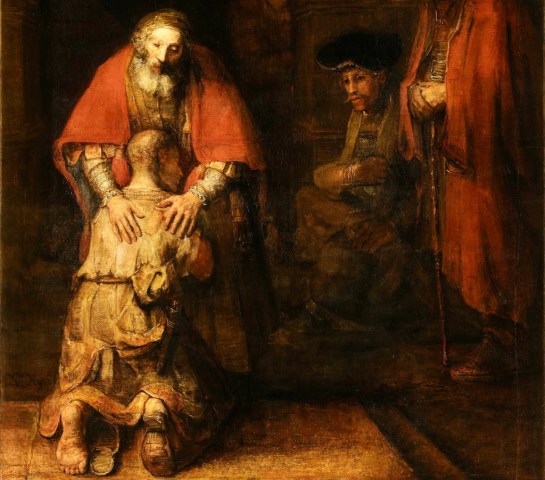
    The Return of the Prodigal by Rembrandt

    There is a classic outline used by traveling evangelistic revivalists. It’s simple and really does get at the flow of this parable:

    The Prodigal

    • His Madness
    • His Sadness
    • His Gladness

    A close look at this parable reveals that those three attributes apply to all three of the main characters in the parable. Each one in turn is mad, sad, and glad – although the older son is only invited into the gladness, and we don’t see if he joins in the revelry.

    I will be preaching at St. John today, so I don’t want to steal my own thunder, but I can give you a peek into what I will share this morning at 11 and this evening at 7.

    The younger son is mad (in the sense of insanity) because he is willing to tell his dad to drop dead, leave his home of plenty and trade that all in for a life of wanton debauchery. He is sad because the money runs out, the friends desert him, and there comes a famine. He is glad when he returns home and his father receives him with open arms and celebrates his return with a great big party.

    The father is likewise mad, giving away all that money to his irresponsible son. He’s sad because his son is gone, and because his older son won’t join the party when the younger son returns. He was glad when he did return.

    The older son was mad (in the sense of ire and bitterness) because his younger brother was being so well treated – something he thought he really deserved. His is sad because he had never been celebrated as his younger brother was now being. Will he be glad? Will he realize there is joy to be experienced and shared?

    This parable is one of a trio in the Lost and Found chapter. The lost and found sheep, one of 100. The lost and found coin, one of 10. The lost and found son, one of two. But there is a refrain at the end of the first two parables. This third one describes this truth: “There is joy before the angels of God over one sinner who repents.”

    Will we join the celebration? Will we return to God if we are far off? Will we come in if we’re standing aloof in bitterness and anger? Every gathering of God’s people is to be a foretaste of the joy to come, a celebration of God’s grace and joy in the fellowship of the redeemed. Don’t be mad or sad. Be glad and rejoice in God’s grace every day.

  • Don’t miss this party! (with minor corrections)

    Click here for an audio version of this podcast

    I am using St. John’s Luke Lent Reading Plan for these devotions.

    Luke 14:15-24

    15 When one of those who reclined at table with him heard these things, he said to him, “Blessed is everyone who will eat bread in the kingdom of God!” 16 But he said to him, “A man once gave a great banquet and invited many. 17 And at the time for the banquet he sent his servant to say to those who had been invited, ‘Come, for everything is now ready.’ 18 But they all alike began to make excuses. The first said to him, ‘I have bought a field, and I must go out and see it. Please have me excused.’ 19 And another said, ‘I have bought five yoke of oxen, and I go to examine them. Please have me excused.’ 20 And another said, ‘I have married a wife, and therefore I cannot come.’ 21 So the servant came and reported these things to his master. Then the master of the house became angry and said to his servant, ‘Go out quickly to the streets and lanes of the city, and bring in the poor and crippled and blind and lame.’ 22 And the servant said, ‘Sir, what you commanded has been done, and still there is room.’ 23 And the master said to the servant, ‘Go out to the highways and hedges and compel people to come in, that my house may be filled. 24 For I tell you, none of those men who were invited shall taste my banquet.’”

    Palo Duro Canyon Pano | January 2025

    When I was about 13 years old, I had a swimming party at our motel pool. On one hand, it was great—even a really cool kid showed up. But it wasn’t so great, because he crashed the party as though he belonged there—and I didn’t have the nerve to stop him. Even worse, after swimming, the kids found a radio or record player (did I provide that?) and started dancing.

    I didn’t join in.

    Again, a failure of nerve. It was my party, after all. But somehow, I didn’t feel like I belonged. Imagine that—not belonging at your own pool party!

    Jesus describes a different kind of party in Luke 14:15-24—a feast where people are invited but strangely don’t want to come. They offer excuse after excuse and beg off. Who ever heard of such a thing? The party of the year—and you don’t want to go? Even more shocking, the party of the ages, and you decline the invitation?

    Why would someone refuse? Maybe because they don’t like the host. If the party were thrown by your bitterest political opponent, would you go? If the host were a known criminal, you might steer clear. Or maybe you’d decline because you expect to be mocked, ignored, or out of place.

    But this feast—the one Jesus speaks of—is for those who have been made new. They love God and their neighbor. They rejoice when the outcast is redeemed. They celebrate as all God’s people gather around Jesus, giving him the honor and praise he deserves.

    In Jesus’ parable, the proud seat themselves in places of honor—only to be humbled. The humble, meanwhile, are invited to move up higher. The host makes all the difference. Those who love Jesus will certainly want to attend his feast.

    This is the feast of victory for our God! Hallelujah! (Apologies to those refraining from “Hallelujah” in Lent.) The Lamb who was slain has begun his reign. Hallelujah!

    So let’s join the celebration. Let’s take our place at the table—not because we deserve it, but because we have been invited.

  • Don’t miss this party!

    Click here for an audio version of this podcast

    I am using St. John’s Luke Lent Reading Plan for these devotions.

    Luke 14 (focusing on v. 15-24)

    One Sabbath, when he went to dine at the house of a ruler of the Pharisees, they were watching him carefully. And behold, there was a man before him who had dropsy. And Jesus responded to the lawyers and Pharisees, saying, “Is it lawful to heal on the Sabbath, or not?” But they remained silent. Then he took him and healed him and sent him away. And he said to them, “Which of you, having a son or an ox that has fallen into a well on a Sabbath day, will not immediately pull him out?” And they could not reply to these things.

    Now he told a parable to those who were invited, when he noticed how they chose the places of honor, saying to them, “When you are invited by someone to a wedding feast, do not sit down in a place of honor, lest someone more distinguished than you be invited by him, and he who invited you both will come and say to you, ‘Give your place to this person,’ and then you will begin with shame to take the lowest place. 10 But when you are invited, go and sit in the lowest place, so that when your host comes he may say to you, ‘Friend, move up higher.’ Then you will be honored in the presence of all who sit at table with you. 11 For everyone who exalts himself will be humbled, and he who humbles himself will be exalted.”

    12 He said also to the man who had invited him, “When you give a dinner or a banquet, do not invite your friends or your brothers or your relatives or rich neighbors, lest they also invite you in return and you be repaid. 13 But when you give a feast, invite the poor, the crippled, the lame, the blind, 14 and you will be blessed, because they cannot repay you. For you will be repaid at the resurrection of the just.”

    15 When one of those who reclined at table with him heard these things, he said to him, “Blessed is everyone who will eat bread in the kingdom of God!” 16 But he said to him, “A man once gave a great banquet and invited many. 17 And at the time for the banquet he sent his servant to say to those who had been invited, ‘Come, for everything is now ready.’ 18 But they all alike began to make excuses. The first said to him, ‘I have bought a field, and I must go out and see it. Please have me excused.’ 19 And another said, ‘I have bought five yoke of oxen, and I go to examine them. Please have me excused.’ 20 And another said, ‘I have married a wife, and therefore I cannot come.’ 21 So the servant came and reported these things to his master. Then the master of the house became angry and said to his servant, ‘Go out quickly to the streets and lanes of the city, and bring in the poor and crippled and blind and lame.’ 22 And the servant said, ‘Sir, what you commanded has been done, and still there is room.’ 23 And the master said to the servant, ‘Go out to the highways and hedges and compel people to come in, that my house may be filled. 24 For I tell you, none of those men who were invited shall taste my banquet.’”

    25 Now great crowds accompanied him, and he turned and said to them, 26 “If anyone comes to me and does not hate his own father and mother and wife and children and brothers and sisters, yes, and even his own life, he cannot be my disciple. 27 Whoever does not bear his own cross and come after me cannot be my disciple. 28 For which of you, desiring to build a tower, does not first sit down and count the cost, whether he has enough to complete it? 29 Otherwise, when he has laid a foundation and is not able to finish, all who see it begin to mock him, 30 saying, ‘This man began to build and was not able to finish.’ 31 Or what king, going out to encounter another king in war, will not sit down first and deliberate whether he is able with ten thousand to meet him who comes against him with twenty thousand? 32 And if not, while the other is yet a great way off, he sends a delegation and asks for terms of peace. 33 So therefore, any one of you who does not renounce all that he has cannot be my disciple.

    34 “Salt is good, but if salt has lost its taste, how shall its saltiness be restored? 35 It is of no use either for the soil or for the manure pile. It is thrown away. He who has ears to hear, let him hear.”

    Palo Duro Canyon Pano | January 2025

    When I was about 13 years old, I had a swimming party at our motel pool. On one hand, it was great—even a really cool kid showed up. But it wasn’t so great, because he crashed the party as though he belonged there—and I didn’t have the nerve to stop him. Even worse, after swimming, the kids found a radio or record player (did I provide that?) and started dancing.

    I didn’t join in.

    Again, a failure of nerve. It was my party, after all. But somehow, I didn’t feel like I belonged. Imagine that—not belonging at your own pool party!

    Jesus describes a different kind of party in Luke 14:15-24—a feast where people are invited but strangely don’t want to come. They offer excuse after excuse and beg off. Who ever heard of such a thing? The party of the year—and you don’t want to go? Even more shocking, the party of the ages, and you decline the invitation?

    Why would someone refuse? Maybe because they don’t like the host. If the party were thrown by your bitterest political opponent, would you go? If the host were a known criminal, you might steer clear. Or maybe you’d decline because you expect to be mocked, ignored, or out of place.

    But this feast—the one Jesus speaks of—is for those who have been made new. They love God and their neighbor. They rejoice when the outcast is redeemed. They celebrate as all God’s people gather around Jesus, giving him the honor and praise he deserves.

    In Jesus’ parable, the proud seat themselves in places of honor—only to be humbled. The humble, meanwhile, are invited to move up higher. The host makes all the difference. Those who love Jesus will certainly want to attend his feast.

    This is the feast of victory for our God! Hallelujah! (Apologies to those refraining from “Hallelujah” in Lent.) The Lamb who was slain has begun his reign. Hallelujah!

    So let’s join the celebration. Let’s take our place at the table—not because we deserve it, but because we have been invited.

  • Healing on the Sabbath: Understanding Jesus’ Bold Act

    Click here for an audio version of this podcast

    I am using St. John’s Luke Lent Reading Plan for these devotions.

    Luke 13

    There were some present at that very time who told him about the Galileans whose blood Pilate had mingled with their sacrifices. And he answered them, “Do you think that these Galileans were worse sinners than all the other Galileans, because they suffered in this way? No, I tell you; but unless you repent, you will all likewise perish. Or those eighteen on whom the tower in Siloam fell and killed them: do you think that they were worse offenders than all the others who lived in Jerusalem? No, I tell you; but unless you repent, you will all likewise perish.”

    And he told this parable: “A man had a fig tree planted in his vineyard, and he came seeking fruit on it and found none. And he said to the vinedresser, ‘Look, for three years now I have come seeking fruit on this fig tree, and I find none. Cut it down. Why should it use up the ground?’ And he answered him, ‘Sir, let it alone this year also, until I dig around it and put on manure. Then if it should bear fruit next year, well and good; but if not, you can cut it down.’”

    10 Now he was teaching in one of the synagogues on the Sabbath. 11 And behold, there was a woman who had had a disabling spirit for eighteen years. She was bent over and could not fully straighten herself. 12 When Jesus saw her, he called her over and said to her, “Woman, you are freed from your disability.” 13 And he laid his hands on her, and immediately she was made straight, and she glorified God. 14 But the ruler of the synagogue, indignant because Jesus had healed on the Sabbath, said to the people, “There are six days in which work ought to be done. Come on those days and be healed, and not on the Sabbath day.” 15 Then the Lord answered him, “You hypocrites! Does not each of you on the Sabbath untie his ox or his donkey from the manger and lead it away to water it? 16 And ought not this woman, a daughter of Abraham whom Satan bound for eighteen years, be loosed from this bond on the Sabbath day?” 17 As he said these things, all his adversaries were put to shame, and all the people rejoiced at all the glorious things that were done by him.

    18 He said therefore, “What is the kingdom of God like? And to what shall I compare it? 19 It is like a grain of mustard seed that a man took and sowed in his garden, and it grew and became a tree, and the birds of the air made nests in its branches.”

    20 And again he said, “To what shall I compare the kingdom of God? 21 It is like leaven that a woman took and hid in three measures of flour, until it was all leavened.”

    22 He went on his way through towns and villages, teaching and journeying toward Jerusalem. 23 And someone said to him, “Lord, will those who are saved be few?” And he said to them, 24 “Strive to enter through the narrow door. For many, I tell you, will seek to enter and will not be able. 25 When once the master of the house has risen and shut the door, and you begin to stand outside and to knock at the door, saying, ‘Lord, open to us,’ then he will answer you, ‘I do not know where you come from.’ 26 Then you will begin to say, ‘We ate and drank in your presence, and you taught in our streets.’ 27 But he will say, ‘I tell you, I do not know where you come from. Depart from me, all you workers of evil!’ 28 In that place there will be weeping and gnashing of teeth, when you see Abraham and Isaac and Jacob and all the prophets in the kingdom of God but you yourselves cast out. 29 And people will come from east and west, and from north and south, and recline at table in the kingdom of God. 30 And behold, some are last who will be first, and some are first who will be last.”

    31 At that very hour some Pharisees came and said to him, “Get away from here, for Herod wants to kill you.” 32 And he said to them, “Go and tell that fox, ‘Behold, I cast out demons and perform cures today and tomorrow, and the third day I finish my course. 33 Nevertheless, I must go on my way today and tomorrow and the day following, for it cannot be that a prophet should perish away from Jerusalem.’ 34 O Jerusalem, Jerusalem, the city that kills the prophets and stones those who are sent to it! How often would I have gathered your children together as a hen gathers her brood under her wings, and you were not willing! 35 Behold, your house is forsaken. And I tell you, you will not see me until you say, ‘Blessed is he who comes in the name of the Lord!’”

    Palo Duro Canyon | January 2025

    Maybe you’ve seen a bent over woman or man. He must twist his head to the side to speak with you. She has to contort her neck to see where she’s going. Such a life is sad and difficult. How could it be, therefore, that when Jesus had pity on this woman and healed her, he was criticized by the synagogue ruler?

    There are some possible answers – all of which are speculative. Maybe she had been a pest every Saturday. Constantly asking for alms. Continuously interrupting the synagogue meeting demanding help. Could be that there had been complaints about her behavior. Perhaps they realized that they had never done anything to help her and they felt guilty when Jesus did help her. I wondered whether the synagogue ruler was afraid of losing control of his synagogue. I wonder if he was genuinely afraid that that loss of control would disqualify him as a leader or actually offend God.

    Many possibilities, but one root cause: sin. Sin blinds us to others’ needs. It holds us captive to fear of Satan, the judgement of others, and our security before God. Recall Isaiah’s response to the vision of the LORD in his temple (Isaiah 6). “Woe to me, for I am a man of unclean lips!” Remember Peter’s response to Jesus after the miraculous catch of fish, “Depart from me, for I am a sinful man” (Luke 5:8). Sin turns us in on ourselves and closes our hearts to others’ needs. It protects our self our assets, our reputation.

    Jesus was not encumbered with sin in his nature. He was totally without sin, so when he saw this woman he saw her need and realized he could do something about it. He harbored no guilt about past failures. He had no ulterior motives. He was committed only to pleasing God and loving others.

    So he healed her. On the Sabbath. In front of the whole synagogue. And he took away her infirmity. And he took on their ire. He calls them to account in the process, saying, “And ought not this woman, a daughter of Abraham whom Satan bound for eighteen years, be loosed from this bond on the Sabbath day?”

    There are two reactions to Jesus’ healing touch. Luke tells us, “As he said these things, all his adversaries were put to shame, and all the people rejoiced at all the glorious things that were done by him.” 

    Lord, grant me courage to do the right thing. In love. For my neighbor’s benefit. For your glory! Amen

  • Please pray these Psalms with me today, on this Lord’s Day

    Psalm 30

    I will extol you, O LORD, for you have drawn me up
        and have not let my foes rejoice over me.
    O LORD my God, I cried to you for help,
        and you have healed me.
    O LORD, you have brought up my soul from Sheol;
        you restored me to life from among those who go down to the pit.

    Sing praises to the LORD, O you his saints,
        and give thanks to his holy name.
    For his anger is but for a moment,
        and his favor is for a lifetime.
    Weeping may tarry for the night,
        but joy comes with the morning.

    As for me, I said in my prosperity,
        “I shall never be moved.”
    By your favor, O LORD,
        you made my mountain stand strong;
    you hid your face;
        I was dismayed.

    To you, O LORD, I cry,
        and to the LORD I plead for mercy:
    “What profit is there in my death,
        if I go down to the pit?
    Will the dust praise you?
        Will it tell of your faithfulness?
    10 Hear, O LORD, and be merciful to me!
        O LORD, be my helper!”

    11 You have turned for me my mourning into dancing;
        you have loosed my sackcloth
        and clothed me with gladness,
    12 that my glory may sing your praise and not be silent.
        O LORD my God, I will give thanks to you forever!

    Psalm 60

    O God, you have rejected us, broken our defenses;
        you have been angry; oh, restore us.
    You have made the land to quake; you have torn it open;
        repair its breaches, for it totters.
    You have made your people see hard things;
        you have given us wine to drink that made us stagger.

    You have set up a banner for those who fear you,
        that they may flee to it from the bow. Selah
    That your beloved ones may be delivered,
        give salvation by your right hand and answer us!

    God has spoken in his holiness:
        “With exultation I will divide up Shechem
        and portion out the Vale of Succoth.
    Gilead is mine; Manasseh is mine;
        Ephraim is my helmet;
        Judah is my scepter.
    Moab is my washbasin;
        upon Edom I cast my shoe;
        over Philistia I shout in triumph.”

    Who will bring me to the fortified city?
        Who will lead me to Edom?
    10 Have you not rejected us, O God?
        You do not go forth, O God, with our armies.
    11 Oh, grant us help against the foe,
        for vain is the salvation of man!
    12 With God we shall do valiantly;
        it is he who will tread down our foes.

    Psalm 90

    LORD, you have been our dwelling place
        in all generations.
    Before the mountains were brought forth,
        or ever you had formed the earth and the world,
        from everlasting to everlasting you are God.

    You return man to dust
        and say, “Return, O children of man!”
    For a thousand years in your sight
        are but as yesterday when it is past,
        or as a watch in the night.

    You sweep them away as with a flood; they are like a dream,
        like grass that is renewed in the morning:
    in the morning it flourishes and is renewed;
        in the evening it fades and withers.

    For we are brought to an end by your anger;
        by your wrath we are dismayed.
    You have set our iniquities before you,
        our secret sins in the light of your presence.

    For all our days pass away under your wrath;
        we bring our years to an end like a sigh.
    10 The years of our life are seventy,
        or even by reason of strength eighty;
    yet their span is but toil and trouble;
        they are soon gone, and we fly away.
    11 Who considers the power of your anger,
        and your wrath according to the fear of you?

    12 So teach us to number our days
        that we may get a heart of wisdom.
    13 Return, O LORD! How long?
        Have pity on your servants!
    14 Satisfy us in the morning with your steadfast love,
        that we may rejoice and be glad all our days.
    15 Make us glad for as many days as you have afflicted us,
        and for as many years as we have seen evil.
    16 Let your work be shown to your servants,
        and your glorious power to their children.
    17 Let the favor of the LORD our God be upon us,
        and establish the work of our hands upon us;
        yes, establish the work of our hands!

    Psalm 120

    In my distress I called to the LORD,
        and he answered me.
    Deliver me, O LORD,
        from lying lips,
        from a deceitful tongue.

    What shall be given to you,
        and what more shall be done to you,
        you deceitful tongue?
    A warrior’s sharp arrows,
        with glowing coals of the broom tree!

    Woe to me, that I sojourn in Meshech,
        that I dwell among the tents of Kedar!
    Too long have I had my dwelling
        among those who hate peace.
    I am for peace,
        but when I speak, they are for war!

    Psalm 150

    Praise the LORD!
    Praise God in his sanctuary;
        praise him in his mighty heavens!
    Praise him for his mighty deeds;
        praise him according to his excellent greatness!

    Praise him with trumpet sound;
        praise him with lute and harp!
    Praise him with tambourine and dance;
        praise him with strings and pipe!
    Praise him with sounding cymbals;
        praise him with loud clashing cymbals!
    Let everything that has breath praise the LORD!
    Praise the LORD!

    The Holy Bible, English Standard Version.
    ESV® Text Edition: 2016. Copyright © 2001 by
    Crossway Bibles, a publishing ministry of Good News Publishers.

  • The Journey to Jerusalem: Jesus’ Mission in Luke

    Click here for an audio version of this podcast

    I am using St. John’s Luke Lent Reading Plan for these devotions.

    Luke 11:14-54

    Now he was casting out a demon that was mute. When the demon had gone out, the mute man spoke, and the people marveled. 15 But some of them said, “He casts out demons by Beelzebul, the prince of demons,” 16 while others, to test him, kept seeking from him a sign from heaven. 17 But he, knowing their thoughts, said to them, “Every kingdom divided against itself is laid waste, and a divided household falls. 18 And if Satan also is divided against himself, how will his kingdom stand? For you say that I cast out demons by Beelzebul. 19 And if I cast out demons by Beelzebul, by whom do your sons cast them out? Therefore they will be your judges. 20 But if it is by the finger of God that I cast out demons, then the kingdom of God has come upon you. 21 When a strong man, fully armed, guards his own palace, his goods are safe; 22 but when one stronger than he attacks him and overcomes him, he takes away his armor in which he trusted and divides his spoil. 23 Whoever is not with me is against me, and whoever does not gather with me scatters.

    24 “When the unclean spirit has gone out of a person, it passes through waterless places seeking rest, and finding none it says, ‘I will return to my house from which I came.’ 25 And when it comes, it finds the house swept and put in order. 26 Then it goes and brings seven other spirits more evil than itself, and they enter and dwell there. And the last state of that person is worse than the first.”

    27 As he said these things, a woman in the crowd raised her voice and said to him, “Blessed is the womb that bore you, and the breasts at which you nursed!”28 But he said, “Blessed rather are those who hear the word of God and keep it!”

    29 When the crowds were increasing, he began to say, “This generation is an evil generation. It seeks for a sign, but no sign will be given to it except the sign of Jonah. 30 For as Jonah became a sign to the people of Nineveh, so will the Son of Man be to this generation. 31 The queen of the South will rise up at the judgment with the men of this generation and condemn them, for she came from the ends of the earth to hear the wisdom of Solomon, and behold, something greater than Solomon is here. 32 The men of Nineveh will rise up at the judgment with this generation and condemn it, for they repented at the preaching of Jonah, and behold, something greater than Jonah is here.

    33 “No one after lighting a lamp puts it in a cellar or under a basket, but on a stand, so that those who enter may see the light. 34 Your eye is the lamp of your body. When your eye is healthy, your whole body is full of light, but when it is bad, your body is full of darkness. 35 Therefore be careful lest the light in you be darkness. 36 If then your whole body is full of light, having no part dark, it will be wholly bright, as when a lamp with its rays gives you light.”

    37 While Jesuswas speaking, a Pharisee asked him to dine with him, so he went in and reclined at table. 38 The Pharisee was astonished to see that he did not first wash before dinner. 39 And the Lord said to him, “Now you Pharisees cleanse the outside of the cup and of the dish, but inside you are full of greed and wickedness. 40 You fools! Did not he who made the outside make the inside also? 41 But give as alms those things that are within, and behold, everything is clean for you.

    42 “But woe to you Pharisees! For you tithe mint and rue and every herb, and neglect justice and the love of God. These you ought to have done, without neglecting the others. 43 Woe to you Pharisees! For you love the best seat in the synagogues and greetings in the marketplaces. 44 Woe to you! For you are like unmarked graves, and people walk over them without knowing it.”

    45 One of the lawyers answered him, “Teacher, in saying these things you insult us also.” 46 And he said, “Woe to you lawyers also! For you load people with burdens hard to bear, and you yourselves do not touch the burdens with one of your fingers. 47 Woe to you! For you build the tombs of the prophets whom your fathers killed. 48 So you are witnesses and you consent to the deeds of your fathers, for they killed them, and you build their tombs. 49 Therefore also the Wisdom of God said, ‘I will send them prophets and apostles, some of whom they will kill and persecute,’ 50 so that the blood of all the prophets, shed from the foundation of the world, may be charged against this generation, 51 from the blood of Abel to the blood of Zechariah, who perished between the altar and the sanctuary. Yes, I tell you, it will be required of this generation. 52 Woe to you lawyers! For you have taken away the key of knowledge. You did not enter yourselves, and you hindered those who were entering.”

    53 As he went away from there, the scribes and the Pharisees began to press him hard and to provoke him to speak about many things, 54 lying in wait for him, to catch him in something he might say.

    Palo Duro Canyon | January 2025

    Thankfully not every encounter of Jesus with people is like the ones in these verses. The lawyers, the people seeking a sign, the woman who praised him, the crowds, the scribes and the Pharisees don’t fare that well in these encounters. Even the woman who expresses praise, “Blessed is the womb that bore you…” is seemingly rebuffed. Jesus’ response: “Blessed rather are those who hear the word of God and keep it!” Is Jesus just in a bad mood?

    Jesus has set his fact toward Jerusalem (Luke 9:51). Luke’s account in these middle chapters is called the Travel Narratives, or Journey to Jerusalem. Things are heating up between Jesus and his detractors. Especially the Pharisees and scribes are ratcheting up their criticisms, opposition, and scheming. They are growing increasingly critical of Jesus’ teaching, and Jesus knows it.

    It might look as though Jesus, for his part, is picking a fight with them, poking them in the eye, and intentionally aggravating them. But something else is at play here. Jesus is heading toward Jerusalem in order to sacrifice himself for the sins of the world. That includes those of the Pharisees. I believe Jesus was provoking them in order that they would see their false ideas for what they were. He is not just being mean. He is uncovering their duplicity.

    Not only that, Jesus is aware that this is a critical time, and the danger of getting derailed is imminent. The pressure is building from the criticisms of the Jewish leaders and the impatient crowds and the confused disciples. These are not peaceful times in his ministry. Jesus must stay the course if he is to usher in the reign and rule of God.

    For the reign and rule of God to be fully grasped it is essential that our sins be forgiven and the pathway to God cleared. Jesus will have to die. And be raised. And give the Great Commission. And ascend to the right hand of God. He reigns there now. But he also reigns in the hearts of all believers. By grace. Through faith. He must let nothing deter him. And thankfully he didn’t.

  • Solitude and Prayer

    Click here for an audio version of this podcast

    I am using St. John’s Luke Lent Reading Plan for these devotions.

    Luke 10:38-11:13

    Now as they went on their way, Jesus entered a village. And a woman named Martha welcomed him into her house. 39 And she had a sister called Mary, who sat at the Lord’s feet and listened to his teaching. 40 But Martha was distracted with much serving. And she went up to him and said, “Lord, do you not care that my sister has left me to serve alone? Tell her then to help me.” 41 But the Lord answered her, “Martha, Martha, you are anxious and troubled about many things, 42 but one thing is necessary. Mary has chosen the good portion, which will not be taken away from her.”

    11 Now Jesus was praying in a certain place, and when he finished, one of his disciples said to him, “Lord, teach us to pray, as John taught his disciples.” And he said to them, “When you pray, say:

    “Father, hallowed be your name.
    Your kingdom come.
    Give us each day our daily bread,
    and forgive us our sins,
        for we ourselves forgive everyone who is indebted to us.
    And lead us not into temptation.”

    And he said to them, “Which of you who has a friend will go to him at midnight and say to him, ‘Friend, lend me three loaves, for a friend of mine has arrived on a journey, and I have nothing to set before him’; and he will answer from within, ‘Do not bother me; the door is now shut, and my children are with me in bed. I cannot get up and give you anything’? I tell you, though he will not get up and give him anything because he is his friend, yet because of his impudence he will rise and give him whatever he needs. And I tell you, ask, and it will be given to you; seek, and you will find; knock, and it will be opened to you. 10 For everyone who asks receives, and the one who seeks finds, and to the one who knocks it will be opened. 11 What father among you, if his son asks for a fish, will instead of a fish give him a serpent; 12 or if he asks for an egg, will give him a scorpion? 13 If you then, who are evil, know how to give good gifts to your children, how much more will the heavenly Father give the Holy Spirit to those who ask him!”

    Palo Duro Canyon | January 2025

    I used to think I was a pretty good pray-er. I had leaned into the praise hymns of Revelation, had taught the P.R.A.Y. (Praise, Repent, Ask, Yield) prayer outline. I regularly exercised my prayer muscles by praying with church staff and members. I regularly led our elders to spend the first 20 minutes in prayer at our monthly meetings. Although I haven’t completely failed at praying the same way I used to, I do feel as though I’m a bit off my game.

    Thankfully I do have some help. Occasionally I will read John Baillie’s A Diary of Private Prayer. It is a treasure trove of morning and evening prayers for each day of the month. I also subscribe to the Moravian Daily Text email. It has two Bible verses and a brief prayer. Well and good. But still feel like a musician who hasn’t practiced as much—still able to play, but not with the same confidence or ease. My prayers feel a bit scattered, sometimes routine, sometimes reaching, but not always as deeply connected as before.

    So I’m with the apostles when they ask Jesus to teach them to pray. Jesus offers us a beautiful pattern in The Lord’s Prayer. It’s found here and in Matthew’s gospel. Luke has,

    “Father, hallowed be your name.
    Your kingdom come.
    Give us each day our daily bread,
    and forgive us our sins,
        for we ourselves forgive everyone who is indebted to us.
    And lead us not into temptation.”

    Simple words with profound meaning. I use it nightly, sometimes even falling asleep while I’m praying. (What better way to fall asleep, right?) Perhaps I need a bit of Mary’s better choice of sitting at the feet of Jesus, not worrying about how I’m going to pray, but listening to his voice.

    In the end I take comfort in knowing that prayer is not about my eloquence or performance, but about God’s presence and embrace. He hears, even when my words feel weak, and He welcomes me, even when I struggle to find the right ones. It’s not about my ability to pray well, but about his gracious invitation to be with him, and his promise to hear when I call.

    Father…