David Bahn – Reflections

Light from the Word and through the lens

  • Jonah 2:6

    You brought up my life from the pit, O Lord my God.

    1 John 3:8

    The Son of God was revealed for this purpose, to destroy the works of the devil.

    20120123-0001-72

    When we visited Israel three years ago, one very powerful experience for me took place in a pit. We were in the basement of Caiaphas’ palace in Jerusalem. We had already seen places of great significance: the Mount of Olives with the ancient olive trees, where Jesus prayed on the night he was betrayed. We saw the birthplace of Jesus – now surrounded by churchly ornamentation, and places of veneration. We saw the place of Jesus’ crucifixion and tomb both inside the Church of the Holy Sepulchre. But somehow the experience of being in that pit stays with me.

    The reason has to do with what happened there. We were led down three levels into a deep pit where I was asked to read Psalm 88 for the group. The psalm expresses much of the angt Jesus experienced at his betrayal and arrest. It was likely that Jesus was in a pit such as the one we were in. When I got to the last phrase of the Psalm, “my companions have become darkness,” the lights were turned out. We were in the pitch darkness of the pit. 

    We were able to climb the narrow steps up out of the pit once the lights were turned back on. But to be brought up out of the pit was still a welcome experience. Jesus not only endured the pit, the darkness, the abandonment, torture, shame, scourging, death of the cross, and rest in the tomb, but through that destroyed the works of the devil. He has been glorified, raised up from the pit, he reigns from on high.

    Whatever pits we may have to endure, we can be confident that our ultimate end is not the pit, but the glory of heaven, and the life of the world to come. In the mean time, we look for glimpses of that glory and foretastes of that perfect deliverance, and thank God when we experience God’s favor and rescue today.


  • Deuteronomy 6:6–7

    Keep these words that I am commanding you today in your heart. Recite them to your children and talk about them.

    James 1:22

    Be doers of the word, and not merely hearers who deceive themselves.

    20140722-4618-2

    One of the most helpful clarifications having to do with obeying God’s commandments has to do with the issue of identity. If we are sons and daughters of God then we live that out in obedience to him. We may never do that perfectly, but when we depart from his commands and ways we are not living out our true identity. Our failures don’t define our identity as God’s people; they simply testify that God has adopted broken people into his family.

    On the other hand, however, we do not obey our way into becoming God’s sons and daughters. That’s the error of the Pharisees and all self-righteous people. To think that we can ingratiate ourselves to God and make ourselves appealing to him by our obedience is not only folly; it is an insult to God’s grace and Jesus’ death.

    We become God’s children – brothers and sisters in Christ – by means of Jesus’ sacrifice and redemption. We become children of God because God moved toward us; not because we moved toward him or impressed him with our godliness. Otherwise, why did Jesus have to die if we can gain God’s favor by our acts of obedience?

    Make no mistake about it, however: We need not prove God to be gracious by adding to our sins (cf, Romans 6:1-4). Nor ought we to pander to God’s grace by making too little of God’s call to obey. That would be to deny our identity and deceive ourselves. As God’s sons and daughters we do well to honor his name by hearing and obeying his word, thanking God all the while for his grace, redemption, and adoption through faith in Jesus Christ our Lord.

  • Isaiah 58:11

    The Lord will guide you continually, and satisfy your needs in parched places. 

    Philippians 4:19

    My God will fully satisfy every need of yours according to his riches in glory in Christ Jesus. 

    20130530-9407
    Diane and I recently met some new neighbors. Since we’ve moved to a new house in a brand new neighborhood, we have been anxious to meet the neighbors. We’ve met Charlie and Peggy, just across the street. We met SB and his daughters Mary and Linda, as well as a few others nearby. The other night we had a long conversation around our firepit with Richard and Elizabeth. Each of these people have unique personalities. Each of these people appear also to be fairly well rooted in their personalities and values. 

    We know some are members of Lakewood United Methodist Church. Others are reportedly Baptists. One has a cross displayed in the window. But when you combine mature age with affluence you have the makings of self-sufficient stability. That’s good for social order and society as a whole. The danger, however, is that we lose sight of our need for God in such situations. The belief that God will supply all our needs is not as precious. God becomes a mascot; we are proud of him, but we don’t look to him for anything of substance.

    Just last night, however, there was a murder not far from here. It wasn’t in our subdivision, but it was in the development of which we are a part. I believe this might be a wake-up call for people to look more closely and intentionally to God for needs like security, peace of heart, courage, and wisdom. 

    We actually are in a parched land – though we disguise that by our nice homes, gated communities, and enviable lifestyle. We need God and his provision more than we know. I’m not worried about trying to change the Baptists and Methodists to Lutherans. I’m thankful for the cross in the window of my neighbor. I do, however, hope somehow to help people remember that God has what we need. That’s true whether we’re in parched places or in gated communities. Maybe I need to start that with my own intentional awareness of God and his rich supply of love, grace, salvation, and peace through Jesus Christ my Lord. How about you?

  • Jeremiah 29:13–14

    If you seek me with all your heart, I will let you find me, says the Lord.

    Matthew 18:19

    If two of you agree on earth about anything you ask, it will be done for you by my Father in heaven.

    2016-03-a-Cal

    These words of Jeremiah are possibly not as well known as the preceeding words: “For I know the plans I have for you, declares the Lord, plans for welfare and not for evil, to give you a future and a hope” (Jeremiah 29:11). Missing, also, but less known, is verse 12: “Then you will call upon me and come and pray to me, and I will hear you.” But these words and promises of God make the promises of verses 13 & 14 all the more appealing. God has good plans for his people. He promises to hear us when we call. Certainly he is worthy of being sought, and a delight to find.

    Then we read how Jesus promises that when we ally ourselves in prayer, God will answer. This is a more challenging thought to me – if for no other reason than our propensity toward self-serving prayers. If I get a good friend to agree with my prayer to win the lottery, with the promise to split the winnings, does that count?

    Of course the whole counsel of God would direct us toward a different path. Rather than using human alliances for selfish pursuits, our thoughts and cares are to be for the good of others. We are called on to think of others as more important than ourselves. We are supposed to deny ourselves, take up our crosses and follow Jesus, not the inclinations of our sinful desires.

    That’s where the presence of God comes in, not only as a blessing for which we would do well to desire, but as a corrective for self-serving prayers. May God deliver us all from such dangerous desires that seek only for our happiness and benefit, and fail to see how God’s goodness extends to all people and that our prayers ought always begin in the spirit of Jesus’ teaching:

    “Our Father in heaven,
    hallowed be your name.
    Your kingdom come,
    your will be done,
        on earth as it is in heaven.
    Give us this day our daily bread,
    and forgive us our debts,
        as we also have forgiven our debtors.
    And lead us not into temptation,
        but deliver us from evil.

    Amen.

  • Revelation 7:9-10

    After this I looked, and behold, a great multitude that no one could number, from every nation, from all tribes and peoples and languages, standing before the throne and before the Lamb, clothed in white robes, with palm branches in their hands, and crying out with a loud voice, “Salvation belongs to our God who sits on the throne, and to the Lamb!”

    20151030-9464-3

    Many years ago I sat with my good friend Jerry Snell in his grandfather’s living room as two Jehovah’s Witnesses tried to convert him to their religion. They lean heavily on the book of Revelation as well as a false belief about God’s holy name. Sadly I didn’t think to ask them about Philippians 2:9-11).The idea that there would be only 144,000 in heaven was the issue we took up. We did, therefore, point them to the verses above.

    What a scene this is! A myriad of peoples: languages, tribes, peoples, nations all gathered before the throne of the Lamb of God, the crucified and now risen and reigning Son of God: Jesus whose name is above every name. Jesus the one at whose name every knee will bow – in heaven and on earth. Oh that glory of that day! What a splendid hope is ours in Jesus!

    November 1 is All Saints Day. We celebrate the reality that there is gathered around the throne of Jesus, the Lamb, singing his praise. When we gather for worship today – whether in the most grand cathedral, giant worship space, or small group of believers – when we hear God’s word and receive his gifts through faith, and raise our songs in praise to him, we join angels, archangels, and all the company of heaven in praise and honor of our God, Father, Son, and Holy Spirit.

    May it be so for you today.

  • 1 Kings 8:57

    The Lord our God may not leave us or abandon us.

    Acts 17:27

    Indeed God is not far from each one of us.

    20150611-8988-Impasto

    This morning’s World and Everything in It podcast offered the thought that a strong truth held weakly is better than a weak truth held strongly. Weak truths tenaciously held to will easily prevent us from grasping a stronger and more salutary reality. A strong truth, on the other hand, will endure our doubts and sustain itself in the end.

    That is different from Bob Sutton’s Strong Opinions Weakly Held approach to business, industry, and science. Such an approach is certainly a valid one in those realms. For even science operates on opinions about theories, and the application of laws and observations. Those convictions are ever changing

    Biblically-founded convictions, however, are another matter. Such convictions are essential to strong faith and the advancement of the Mission of God. People of deep biblical convictions move the Kingdom of God into the consciousness of people. The light dawns about God and his true glory and ultimate reign. In that light the Good News of Jesus is sweeter still.

    Now to the weakly-held truth that is witnessed to in the passages above: God is near to us. He will not leave or abandon us. It seems to me that we hold that truth too weakly. That’s better than holding a weak truth to strongly. For example to hold strongly to the idea that God’s goodness means our lives will always be pleasant (a weak truth) is dangerous. Holding to that will set us up only for disappointment and maybe even abandonment of faith. In the face of that to hold more strongly to the reality of God’s promised presence will sustain us.

    We surely ought to examine our weakly-held beliefs, and claim more fully those which align with God’s word. They will sustain us far more fully and productively than weak truths held stubbornly.

  • Jeremiah 9:23–24

    Thus says the Lord: Do not let the wise boast in their wisdom, do not let the mighty boast in their might, do not let the wealthy boast in their wealth; but let those who boast boast in this, that they understand and know me.

    Romans 1:16

    Paul wrote: I am not ashamed of the gospel; it is the power of God for salvation to everyone who has faith.

    20140422-3366-3

    These are dark days for fans of Texas football. At least four major teams are having seasons of shame: Texas A&M, University of Texas, Dallas Cowboys, and Houston Texans can’t seem to get a win or catch a break on the injury front. Then comes the bickering and blame-gaming: The GM and coach don’t get along. The scouts didn’t do a very good job. The coach can’t keep his players in line. It’s sad. TCU, U of H, Texas Tech, or Baylor may provide some bright spots. But fans of those other teams have no bragging rights.

    When it comes to God and Gospel, however, we are urged to boast. Have you ever thought of boasting in God? Have you ever even considered wearing your tee-shirt or ball cap emblazoned with cross, fish, or Bible verse as a token of pride. My approach in these outward expressions of faith have much to do with hoped-for publicity, soft-sell witness, or invitation to believe. But this is a new thought to me; actually boasting about my God is a different thing altogether.

    I’m not certain this calls for an in-your-face declaration, “My God is greater than all other gods.” But I’m not sure that shouldn’t be more the spirit of our public witness and testimony. It’s certainly not politically-correct to make such a claim. But think of this: what difference does it make whether your team wins or loses the game or has a winning the season? On the other hand, our alignment with the King of the Universe has eternal consequences. Teams come and teams go, but our God stands forever, and those who look to him truly have something to brag about. That’s good news for which we never heed to be ashamed.

  • Numbers 14:19

    Lord, forgive the iniquity of this people according to the greatness of your steadfast love.

    1 John 2:2

    Jesus Christ is the atoning sacrifice for our sins, and not for ours only but also for the sins of the whole world.

    20141002-5356-2

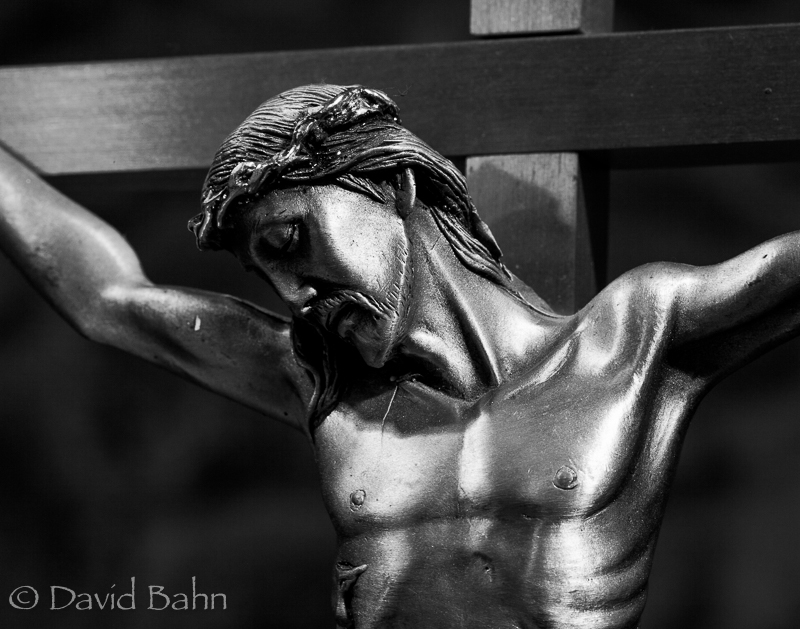
    Ms. Young was my first grade teacher. She had a Bible on her desk, opened to a picture of Jesus on the cross. He was bloody. It looked quite gruesome. But it left an impression on me that I can recall nearly 60 years later. Some would say that we Christians and church people talk too much about sin. People want to hear happy words of affirmation. We all want the trophy – if for no other reason than that we participated in the game. We would rather not focus so much on the negative. Let’s feel good. Let’s be happy. Let’s not worry. And even when we realize we’ve done something wrong, who’s to say it was actually wrong anyway?

    That’s OK when you’re the sinner as long as you leave God out of the picture. But what about when you’re the one against whom someone else sins? What if you’re the victim of someone else’s sin? How do you feel then about offering happy words of affirmation, encouragement for the good the other has done, positive thoughts, and happy feelings? When your heart has been broken by unkind words or you’ve been made the brunt of an office politics scheme, and you’re left in the cubicle while the schemer gets the corner office and everyone on his team gets the bonus.

    There are those who believe that the positive approach to these and even more major world problems is best. If we just lift the terrorist groups out of poverty, show them we care about them, and offer kindness they will be won to our way of thinking. The criminal is simply a victim of a poor economic situation, he needs help, not condemnation. Worse yet is the idea that certain sexual behaviors – really almost any – are acceptable and not sinful is rampant in the world today.

    If sin is really no big deal, why did Jesus have to die? If sin is an outdated notion, why do we ever struggle with a guilty conscience? If all we need is positive thoughts how come those who disagree are criticized for their lack of positive words of affirmation?

    Ignoring sin is never good. God did not do it. He urges us not to do it either. Rather than ignoring sin, God forgave sin. He expresses his steadfast love to the world by forgiving sin even before we admit we need it. When Jesus died, he said, “Father forgive them.” Those who had him crucified were convinced they were doing good. In reality God was doing good. He was doing what he would not let Abraham do, and offering his own Son for the sins of the whole world.

    I think that’s why Ms. Young had that Bible on her desk in first grade. That’s why we confess our sins. God has acted in the face of our sin, forgiving iniquity and expressing a steadfast love in which we are embraced for all eternity.

  • Genesis 31:42

    God saw my affliction and the labor of my hands.

    Luke 1:46–48

    Mary said, “My soul magnifies the Lord, and my spirit rejoices in God my Savior, for he has looked with favor on the lowliness of his servant.”

    20150922-9319

    When it comes to the manner in which God doles out his grace and favor, I’m not always happy. I suspect that you are not either. When it is a young virgin told by an angel that she will bear the Son of God, the Savior of the world, that’s one thing. We delight that God “looked with favor on the lowliness” of Mary. She is the poster child of the pure at heart, the godly woman who says, “I am the Lord’s servant. Let it be to me as you have said” (Luke 1:38).

    But I’m not so sure about Jacob. Remember how he was born: grasping the heel of his twin brother? Recall how he cheated and connived his way through life in an effort to get what he wanted? True: in the context of his comments recorded above, he had been taken advantage of. He had wanted to marry Rachael, the more beautiful of Laban’s two daughters. He had been tricked into marrying Leah, and had worked for his father-in-law for 20 years to gain both daughters and some flocks. But that was his life. Whether it was cheating his brother out of his birthright, or fooling his father with fake hairy arms and wild game stew, Jacob knew how to play the game. He was no innocent fool.

    How do you feel when the scoundrel gets federal witness protection care? How about the guy who manages to take advantage of every shady deal, dodges his taxes, and gets away with his miscreant behavior because he was used in a sting operation to get a higher-ranking mob boss?

    Grace is usually welcomed by those who receive it, but not so easily appreciated when seen in the life of someone we deem unworthy of it. That’s why it’s good that we are not God. We would give grace only to the deserving. But in the end grace is not about justice. Grace is not grace if it is deserved. While both Mary and Jacob could claim a place of neediness, their expression is not a justification of God’s grace, but an acknowledgement of God’s favor to them.

    Grace is about God’s character, goodness, love, and kindness. Grace works its way through the saga of human history to accomplish God’s purposes. Grace sent Jesus to us to redeem and save us who have no claim on God’s justice, but deeply needed his mercy. I may think that certain people are undeserving of God’s grace. But neither am I. God gives grace even to me who would sit in judgment of others or try to determine how worthy they are for his love. For that we can all magnify the Lord (make him larger in our lives) and rejoice in God our Savior!

  • Deuteronomy 13:4

    The Lord your God you shall follow, him alone you shall fear, his commandments you shall keep, his voice you shall obey, him you shall serve, and to him you shall hold fast.  

    John 15:14

    Jesus said, “You are my friends if you do what I command you.” 

        
    You would think that a man given to serving as a pastor for the cause of Christ and his reign in peoples’ hearts would have this one down: Fear God alone. Follow him alone. Obey him alone. Serve him alone. Hold fast to him alone. And for the most part, in general, and outwardly-speaking I do these things. I fear God, obey him, serve him. But I don’t do it perfectly. 

    I’m convinced, moreover, that I’m not alone in that. In fact, we all miss the mark one way or another in regard to this command. We let people bully us into abandoning God’s ways, end up serving our own needs and insecurities, waltz around the edge of certain commandments, wander off the path in pursuit of our own goals or distractions. Often we are not even aware of our wandering. 

    I love the thought attributed to Martin Luther: A God is that to which we look for the highest good in life.” And herein lies the secret of fearing, loving, and trusting in God above all things: We don’t follow, obey, fear, serve, and hold fast to God so that we may be Jesus’ friends. We do so because we are Jesus’ friends. We show we are Jesus’ friends by obeying his commands. When we fail to do so, we are abandoning his friendship and our true identity as sons and daughters of the Heavenly Father. 

    The grave danger of false religion is the idea that we must appease God, please him, and win his affections. But just as it is true that we sin (acting) because we are sinners (being), it is also true that we obey (act) because we are God’s children (being). We could never act our way into being – no matter what the behaviorists may assert. But what we could not do, God has done. He sent his Son to save us, called us to himself through the Good News of Jesus, brought us to faith by the power of the Holy Spirit, and declared us to be righteous through faith. 

    My Lord Jesus perfectly obeyed, feared God, served him, followed only the path of obedience – to the point of death on the cross. I claim his righteousness and seek to show that in a life of obedience and service. When I fail, I thank God for his mercy and forgiveness in Christ. In the mean time, I continually seek to follow, love, serve, obey, and honor him who called me his son. I am simply living out who I am in Christ. He alone has our hightest good in mind.