David Bahn – Reflections

Light from the Word and through the lens

  • Faithfulness in the Face of Fear

    Click here for an audio version of this podcast

    I am using St. John’s Luke Lent Reading Plan for these devotions.

    Luke 19:11-27

    As they heard these things, he proceeded to tell a parable, because he was near to Jerusalem, and because they supposed that the kingdom of God was to appear immediately. 12 He said therefore, “A nobleman went into a far country to receive for himself a kingdom and then return. 13 Calling ten of his servants, he gave them ten minas, and said to them, ‘Engage in business until I come.’ 14 But his citizens hated him and sent a delegation after him, saying, ‘We do not want this man to reign over us.’ 15 When he returned, having received the kingdom, he ordered these servants to whom he had given the money to be called to him, that he might know what they had gained by doing business. 16 The first came before him, saying, ‘Lord, your mina has made ten minas more.’ 17 And he said to him, ‘Well done, good servant! Because you have been faithful in a very little, you shall have authority over ten cities.’ 18 And the second came, saying, ‘Lord, your mina has made five minas.’ 19 And he said to him, ‘And you are to be over five cities.’ 20 Then another came, saying, ‘Lord, here is your mina, which I kept laid away in a handkerchief; 21 for I was afraid of you, because you are a severe man. You take what you did not deposit, and reap what you did not sow.’ 22 He said to him, ‘I will condemn you with your own words, you wicked servant! You knew that I was a severe man, taking what I did not deposit and reaping what I did not sow? 23 Why then did you not put my money in the bank, and at my coming I might have collected it with interest?’ 24 And he said to those who stood by, ‘Take the mina from him, and give it to the one who has the ten minas.’ 25 And they said to him, ‘Lord, he has ten minas!’ 26 ‘I tell you that to everyone who has, more will be given, but from the one who has not, even what he has will be taken away. 27 But as for these enemies of mine, who did not want me to reign over them, bring them here and slaughter them before me.’”

    Sunset at Palo Duro Canyon | January 2025

    I’m not sure I like the end of this parable, “But as for these enemies of mine, who did not want me to reign over them, bring them here and slaughter them before me.” This is a hard saying. Retribution in such a harsh manner repulses me. But it is a stark warning. There are those enemies of God who will be slaughtered. God’s justice will be served. 

    I suppose I don’t like it because I have not experienced the harsh and ugly treatment that God has. I’ve not given my Son only to have him crucified. I’ve not sent out emissaries only to have them rejected, dismissed, and killed. I’ve not had my people taken into captivity. I’ve not had my temple, the holy place of my promised presence, ransacked and destroyed. I’ve not had my faithful ones sawn in two, thrown to the lions, or skinned alive. (Sorry for the harsh language here, but I’m trying to get behind the harsh treatment of God’s enemies.)

    How does Jesus fit into this picture? I note there are two groups of people who displease the owner of the vineyard in this parable. The owner is God. And those who receive the minas (a mina equals about 3 month’s wages) are God’s people – you and me. Some of us are more productive with the talents we’ve been given. Some are less. Some hide their talents altogether. Even though they are God’s people they think of him as severe, taking what he did not deposit, and reaping what he did not sow. I notice they are chided for their failure to produce and rebuked for their poor opinion of God. But they do not receive the same severe sentence as those who did not want to be ruled by God. I see a ray of light between them and the third steward. 

    I cannot fail to draw a conclusion about this parable that relates to the secondary motivation for obedience and faithfulness. That’s fear. It’s not the primary motivation, but sometimes we need to haul ourselves up short rather than give in to temptation out of fear of God. Sometimes we need to use our talents for fear of being reprimanded if we do not.

    Better always, we resist temptation and use our gifts faithfully because we love and trust in God. But this is a good reminder that we are to fear God as well. So we say, “We should fear, love, and trust in God above all things.” This is most certainly true!


  • Zacchaeus: The Little Big Man

    Click here for an audio version of this podcast

    I am using St. John’s Luke Lent Reading Plan for these devotions.

    Luke 19:1-10

    He entered Jericho and was passing through. And behold, there was a man named Zacchaeus. He was a chief tax collector and was rich. And he was seeking to see who Jesus was, but on account of the crowd he could not, because he was small in stature. So he ran on ahead and climbed up into a sycamore tree to see him, for he was about to pass that way. And when Jesus came to the place, he looked up and said to him, “Zacchaeus, hurry and come down, for I must stay at your house today.” So he hurried and came down and received him joyfully. And when they saw it, they all grumbled, “He has gone in to be the guest of a man who is a sinner.” And Zacchaeus stood and said to the Lord, “Behold, Lord, the half of my goods I give to the poor. And if I have defrauded anyone of anything, I restore it fourfold.” And Jesus said to him, “Today salvation has come to this house, since he also is a son of Abraham. 10 For the Son of Man came to seek and to save the lost.”

    Sycamore Tree in Jericho Like Zacchaeus Climbed (from a web search) [I thought I had had my own photo of this tree, but couldn’t locate it.]
    We visited the oldest city in the world, Jericho, in 2012. We saw the sycamore tree in the center of the town that Zacchaeus is said to have climbed. I have my doubts. It’s extremely unlikely that this tree is the one. Sycamore trees live for centuries, but not millenia. The power of this account of Zacchaeus isn’t dependent on the exact tree, but on the grace of Jesus who sees Zacchaeus and welcomes him into fellowship—transforming his life. Zacchaeus becomes truly a little big man.

    If we think of the “little man complex” in his case, it could explain why he pursued a position that gave him authority and control, even if it made him unpopular. His actions—climbing a tree to see Jesus—could also reflect both his resourcefulness and his deep longing for something beyond status or wealth.

    But what makes Zacchaeus’ story remarkable is that Jesus sees him differently—not as a man compensating for his height or social status, but as a lost soul in need of grace.

    And what a difference grace makes. Better yet, and more accurate: what a difference Jesus makes! Jesus not only sees Zacchaeus as lost, but acts in his behalf, inviting himself into Zacchaeus’ house. “I must stay at your house today,” is more than a strong request. It is an intrusion into Zacchaeus’ life. Jesus will insert himself into Zacchaeus’ life and Zacchaeus will be remarkably changed.

    There is a little Greek nuance here in the phrase, “I must stay” at your house. The word for “must” (δεῖ) is a powerful little word. It is the word Jesus uses when he says, “It is necessary” that the Son of Man go up to Jerusalem to suffer and die. No option here. In this case the necessity is that Jesus would not just go to Zacchaeus’ house. He “must stay” at his house. The powerful implication of “must stay” is that Jesus is not just making a friendly visit. He is enacting God’s mission—to enter the home (and heart) of a sinner. The emphasis is not on how long Jesus stays, but that he does stay, decisively and graciously.

    And the little man becomes a big man. Big in receiving God’s grace. Big in having a changed heart. Big in generosity. Big because Christ has come and stayed in his home and will remain in his heart. This man, little in stature, becomes big in the example he gives us of what it means to have Jesus remain with us. We may not need to give half of our possessions to the poor, or return four times of what we have defrauded others. But we can certainly give thanks to God, recognize Jesus as Lord, and rejoice that Jesus came to seek and save the lost.

    Our story may not be as dramatic as Zacchaeus’ story. But Jesus’ grace is as far reaching, and our salvation is just as extraordinary. And his presence in our hearts and lives is just as gracious.

    [NOTE: I will be preaching today at St. John’s Lenten worship services, 11 AM and 7 PM. This is the text I will use and I will expand on these thoughts. Thanks for letting me cogitate on this with you through this blog post!]

  • What does humble faith look like?

    Click here for an audio version of this podcast

    I am using St. John’s Luke Lent Reading Plan for these devotions.

    Luke 18:31-43

    And taking the twelve, he said to them, “See, we are going up to Jerusalem, and everything that is written about the Son of Man by the prophets will be accomplished. 32 For he will be delivered over to the Gentiles and will be mocked and shamefully treated and spit upon. 33 And after flogging him, they will kill him, and on the third day he will rise.” 34 But they understood none of these things. This saying was hidden from them, and they did not grasp what was said.

    35 As he drew near to Jericho, a blind man was sitting by the roadside begging. 36 And hearing a crowd going by, he inquired what this meant. 37 They told him, “Jesus of Nazareth is passing by.” 38 And he cried out, “Jesus, Son of David, have mercy on me!” 39 And those who were in front rebuked him, telling him to be silent. But he cried out all the more, “Son of David, have mercy on me!” 40 And Jesus stopped and commanded him to be brought to him. And when he came near, he asked him, 41 “What do you want me to do for you?” He said, “Lord, let me recover my sight.” 42 And Jesus said to him, “Recover your sight; your faith has made you well.” 43 And immediately he recovered his sight and followed him, glorifying God. And all the people, when they saw it, gave praise to God.

    Nearing Sunset at Palo Duro Canyon | January 2025

    It’s clear that many people in Jesus’ day didn’t really understand what God had in mind when he sent his messiah. Some eventually realized that Jesus was The Messiah. But even the disciples didn’t grasp the full implications of that fact. They were all, to some extent, spiritually blind.

    It doesn’t look like those who were in front who rebuked the blind man, telling him to be silent. It doesn’t look like presuming you know better than God what is good and evil. It doesn’t look like telling people not to bother Jesus. It doesn’t look like the disciples at this point who can’t grasp what Jesus is telling them regarding his coming suffering and death.

    It does look like a blind man who knows his only hope is in Jesus, the Son of David and in God’s mercy delivered to him through Jesus. It looks importune. It looks demanding. It looks like making a scene in your urgent need. It may discomfort some. It may seem poorly timed by others. But humble faith cares little about making a scene, bring importune, or bothering Jesus. Humble faith cares about connecting with Jesus. Humble faith sees Jesus as the arm of God’s mercy and the means by which healing and hope is to come.

    Humble faith also answers the simple question of Jesus, “What do you want me to do for you?” with a simple answer, “Lord, let me recover my sight.” Lord: that’s key. For faith isn’t an internal conviction alone. It is a conviction centered in and relying on Jesus of Nazareth, Son of David.

    Could you answer such a question as Jesus asks? What do you want him to do for you? Do you realize your deepest problem, be it physical healing or spiritual blindness.

    I believe that just as the people of Jesus’ day didn’t really know what to expect in the Messiah, we are very likely not fully to know what it will be like when Jesus returns and when we are with him face to face. In the meantime, we do well to cultivate a humble faith. That’s a beautiful thing.

  • Why Humility Matters

    Click here for an audio version of this podcast

    I am using St. John’s Luke Lent Reading Plan for these devotions.

    Luke 18:9-30

    Jesus also told this parable to some who trusted in themselves that they were righteous, and treated others with contempt: 10 “Two men went up into the temple to pray, one a Pharisee and the other a tax collector. 11 The Pharisee, standing by himself, prayed thus: ‘God, I thank you that I am not like other men, extortioners, unjust, adulterers, or even like this tax collector. 12 I fast twice a week; I give tithes of all that I get.’ 13 But the tax collector, standing far off, would not even lift up his eyes to heaven, but beat his breast, saying, ‘God, be merciful to me, a sinner!’ 14 I tell you, this man went down to his house justified, rather than the other. For everyone who exalts himself will be humbled, but the one who humbles himself will be exalted.”

    15 Now they were bringing even infants to him that he might touch them. And when the disciples saw it, they rebuked them. 16 But Jesus called them to him, saying, “Let the children come to me, and do not hinder them, for to such belongs the kingdom of God. 17 Truly, I say to you, whoever does not receive the kingdom of God like a child shall not enter it.”

    18 And a ruler asked him, “Good Teacher, what must I do to inherit eternal life?” 19 And Jesus said to him, “Why do you call me good? No one is good except God alone. 20 You know the commandments: ‘Do not commit adultery, Do not murder, Do not steal, Do not bear false witness, Honor your father and mother.’” 21 And he said, “All these I have kept from my youth.” 22 When Jesus heard this, he said to him, “One thing you still lack. Sell all that you have and distribute to the poor, and you will have treasure in heaven; and come, follow me.” 23 But when he heard these things, he became very sad, for he was extremely rich. 24 Jesus, seeing that he had become sad, said, “How difficult it is for those  who have wealth to enter the kingdom of God! 25 For it is easier for a camel to go through the eye of a needle than for a rich person to enter the kingdom of God.” 26 Those who heard it said, “Then who can be saved?” 27 But he said, “What is impossible with man is possible with God.” 28 And Peter said, “See, we have left our homes and followed you.” 29 And he said to them, “Truly, I say to you, there is no one who has left house or wife or brothers or parents or children, for the sake of the kingdom of God, 30 who will not receive many times more in this time, and in the age to come eternal life.”

    Palo Duro Canyon | January 2025

    It’s hard to be humble if…You probably know how that line ends: …if you’re perfect in every way. But I’m convinced it’s hard to be humble in many different scenarios. If you’re a dedicated follower of Jesus and have tried to live a decent and godly life it’s hard to be humble. It’s hard to be humble if you’re constantly comparing yourself to others. It’s easy to miss the log in your own eye when seeing the speck in your brother’s or sister’s eye. If you have a position of responsibility in the church or at work, it’s hard to be humble. If you’re a boss. If you’ve got your life together. If your team is doing well. If your grandson is the captain of the football team. If you’re wealthy. If, if, if… It’s just plain hard to be humble.

    Jesus tells the parable of the two men who went to the temple to pray. One is humble. The other is full of hubris. The disciples take upon themselves to police the children’s access to Jesus. They discover that their assessment of their importance – or of the importance of the little children is off by 180 degrees. The rich man discovers how difficult it is to rely on God rather than his wealth. He’s not able to humble himself to the extent needed to enter the kingdom of God.

    Why is it so hard to be humble? It’s because we’re hard wired to self-righteousness, self-idolatry, and self-justification. Pride is the posture of the heart that refuses to need God. It’s the primal sin. And we’ve all inherited it. It’s as natural as blinking your eyes, as unconscious breathing.

    And if we manage to tame the pride monster, we’ll all too easily become proud of our humility. What hope do we have?

    Our only hope is Jesus who was perfectly humble and completely submissive to his Father. He became obedient even unto death for us. Now that he is exalted to the right hand of God. He is our righteousness, hope, and salvation.

    The tax collector in Jesus’ parable went home justified not because he was impressive, but because he knew he wasn’t. He threw himself on the mercy of God—and that’s exactly where grace meets us.

    Humility isn’t something we muster—it’s something that happens when we stand before the cross and realize what Jesus did to gain our salvation. There we find what we could never achieve on our own: the smile of God, the welcome of Jesus, and the joy of going home justified.

  • Please pray these Psalms with me today, on this Lord’s Day

    Psalm 6

    LORD, rebuke me not in your anger,
        nor discipline me in your wrath.
    Be gracious to me, O LORD, for I am languishing;
        heal me, O LORD, for my bones are troubled.
    My soul also is greatly troubled.
        But you, O LORD—how long?

    Turn, O LORD, deliver my life;
        save me for the sake of your steadfast love.
    For in death there is no remembrance of you;
        in Sheol who will give you praise?

    I am weary with my moaning;
        every night I flood my bed with tears;
        I drench my couch with my weeping.
    My eye wastes away because of grief;
        it grows weak because of all my foes.

    Depart from me, all you workers of evil,
        for the LORD has heard the sound of my weeping.
    The LORD has heard my plea;
        the LORD accepts my prayer.
    10 All my enemies shall be ashamed and greatly troubled;
        they shall turn back and be put to shame in a moment.

    Psalm 36

    Transgression speaks to the wicked
        deep in his heart;
    there is no fear of God
        before his eyes.
    For he flatters himself in his own eyes
        that his iniquity cannot be found out and hated.
    The words of his mouth are trouble and deceit;
        he has ceased to act wisely and do good.
    He plots trouble while on his bed;
        he sets himself in a way that is not good;
        he does not reject evil.

    Your steadfast love, O LORD, extends to the heavens,
        your faithfulness to the clouds.
    Your righteousness is like the mountains of God;
        your judgments are like the great deep;
        man and beast you save, O LORD.

    How precious is your steadfast love, O God!
        The children of mankind take refuge in the shadow of your wings.
    They feast on the abundance of your house,
        and you give them drink from the river of your delights.
    For with you is the fountain of life;
        in your light do we see light.

    10 Oh, continue your steadfast love to those who know you,
        and your righteousness to the upright of heart!
    11 Let not the foot of arrogance come upon me,
        nor the hand of the wicked drive me away.
    12 There the evildoers lie fallen;
        they are thrust down, unable to rise.

    Psalm 66

    Shout for joy to God, all the earth;
        sing the glory of his name;
        give to him glorious praise!
    Say to God, “How awesome are your deeds!
        So great is your power that your enemies come cringing to you.
    All the earth worships you
        and sings praises to you;
        they sing praises to your name.” Selah

    Come and see what God has done:
        he is awesome in his deeds toward the children of man.
    He turned the sea into dry land;
        they passed through the river on foot.
    There did we rejoice in him,
        who rules by his might forever,
    whose eyes keep watch on the nations—
        let not the rebellious exalt themselves. Selah

    Bless our God, O peoples;
        let the sound of his praise be heard,
    who has kept our soul among the living
        and has not let our feet slip.
    10 For you, O God, have tested us;
        you have tried us as silver is tried.
    11 You brought us into the net;
        you laid a crushing burden on our backs;
    12 you let men ride over our heads;
        we went through fire and through water;
    yet you have brought us out to a place of abundance.

    13 I will come into your house with burnt offerings;
        I will perform my vows to you,
    14 that which my lips uttered
        and my mouth promised when I was in trouble.
    15 I will offer to you burnt offerings of fattened animals,
        with the smoke of the sacrifice of rams;
    I will make an offering of bulls and goats. Selah

    16 Come and hear, all you who fear God,
        and I will tell what he has done for my soul.
    17 I cried to him with my mouth,
        and high praise was on my tongue.
    18 If I had cherished iniquity in my heart,
        the LORD would not have listened.
    19 But truly God has listened;
        he has attended to the voice of my prayer.

    20 Blessed be God,
        because he has not rejected my prayer
        or removed his steadfast love from me!

    Psalm 96

    Oh sing to the LORD a new song;
        sing to the LORD, all the earth!
    Sing to the LORD, bless his name;
        tell of his salvation from day to day.
    Declare his glory among the nations,
        his marvelous works among all the peoples!
    For great is the LORD, and greatly to be praised;
        he is to be feared above all gods.
    For all the gods of the peoples are worthless idols,
        but the LORD made the heavens.
    Splendor and majesty are before him;
        strength and beauty are in his sanctuary.

    Ascribe to the LORD, O families of the peoples,
        ascribe to the LORD glory and strength!
    Ascribe to the LORD the glory due his name;
        bring an offering, and come into his courts!
    Worship the LORD in the splendor of holiness;
        tremble before him, all the earth!

    10 Say among the nations, “The LORD reigns!
        Yes, the world is established; it shall never be moved;
        he will judge the peoples with equity.”

    11 Let the heavens be glad, and let the earth rejoice;
        let the sea roar, and all that fills it;
    12     let the field exult, and everything in it!
    Then shall all the trees of the forest sing for joy
    13     before the LORD, for he comes,
        for he comes to judge the earth.
    He will judge the world in righteousness,
        and the peoples in his faithfulness.

    Psalm 126

    When the LORD restored the fortunes of Zion,
        we were like those who dream.
    Then our mouth was filled with laughter,
        and our tongue with shouts of joy;
    then they said among the nations,
        “The LORD has done great things for them.”
    The LORD has done great things for us;
        we are glad.

    Restore our fortunes, O LORD,
        like streams in the Negeb!
    Those who sow in tears
        shall reap with shouts of joy!
    He who goes out weeping,
        bearing the seed for sowing,
    shall come home with shouts of joy,
        bringing his sheaves with him.

    The Holy Bible, English Standard Version.
    ESV® Text Edition: 2016. Copyright © 2001 by
    Crossway Bibles, a publishing ministry of Good News Publishers.

  • How Faithfulness and Gratitude Show in a Life of Discipleship

    Click here for an audio version of this podcast

    I am using St. John’s Luke Lent Reading Plan for these devotions.

    Luke 17:1-19

    And Jesus said to his disciples, “Temptations to sin are sure to come, but woe to the one through whom they come! It would be better for him if a millstone were hung around his neck and he were cast into the sea than that he should cause one of these little ones to sin. Pay attention to yourselves! If your brother sins, rebuke him, and if he repents, forgive him, and if he sins against you seven times in the day, and turns to you seven times, saying, ‘I repent,’ you must forgive him.”

    The apostles said to the Lord, “Increase our faith!” And the Lord said, “If you had faith like a grain of mustard seed, you could say to this mulberry tree, ‘Be uprooted and planted in the sea,’ and it would obey you.

    “Will any one of you who has a servant plowing or keeping sheep say to him when he has come in from the field, ‘Come at once and recline at table’? Will he not rather say to him, ‘Prepare supper for me, and dress properly, and serve me while I eat and drink, and afterward you will eat and drink’? 9 Does he thank the servant because he did what was commanded? 10 So you also, when you have done all that you were commanded, say, ‘We are unworthy servants; we have only done what was our duty.’”

    11 On the way to Jerusalem he was passing along between Samaria and Galilee. 12 And as he entered a village, he was met by ten lepers, who stood at a distance 13 and lifted up their voices, saying, “Jesus, Master, have mercy on us.” 14 When he saw them he said to them, “Go and show yourselves to the priests.” And as they went they were cleansed. 15 Then one of them, when he saw that he was healed, turned back, praising God with a loud voice; 16 and he fell on his face at Jesus’ feet, giving him thanks. Now he was a Samaritan. 17 Then Jesus answered, “Were not ten cleansed? Where are the nine? 18 Was no one found to return and give praise to God except this foreigner?” 19 And he said to him, “Rise and go your way; your faith has made you well.”

    Curious Log in the Weeds | Palo Duro Canyon | January 2025

    The Christian faith is anything other than one-dimensional. It’s beyond two-dimensions. It is multi-faceted, multi-dimensional, and multi-textured, weaving together theology, community, and personal experience. In these verses from Luke 17, we have an interesting interplay between faith, forgiveness, humility, and gratitude.

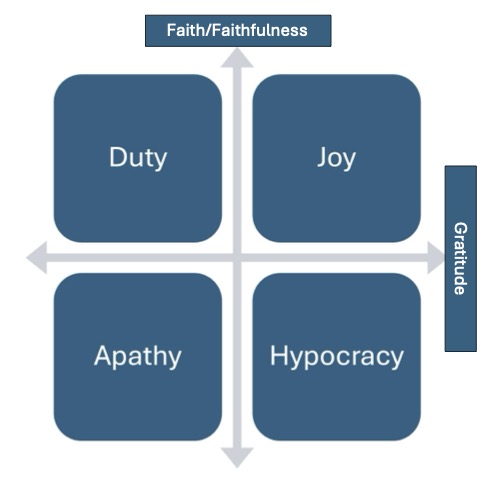
    I want to focus today on the interplay between faith/faithfulness and gratitude. It’s possible to have one of a sort without the other. Consider people who have great supposed faith but no gratitude. They would see the Christian life as mere duty. There is no fullness of heart in their service or worship. They do what they’re supposed to do because they’re supposed to do it.

    There are also those people, sadly, who have no sense of gratitude nor any true faith. Theirs is a life of meaningless apathy. They don’t really care about how God is leading them nor do they recognize him as the giver of every good gift. Some people live with lots of gratitude. But it’s not focused on God. It’s merely a desirable character attribute. It goes nowhere. But those who live lives of faithful gratitude are filled with true joy. Their worship is rich and authentic. Their service is free and gracious. They know their sins have been forgiven, rejoice in that grace of God, and seek to serve him with good and thankful hearts.

    We have people recognizing their need for greater faith, and then being challenged to recognize it’s not the size of the faith but the strength of faith’s object that matters. We have Jesus calling his followers to a life of humble service. And we have 9 out of 10 lepers who exhibit only faith and no gratitude.

    But the one! One of the lepers who called out to Jesus in faith also returns to him in gratitude. His is the fullest and purest joy. The other 9 may have joy in the moment of their healing. But this one will have an eternal joy having been dismissed by Jesus with the incredible blessing: “Rise and go your way; your faith has made you well.”

    The fullness of joy is found in a life of faithful gratitude. I’m thankful to God for his faithfulness, and grateful to him even as I pray, “Lord, increase my faith.”

    PS: Here’s my diagram of the interplay between faith and gratitude. What do you think?

  • The Rich Man and Lazarus: A Lesson on Compassion

    Click here for an audio version of this podcast

    I am using St. John’s Luke Lent Reading Plan for these devotions.

    Luke 16:19-31

    “There was a rich man who was clothed in purple and fine linen and who feasted sumptuously every day. 20 And at his gate was laid a poor man named Lazarus, covered with sores, 21 who desired to be fed with what fell from the rich man’s table. Moreover, even the dogs came and licked his sores. 22 The poor man died and was carried by the angels to Abraham’s side. The rich man also died and was buried, 23 and in Hades, being in torment, he lifted up his eyes and saw Abraham far off and Lazarus at his side. 24 And he called out, ‘Father Abraham, have mercy on me, and send Lazarus to dip the end of his finger in water and cool my tongue, for I am in anguish in this flame.’ 25 But Abraham said, ‘Child, remember that you in your lifetime received your good things, and Lazarus in like manner bad things; but now he is comforted here, and you are in anguish. 26 And besides all this, between us and you a great chasm has been fixed, in order that those who would pass from here to you may not be able, and none may cross from there to us.’ 27 And he said, ‘Then I beg you, father, to send him to my father’s house— 28 for I have five brothers—so that he may warn them, lest they also come into this place of torment.’ 29 But Abraham said, ‘They have Moses and the Prophets; let them hear them.’ 30 And he said, ‘No, father Abraham, but if someone goes to them from the dead, they will repent.’ 31 He said to him, ‘If they do not hear Moses and the Prophets, neither will they be convinced if someone should rise from the dead.’”

    Palo Duro Canyon | January 2025

    Where do you fit in this story? Are you the rich man who dines in full view of the poor and callously ignores them? Or are you a poor man sitting outside a rich man’s gate covered in sores and wishing for even a morsel of food from the rich man’s table? I’m guessing you might not be able to identify with either one. We would all wish to identify as one carried to Abraham’s side. That’s heaven. None of us wish to be taken to hades and suffer that agony.

    Jesus makes the comparison so extreme that there is no wiggle room for the rich man in his callous disregard of the poor man’s plight. This is not just a story of a priest passing by on the other side.  This is a man laying at the rich man’s gate. He had to see him every day. And there’s the problem.

    “Time in erodes awareness of,” I like to say to church leaders who are crafting a mission plan. We tend to ignore things we’ve seen again and again. So too, the poor. They are easily overlooked. But they ought not be.

    We were in China on our way to a restaurant for our evening meal. A man with no legs and dressed in rags was begging on the sidewalk. We had been told to be careful of beggars. Our missionary leader, however, took out some money and gave it to the man. I asked about that, and he said, “He looks to be in legitimate need.” I wish I had given him some money as well.

    There will come a time when we see how richly we have been blessed. And as Mother Teresa said, “Only in heaven will we see how much we owe to the poor for helping us to love God better because of them.”

    We may always have the poor among us. But that should not erode our awareness of them or blind us to the opportunities we have to serve them. After all that is what Jesus did to serve poor miserable sinners such as us. He didn’t overlook us. He served and saved us and calls us to do the same. Furthermore, Jesus has risen from the dead. Surely we will listen to him!

  • The Prodigal Son: A Journey from Madness to Gladness

    Click here for an audio version of this podcast

    I am using St. John’s Luke Lent Reading Plan for these devotions.

    Luke 15:1-2, 11-32

    Now the tax collectors and sinners were all drawing near to hear him. And the Pharisees and the scribes grumbled, saying, “This man receives sinners and eats with them.”

    11 And he said, “There was a man who had two sons. 12 And the younger of them said to his father, ‘Father, give me the share of property that is coming to me.’ And he divided his property between them.13 Not many days later, the younger son gathered all he had and took a journey into a far country, and there he squandered his property in reckless living.14 And when he had spent everything, a severe famine arose in that country, and he began to be in need. 15 So he went and hired himself out to one of the citizens of that country, who sent him into his fields to feed pigs. 16 And he was longing to be fed with the pods that the pigs ate, and no one gave him anything.

    17 “But when he came to himself, he said, ‘How many of my father’s hired servants have more than enough bread, but I perish here with hunger! 18 I will arise and go to my father, and I will say to him, “Father, I have sinned against heaven and before you. 19 I am no longer worthy to be called your son. Treat me as one of your hired servants.”’ 20 And he arose and came to his father. But while he was still a long way off, his father saw him and felt compassion, and ran and embraced him and kissed him.21 And the son said to him, ‘Father, I have sinned against heaven and before you. I am no longer worthy to be called your son.’ 22 But the father said to his servants, ‘Bring quickly the best robe, and put it on him, and put a ring on his hand, and shoes on his feet. 23 And bring the fattened calf and kill it, and let us eat and celebrate. 24 For this my son was dead, and is alive again; he was lost, and is found.’ And they began to celebrate.

    25 “Now his older son was in the field, and as he came and drew near to the house, he heard music and dancing. 26 And he called one of the servants and asked what these things meant.27 And he said to him, ‘Your brother has come, and your father has killed the fattened calf, because he has received him back safe and sound.’ 28 But he was angry and refused to go in. His father came out and entreated him,29 but he answered his father, ‘Look, these many years I have served you, and I never disobeyed your command, yet you never gave me a young goat, that I might celebrate with my friends. 30 But when this son of yours came, who has devoured your property with prostitutes, you killed the fattened calf for him!’ 31 And he said to him, ‘Son, you are always with me, and all that is mine is yours. 32 It was fitting to celebrate and be glad, for this your brother was dead, and is alive; he was lost, and is found.’”

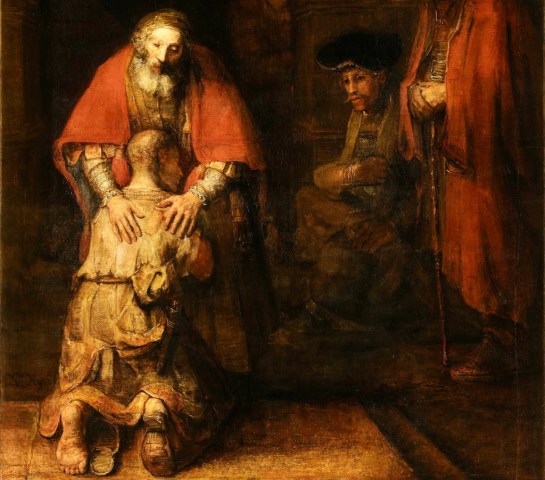
    The Return of the Prodigal by Rembrandt

    There is a classic outline used by traveling evangelistic revivalists. It’s simple and really does get at the flow of this parable:

    The Prodigal

    • His Madness
    • His Sadness
    • His Gladness

    A close look at this parable reveals that those three attributes apply to all three of the main characters in the parable. Each one in turn is mad, sad, and glad – although the older son is only invited into the gladness, and we don’t see if he joins in the revelry.

    I will be preaching at St. John today, so I don’t want to steal my own thunder, but I can give you a peek into what I will share this morning at 11 and this evening at 7.

    The younger son is mad (in the sense of insanity) because he is willing to tell his dad to drop dead, leave his home of plenty and trade that all in for a life of wanton debauchery. He is sad because the money runs out, the friends desert him, and there comes a famine. He is glad when he returns home and his father receives him with open arms and celebrates his return with a great big party.

    The father is likewise mad, giving away all that money to his irresponsible son. He’s sad because his son is gone, and because his older son won’t join the party when the younger son returns. He was glad when he did return.

    The older son was mad (in the sense of ire and bitterness) because his younger brother was being so well treated – something he thought he really deserved. His is sad because he had never been celebrated as his younger brother was now being. Will he be glad? Will he realize there is joy to be experienced and shared?

    This parable is one of a trio in the Lost and Found chapter. The lost and found sheep, one of 100. The lost and found coin, one of 10. The lost and found son, one of two. But there is a refrain at the end of the first two parables. This third one describes this truth: “There is joy before the angels of God over one sinner who repents.”

    Will we join the celebration? Will we return to God if we are far off? Will we come in if we’re standing aloof in bitterness and anger? Every gathering of God’s people is to be a foretaste of the joy to come, a celebration of God’s grace and joy in the fellowship of the redeemed. Don’t be mad or sad. Be glad and rejoice in God’s grace every day.

  • Don’t miss this party! (with minor corrections)

    Click here for an audio version of this podcast

    I am using St. John’s Luke Lent Reading Plan for these devotions.

    Luke 14:15-24

    15 When one of those who reclined at table with him heard these things, he said to him, “Blessed is everyone who will eat bread in the kingdom of God!” 16 But he said to him, “A man once gave a great banquet and invited many. 17 And at the time for the banquet he sent his servant to say to those who had been invited, ‘Come, for everything is now ready.’ 18 But they all alike began to make excuses. The first said to him, ‘I have bought a field, and I must go out and see it. Please have me excused.’ 19 And another said, ‘I have bought five yoke of oxen, and I go to examine them. Please have me excused.’ 20 And another said, ‘I have married a wife, and therefore I cannot come.’ 21 So the servant came and reported these things to his master. Then the master of the house became angry and said to his servant, ‘Go out quickly to the streets and lanes of the city, and bring in the poor and crippled and blind and lame.’ 22 And the servant said, ‘Sir, what you commanded has been done, and still there is room.’ 23 And the master said to the servant, ‘Go out to the highways and hedges and compel people to come in, that my house may be filled. 24 For I tell you, none of those men who were invited shall taste my banquet.’”

    Palo Duro Canyon Pano | January 2025

    When I was about 13 years old, I had a swimming party at our motel pool. On one hand, it was great—even a really cool kid showed up. But it wasn’t so great, because he crashed the party as though he belonged there—and I didn’t have the nerve to stop him. Even worse, after swimming, the kids found a radio or record player (did I provide that?) and started dancing.

    I didn’t join in.

    Again, a failure of nerve. It was my party, after all. But somehow, I didn’t feel like I belonged. Imagine that—not belonging at your own pool party!

    Jesus describes a different kind of party in Luke 14:15-24—a feast where people are invited but strangely don’t want to come. They offer excuse after excuse and beg off. Who ever heard of such a thing? The party of the year—and you don’t want to go? Even more shocking, the party of the ages, and you decline the invitation?

    Why would someone refuse? Maybe because they don’t like the host. If the party were thrown by your bitterest political opponent, would you go? If the host were a known criminal, you might steer clear. Or maybe you’d decline because you expect to be mocked, ignored, or out of place.

    But this feast—the one Jesus speaks of—is for those who have been made new. They love God and their neighbor. They rejoice when the outcast is redeemed. They celebrate as all God’s people gather around Jesus, giving him the honor and praise he deserves.

    In Jesus’ parable, the proud seat themselves in places of honor—only to be humbled. The humble, meanwhile, are invited to move up higher. The host makes all the difference. Those who love Jesus will certainly want to attend his feast.

    This is the feast of victory for our God! Hallelujah! (Apologies to those refraining from “Hallelujah” in Lent.) The Lamb who was slain has begun his reign. Hallelujah!

    So let’s join the celebration. Let’s take our place at the table—not because we deserve it, but because we have been invited.

  • Don’t miss this party!

    Click here for an audio version of this podcast

    I am using St. John’s Luke Lent Reading Plan for these devotions.

    Luke 14 (focusing on v. 15-24)

    One Sabbath, when he went to dine at the house of a ruler of the Pharisees, they were watching him carefully. And behold, there was a man before him who had dropsy. And Jesus responded to the lawyers and Pharisees, saying, “Is it lawful to heal on the Sabbath, or not?” But they remained silent. Then he took him and healed him and sent him away. And he said to them, “Which of you, having a son or an ox that has fallen into a well on a Sabbath day, will not immediately pull him out?” And they could not reply to these things.

    Now he told a parable to those who were invited, when he noticed how they chose the places of honor, saying to them, “When you are invited by someone to a wedding feast, do not sit down in a place of honor, lest someone more distinguished than you be invited by him, and he who invited you both will come and say to you, ‘Give your place to this person,’ and then you will begin with shame to take the lowest place. 10 But when you are invited, go and sit in the lowest place, so that when your host comes he may say to you, ‘Friend, move up higher.’ Then you will be honored in the presence of all who sit at table with you. 11 For everyone who exalts himself will be humbled, and he who humbles himself will be exalted.”

    12 He said also to the man who had invited him, “When you give a dinner or a banquet, do not invite your friends or your brothers or your relatives or rich neighbors, lest they also invite you in return and you be repaid. 13 But when you give a feast, invite the poor, the crippled, the lame, the blind, 14 and you will be blessed, because they cannot repay you. For you will be repaid at the resurrection of the just.”

    15 When one of those who reclined at table with him heard these things, he said to him, “Blessed is everyone who will eat bread in the kingdom of God!” 16 But he said to him, “A man once gave a great banquet and invited many. 17 And at the time for the banquet he sent his servant to say to those who had been invited, ‘Come, for everything is now ready.’ 18 But they all alike began to make excuses. The first said to him, ‘I have bought a field, and I must go out and see it. Please have me excused.’ 19 And another said, ‘I have bought five yoke of oxen, and I go to examine them. Please have me excused.’ 20 And another said, ‘I have married a wife, and therefore I cannot come.’ 21 So the servant came and reported these things to his master. Then the master of the house became angry and said to his servant, ‘Go out quickly to the streets and lanes of the city, and bring in the poor and crippled and blind and lame.’ 22 And the servant said, ‘Sir, what you commanded has been done, and still there is room.’ 23 And the master said to the servant, ‘Go out to the highways and hedges and compel people to come in, that my house may be filled. 24 For I tell you, none of those men who were invited shall taste my banquet.’”

    25 Now great crowds accompanied him, and he turned and said to them, 26 “If anyone comes to me and does not hate his own father and mother and wife and children and brothers and sisters, yes, and even his own life, he cannot be my disciple. 27 Whoever does not bear his own cross and come after me cannot be my disciple. 28 For which of you, desiring to build a tower, does not first sit down and count the cost, whether he has enough to complete it? 29 Otherwise, when he has laid a foundation and is not able to finish, all who see it begin to mock him, 30 saying, ‘This man began to build and was not able to finish.’ 31 Or what king, going out to encounter another king in war, will not sit down first and deliberate whether he is able with ten thousand to meet him who comes against him with twenty thousand? 32 And if not, while the other is yet a great way off, he sends a delegation and asks for terms of peace. 33 So therefore, any one of you who does not renounce all that he has cannot be my disciple.

    34 “Salt is good, but if salt has lost its taste, how shall its saltiness be restored? 35 It is of no use either for the soil or for the manure pile. It is thrown away. He who has ears to hear, let him hear.”

    Palo Duro Canyon Pano | January 2025

    When I was about 13 years old, I had a swimming party at our motel pool. On one hand, it was great—even a really cool kid showed up. But it wasn’t so great, because he crashed the party as though he belonged there—and I didn’t have the nerve to stop him. Even worse, after swimming, the kids found a radio or record player (did I provide that?) and started dancing.

    I didn’t join in.

    Again, a failure of nerve. It was my party, after all. But somehow, I didn’t feel like I belonged. Imagine that—not belonging at your own pool party!

    Jesus describes a different kind of party in Luke 14:15-24—a feast where people are invited but strangely don’t want to come. They offer excuse after excuse and beg off. Who ever heard of such a thing? The party of the year—and you don’t want to go? Even more shocking, the party of the ages, and you decline the invitation?

    Why would someone refuse? Maybe because they don’t like the host. If the party were thrown by your bitterest political opponent, would you go? If the host were a known criminal, you might steer clear. Or maybe you’d decline because you expect to be mocked, ignored, or out of place.

    But this feast—the one Jesus speaks of—is for those who have been made new. They love God and their neighbor. They rejoice when the outcast is redeemed. They celebrate as all God’s people gather around Jesus, giving him the honor and praise he deserves.

    In Jesus’ parable, the proud seat themselves in places of honor—only to be humbled. The humble, meanwhile, are invited to move up higher. The host makes all the difference. Those who love Jesus will certainly want to attend his feast.

    This is the feast of victory for our God! Hallelujah! (Apologies to those refraining from “Hallelujah” in Lent.) The Lamb who was slain has begun his reign. Hallelujah!

    So let’s join the celebration. Let’s take our place at the table—not because we deserve it, but because we have been invited.