David Bahn – Reflections

Light from the Word and through the lens

  • Now there was a disciple at Damascus named Ananias. The Lord said to him in a vision, “Ananias.” And he said, “Here I am, Lord.” 11 And the Lord said to him, “Rise and go to the street called Straight, and at the house of Judas look for a man of Tarsus named Saul, for behold, he is praying, 12 and he has seen in a vision a man named Ananias come in and lay his hands on him so that he might regain his sight.” 13 But Ananias answered, “Lord, I have heard from many about this man, how much evil he has done to your saints at Jerusalem. 14 And here he has authority from the chief priests to bind all who call on your name.” 15 But the Lord said to him, “Go, for he is a chosen instrument of mine to carry my name before the Gentiles and kings and the children of Israel. 16 For I will show him how much he must suffer for the sake of my name.” 17 So Ananias departed and entered the house. And laying his hands on him he said, “Brother Saul, the Lord Jesus who appeared to you on the road by which you came has sent me so that you may regain your sight and be filled with the Holy Spirit.” 18 And immediately something like scales fell from his eyes, and he regained his sight. Then he rose and was baptized; 19 and taking food, he was strengthened. – Acts 9:10-19

    20170331-DSC06056
    Petunia blossom at The Flower Fields in Carlsbad, CA | Photo taken March 2017

    When it comes to salvation by grace through faith there is no one who quite as clearly lays it out as does the Apostle Paul. He is relentless: Salvation is by God’s grace alone, apart from works of the Law (Romans 3:21-28). He makes the point again: We have been saved by grace through faith, not by works (Ephesians 2:8-9).

    So how is it that at his conversion God says, “I will show him how much he must suffer for the sake of my name.” You might think there is a conflict here: it’s either salvation by grace through faith, or it’s suffer for the sake of Jesus’ name, isn’t it? How is it that Paul – who will suffer greatly for the sake of Jesus’ name – is the champion of justification by grace through faith? Paul suffered shipwreck, beatings, imprisonment, opposition, false accusations and even opposition from within. His life is a fulfillment of Jesus’ words: he suffered for the sake of Jesus’ name.

    All this was made possible by God’s grace at work initially by means of striking Saul blind and revealing himself to Saul. It was made possible further by Ananias’ intervention, healing prayer, and gift of the Holy Spirit.

    Being saved does not transport us immediately to heaven. God converts us and makes us new so that we may walk in newness of life. He brings us into his rule and reign so that we may serve him in everyday ways. It may be providing the food for a hungry new convert (v. 19). It may be a matter of praying for someone who is in need of God’s help. It might involve even great suffering for the cause of Jesus’ name.

    Ask those who give themselves to such things. They will surely tell you it was worth it. Paul himself says as much at the end of his challenging yet dedicated life: “I have fought the good fight, I have finished the race, I have kept the faith. Henceforth there is laid up for me the crown of righteousness, which the Lord, the righteous judge, will award to me on that day, and not only to me but also to all who have loved his appearing” (2 Timothy 4:7-8).

  • But Saul, still breathing threats and murder against the disciples of the Lord, went to the high priest and asked him for letters to the synagogues at Damascus, so that if he found any belonging to the Way, men or women, he might bring them bound to Jerusalem. Now as he went on his way, he approached Damascus, and suddenly a light from heaven shone around him. And falling to the ground, he heard a voice saying to him, “Saul, Saul, why are you persecuting me?” And he said, “Who are you, Lord?” And he said, “I am Jesus, whom you are persecuting. But rise and enter the city, and you will be told what you are to do.” The men who were traveling with him stood speechless, hearing the voice but seeing no one. Saul rose from the ground, and although his eyes were opened, he saw nothing. So they led him by the hand and brought him into Damascus. And for three days he was without sight, and neither ate nor drank. – Acts 9:1-9

    20170603-DSC00214
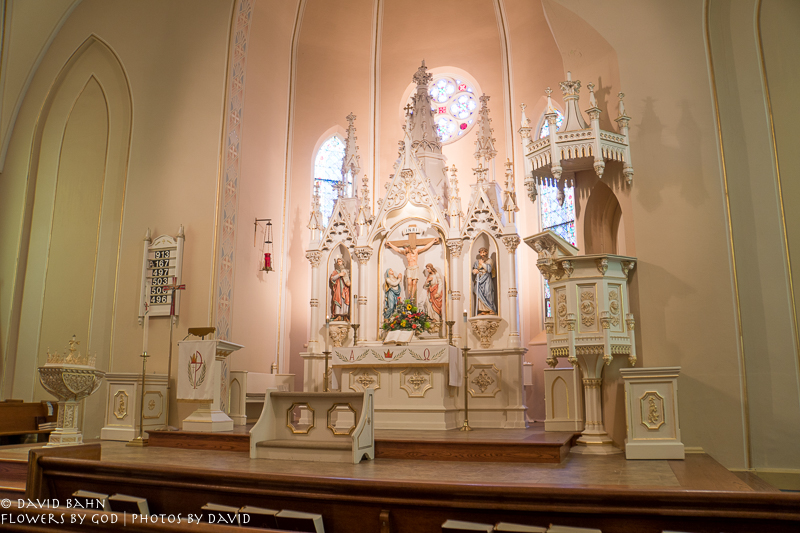
    The altar and chancel of Immanuel Lutheran Church in St. Charles, MO. June 2017

    I can think of a few people who take their faith, politics, and values to an extreme that is uncomfortable to me – to say the least. The fanatical right or left-wing politician. The over-the-top religious fanatic. The we-don’t-eat-anything-that-can’t-be-eaten-with-a-spoon, (and neither should you!) food cop: I feel no great need for their company or influence. Oh how I wish they would experience a Paul-on-the-road-to-Damascus moment!

    My motives for God’s intervention, however, are not about lessening the aggravation-factor of a misguided and bull-headed religious fanatic. God is not just frustrated with Saul’s antics and disappointed with his plans. Nor is God merely anxious about Saul’s plans to persecute the followers of Jesus.

    All those are important and valid reasons forGod’s intervention in Saul’s plans and interruption of his travels. God will throw Saul to the ground. He will strike him blind. He will speak a powerful and theology-shaping message to his heart. He will set things in motion that will yield not just a dramatic conversion, but an ultimate reorientation from persecutor of the faith to a missionary and servant for the cause of the faith he was trying to destroy.

    From this encounter will come a way of speaking about the church that Paul will use as he writes to the church in Corinth and which we use even today. Paul will refer to the church as the body of Christ. Perhaps that is because of this encounter: Saul was persecuting the church, and Jesus himself says, “Saul, Saul, why are you persecuting me?” Persecute the church and you persecute Jesus, for the church is the body of Christ.

    Jesus loves the church and will protect his people. He desires all people be saved. He will send Saul on missionary journeys, and people will be saved, and churches will be formed, and the body of Christ will grow and God’s good will will be done.

  • And the eunuch said to Philip, “About whom, I ask you, does the prophet say this, about himself or about someone else?” 35 Then Philip opened his mouth, and beginning with this Scripture he told him the good news about Jesus. 36 And as they were going along the road they came to some water, and the eunuch said, “See, here is water! What prevents me from being baptized?” 38 And he commanded the chariot to stop, and they both went down into the water, Philip and the eunuch, and he baptized him. 39 And when they came up out of the water, the Spirit of the Lord carried Philip away, and the eunuch saw him no more, and went on his way rejoicing. 40 But Philip found himself at Azotus, and as he passed through he preached the gospel to all the towns until he came to Caesarea. – Acts 8:34-40

    20170603-DSC00239
    This rose was growing in the garden area of Blanchette Park in St. Charles, MO. June 2017

    I use a teaching tool to speak about baptism: BoB, the Blessings of Baptism. I make the point that God’s word puts the blessings of baptism into the water of baptism, and faith receives those blessings and makes them our own. These truths are more than a teaching tool for me and our family.

    When our son was born – 8 weeks premature and weighing 3 #, 12.5 oz. – the blessings of baptism took on new significance. When it became necessary to send him to a specialized children’s hospital in another town, I wanted to baptize him and did so while he was in the neonatal ICU. Once he was baptized I knew that there were promises attached to him, that prior to that moment had not. It was a moment of monumental relief and confidence.

    When Philip tells the Ethiopian eunuch the Good News about Jesus he must have included the Good News of God’s grace and promises in baptism. The eunuch asks if he can be baptized.

    The New Testament means of “sealing the deal” in regard to the conversion of someone is baptism. In baptism God puts his name on us. He claims us as his own. He promises forgiveness of sins, the gift of the Holy Spirit, and says (cf. Acts 2:38-39) that those promises are for all people – including children, and those far off (Ethiopian eunuchs?).

    The deal has been sealed now with the Ethiopian eunuch. Philip has served as God’s instrument to bring another into the rule and reign of Jesus. These two will now separate: one will go on his way to his home. Another will find himself in another place and continue to preach the Good News of Jesus on his way to Caesarea.

    Thirty-three years ago, after I baptized our newborn son, I went on my way, back to the church I served and led worship and preached the Good News to the people there. Our son went on by ambulance to the hospital. We connected later that day. He is now a healthy 33 year old man, and I am thankful for God’s gifts and Blessings of Baptism.

  • So Philip ran to him and heard him reading Isaiah the prophet and asked, “Do you understand what you are reading?” 31 And he said, “How can I, unless someone guides me?” And he invited Philip to come up and sit with him. 32 Now the passage of the Scripture that he was reading was this:

    “Like a sheep he was led to the slaughter
        and like a lamb before its shearer is silent,
        so he opens not his mouth.
    33 In his humiliation justice was denied him.
        Who can describe his generation?
    For his life is taken away from the earth.”

    34 And the eunuch said to Philip, “About whom, I ask you, does the prophet say this, about himself or about someone else?” 35 Then Philip opened his mouth, and beginning with this Scripture he told him the good news about Jesus. – Acts 8:30-35

    20170603-DSC00235
    Flower at Blanchette Park | St. Charles, MO | June 2017

    I visited Russia shortly after the Berlin Wall fell, and the Soviet Union dissolved. It was a remarkable experience on almost every level. The people were wonderful. The food was very interesting. The hospitals, prisons, schools, and other things we experienced were life-changing. When you see a 20-year-old Russian man who was our interpreter, stand on the desk in the front of a Russian classroom and preach an evangelistic sermon to school children…wow! I still shake my head all these years later.

    When we visited one hospital the group split up. One group stayed behind with the doctors and nurses in the lounge area while we (whom I considered more important!) went on a tour of the hospital. We saw interesting medical equipment, patients, and evidence of treatments of various kinds – none of which were impressive to us.

    Meanwhile those who were not deemed important enough (I say that with a shake of my head – how arrogant, and how wrong!) had an interesting opportunity. We had taken giant suitcases filled with all kinds of medical supplies to be given to the people there. When they opened the suitcases they asked our group, “Why are you doing this?”

    “We want to share the love of Jesus with you,” our unimportant mission parters replied. “Tell us about this Jesus,” asked the nurses and doctors. “Who is he? Why is he so important?” That led ultimately to a conversation and a real lesson for us who returned from our tour shortly after they had finished sharing the good news of Jesus. Nurses and doctors were coming out of the room wiping their eyes, tears of joy flowing down their cheeks. It was an amazing moment. One doctor followed us out of the hospital and, waving at us in joy, stood in the snow-covered parking lot as our bus drove away.

    I’m not sure the Ethiopian eunuch was crying when Philip left him, but I am certain Philip rejoiced to have been invited so directly to share the good news of Jesus. No doubt the apostles and others were doing important things back in Jerusalem.

    Nothing is more important than being able to tell someone that their sins have been forgiven, that they have an destiny of eternal joy and delight because of Jesus’ death and resurrection. The Good News of Jesus is a joy to share and a joy to hear. What would you say if someone asked you, “Tell me about this Jesus. Why is he so important to you?”

  •  Now an angel of the Lord said to Philip, “Rise and go toward the south to the road that goes down from Jerusalem to Gaza.” This is a desert place. 27 And he rose and went. And there was an Ethiopian, a eunuch, a court official of Candace, queen of the Ethiopians, who was in charge of all her treasure. He had come to Jerusalem to worship 28 and was returning, seated in his chariot, and he was reading the prophet Isaiah. 29 And the Spirit said to Philip, “Go over and join this chariot.” 30 So Philip ran to him and heard him reading Isaiah the prophet and asked, “Do you understand what you are reading?” – Acts 8:26-30

    20170603-DSC00205
    I especially noticed how the sun was kissing the petals of this St. Charles, MO Lily. June 2017

    I was in college and very active in the Lutheran Campus Center’s evangelism program. We would go to dorms and visit students, talking to them about Jesus. One conversation, however, didn’t happen in the dorm, or even on an official evangelism call. I had just met a girl, and we were talking across the table in a booth at a local college student  hangout. I asked her, “I see you’re wearing a cross. Are you a Christian?” Her reply surprised me: “No. I just wear this to scare off vampires.” The conversation went from there in such a way that I found myself sharing the gospel with her – without even realizing I had begun to do so.

    Not every encounter with God must happen inside the walls of the church, or even on official church business. But God surely do orchestrate such encounters and allows us to share Jesus in many and various places. Such was the case with Philip’s encounter with the Ethiopian eunuch. God has brought these two people together in a providential encounter by which the Good News of Jesus will be shared, and embraced. All Philip has to do is go up, “join the chariot”, and begin the conversation.

    Something had set the stage for this encounter beyond even this providential string-pulling of God. Somehow the eunuch had to have gotten a copy of the prophet Isaiah. This, in itself is providential, for what other book of the Old Testament so clearly points to Jesus Christ, and the message of salvation through him than this book!

    Isaiah chapter 53 is perhaps the most powerful chapter in the entire Old Testament, and gives opportunity to point people to Jesus’ sacrificial and substitutional atonement, this rest in the grave, and his resurrection from the dead. God had brought things together in such a way that Philip has only to ask, “Do you understand what you are reading?” The Eunuch was ready to listen and the Holy Spirit will do the rest.

    The conversation might take place in a front yard, a restaurant booth, an office cube, or a dinner party. Wherever it may be, you might in fact cross paths today with someone who is ready to hear the Good News of Jesus. Maybe you can ask him, “What do you think of Jesus?” It could be that she is reading a book that gives you an opening to engage in conversation. It might be a movie or a news item that allows for conversation.

    But the conversation will never happen if you don’t go up and “join the chariot.”

  • Now when the apostles at Jerusalem heard that Samaria had received the word of God, they sent to them Peter and John, 15 who came down and prayed for them that they might receive the Holy Spirit, 16 for he had not yet fallen on any of them, but they had only been baptized in the name of the Lord Jesus. 17 Then they laid their hands on them and they received the Holy Spirit. 18 Now when Simon saw that the Spirit was given through the laying on of the apostles’ hands, he offered them money, 19 saying, “Give me this power also, so that anyone on whom I lay my hands may receive the Holy Spirit.” 20 But Peter said to him, “May your silver perish with you, because you thought you could obtain the gift of God with money! 21 You have neither part nor lot in this matter, for your heart is not right before God. 22 Repent, therefore, of this wickedness of yours, and pray to the Lord that, if possible, the intent of your heart may be forgiven you. 23 For I see that you are in the gall of bitterness and in the bond of iniquity.”24 And Simon answered, “Pray for me to the Lord, that nothing of what you have said may come upon me.”

    25 Now when they had testified and spoken the word of the Lord, they returned to Jerusalem, preaching the gospel to many villages of the Samaritans. – Acts 8:14-25

    20170603-DSC00199
    Another St. Charles, MO lily | June 2017

    I have very seldom had the experience of confronting someone, calling him or her to repent, and seeing the kind of dramatic response that Simon offers to Peter on this occasion. This is a come-to-Jesus-moment gone good. Too many other times in the New Testament Jesus confronts Pharisees, Scribes and other teachers of the Law only to be rebuffed, rejected, ridiculed, and resisted.

    Certainly this is partly true due to the difference between immature disobedience (out of ignorance and a lack of character development), and mature resistance (out of willful rejection, self-righteousness, and opposition to Jesus).

    Immature disobedience flows from a heart and mind that is not founded on the deeper truths of God’s word. It comes from an ignorance of what is truly good and right. Immature ignorance is the reason for much of the writings of Paul in the New Testament.  A church would be founded in a new city. New believers would be baptized. They might have little knowledge of the commandments of God, and the ways of the Christian walk. So they would err – sometimes grievously. Paul would write letters such as 1 & 2 Corinthians on such occasions.

    When the time came, however, for Paul to advise Titus about how to handle his spiritual leadership in the church he had to tell him, “Warn a divisive man once or twice, then have nothing to do with him” (Titus 3:10). Ugh. I don’t want to be that guy. As such, I want to stay teachable, humble, and willing to hear someone who speaks even a challenging word to me.

    The question for you: Are you approachable? Are you willing to take correction? Do you realize that the most dangerous attitude toward God is not doubt, nor even thinking you can buy spiritual influence or powers, but rigorous self-righteousness which prevents one from repenting? Thankfully Simon recognized the truth of what Peter was saying, and repented, asking for Peter’s prayers, desiring not to forfeit the favor of God for the sake of saving face.

  • But there was a man named Simon, who had previously practiced magic in the city and amazed the people of Samaria, saying that he himself was somebody great. 10 They all paid attention to him, from the least to the greatest, saying, “This man is the power of God that is called Great.” 11 And they paid attention to him because for a long time he had amazed them with his magic. 12 But when they believed Philip as he preached good news about the kingdom of God and the name of Jesus Christ, they were baptized, both men and women. 13 Even Simon himself believed, and after being baptized he continued with Philip. And seeing signs and great miracles performed, he was amazed. – Acts 8:9-13

    20170603-DSC00197
    Lily II | St. Charles, MO | June 2017

    Some time ago I went to visit a church member who was contemplating an action that was contrary to the gospel of Jesus Christ. When I walked in the door, he asserted, “I know why you’re here, and I’m not changing my mind.” At that very moment, I knew he would change his mind; sometimes, the bigger they are, the harder they fall. I was confident that he would fall back into the arms of Jesus and the Good News of life, salvation, forgiveness and grace through faith alone. By the end of the evening it was as I had thought. He gave up his wayward plan and remains a faithful member of that congregation to this day.

    I don’t take much credit for that outcome. I certainly did use the knowledge of the Bible, faith, and the issue at hand that God had given me. I engaged him straight on and even offered a story about the very negative results another person had experienced when he had followed the path this church member was contemplating.

    But only God has the key to people’s hearts. Only God can turn a man back to himself. He does it through means: the word and sacraments, and the conversation and consolation of brothers and sisters in Christ.

    So it  was with Simon. He was a powerful and influential fellow. He wowed the crowds. He made an impression. But God touched his heart with the Good News of Jesus and he was changed. He was brought to faith. He was saved.

    Simon will yet undergo further refining. His faith is not perfect. He has some very rough edges to smooth off. There will come a moment when he is on the brink of condemnation – even after his conversion. But for now we can rest in the joy of Simon’s salvation. He was really someone until he learned of the real Some One: Jesus Christ.

    Is there someone in your life for whom you are praying that God will turn the key of his or her heart? Might you speak to him with the confidence of God’s intent and power undergirding your words of grace and truth?

  • And Saul approved of Stephen’s execution.

    And there arose on that day a great persecution against the church in Jerusalem, and they were all scattered throughout the regions of Judea and Samaria, except the apostles. Devout men buried Stephen and made great lamentation over him. But Saul was ravaging the church, and entering house after house, he dragged off men and women and committed them to prison.

    Now those who were scattered went about preaching the word. Philip went down to the city of Samaria and proclaimed to them the Christ. And the crowds with one accord paid attention to what was being said by Philip, when they heard him and saw the signs that he did. For unclean spirits, crying out with a loud voice, came out of many who had them, and many who were paralyzed or lame were healed. So there was much joy in that city. – Acts 8:1-8

    20170603-DSC00194
    St. Charles MO | June 2017

    I have known some mean people in my life, but thankfully not too many. One such person worked in the meat department of the grocery story I worked at in high school. He was mean and surly. He would make a point of being rude and bullying me. He imposed himself in every encounter I had. If it were not for the kindly managers of the meat and produce departments, my work life would have been entirely unbearable. “Rudy Boy” (that was what the butcher, his immediate boss called him) was a bully, but my friends, Mr. Happle and the butcher kept me at arm’s length from his ill intentions.

    Saul of Taursus was not just a bully, however, he was a violent persecutor. He was zealous for what he understood as true, right, holy, and vitally important to the wellbeing of Israel and the Jewish faith. Saul stands in approving agreement at the stoning of Stephen. I have a picture of him as arms crossed, nodding in approval – as though his approval would certainly mean something to those who were doing the dastardly deed. Saul was full of himself, and so much so that he advanced beyond all his peers in legalistic righteousness. He would later say of himself, “…formerly I was a blasphemer, persecutor, and insolent opponent” (1 Timothy 1:13).

    While Saul set out on his self-appointed mission to rid the world of followers of Jesus, the followers of Jesus continue on their way of sharing the gospel. The followers of Jesus were scattered, but they take advantage of that opportunity to share the gospel wherever they go. Philip has such great success in a city of Samaria that there was “much joy in that city.” Some were mourning the death of Stephen. At the same time others were learning of the One who overcomes death, sin, disease, and despair.

    I am – just this moment – somewhat distressed at the slowness of my knee surgery recovery. It’s been more than seven weeks now, and I still cannot straighten my leg as either I or my physical therapists desire. My leg aches when I put it up and straighten it out in order to stretch out my hamstrings and the ligaments in the back of my knee. I could go on. And truly God cares about this – just as he did about Stephen and those who mourned his death. But I don’t want to lose sight of a larger battle, and recognize that all that God is doing is not confined to my knee in this moment.

    He is at work just now in a meeting of Sunday school teachers, and Vacation Bible School ministry partners. He is at work in a training session for some folks who are involved in the initial efforts of our capital stewardship campaign. He is at work in the homes of families who have invited their friends to dinner in order to begin a conversation about faith and Jesus, life, and salvation.

    Our “momentary, light afflictions” (cf. 2 Corinthians 4:17) or even the largest of trauma and distress do not prevent God’s work from moving forward. He will pursue people to bless, save, enliven, and comfort them by his loving grace in Jesus. That is good for me to remember just now, and at all times. When I have the privilege of being part of God’s work in others’ lives, I must thank God for that privilege and seek to be faithful in the face of persecution, and grateful in the experience of his favor.

  • Now when they heard these things they were enraged, and they ground their teeth at him.55 But he, full of the Holy Spirit, gazed into heaven and saw the glory of God, and Jesus standing at the right hand of God. 56 And he said, “Behold, I see the heavens opened, and the Son of Man standing at the right hand of God.” 57 But they cried out with a loud voice and stopped their ears and rushed together at him. 58 Then they cast him out of the city and stoned him. And the witnesses laid down their garments at the feet of a young man named Saul.59 And as they were stoning Stephen, he called out, “Lord Jesus, receive my spirit.” 60 And falling to his knees he cried out with a loud voice, “Lord, do not hold this sin against them.” And when he had said this, he fell asleep. – Acts 7:54-60

    20170603-DSC00189
    Lily in the back yard of our St. Charles, MO relatives. June 2017

    Perhaps you have seen some of the horrible images of those who have been put to death because of their faith in Jesus Christ. Some of them are so horrible I will not describe them here. Voice of the Martyrs chronicles many of those persecutions for those who are interested. Sadly, just as in Stephen’s day, there are those who are committed to silencing the message of the gospel. There are those who want to stamp out the Christian faith at all costs – even the cost of life.

    In the Early Church there was much controversy over the question about those who did not remain faithful in the face of torture. Some even wondered if one who denied Jesus – even under duress – could be saved. The question does not apply to Stephen, however, for he remained faithful all the way to the end. He was the first Christian martyr. Many would follow over the years. But he was first in that long line.

    I notice how the Holy Spirit was the catalyst for Stephen’s witness to his vision of Jesus’ glory. So too is our witness emboldened by the Holy Spirit. I have long taught – and rightly so – that the Holy Spirit’s work is to bring us to faith in Jesus (cf. 1 Corinthians 12:3, and Luther’s Small Catechism, 3rd Article Explanation). The Holy Spirit’s work, however, does not stop there. The Spirit propels God’s people to witness and proclaim his grace. The Holy Spirit moves the church forward, and as we will see tomorrow, even in the face of persecution.

    I would rather not ever be compelled to witness by means of threat or persecution. But I am thankful that the Holy Spirit is not hamstrung by the vilest of enemies and cruelest of persecutions. God’s message of grace, truth, life and salvation, will go out. People will be saved. Even in his last breath, Stephen is offering prayers for his persecutors. Only the Holy Spirit can inspire such rich grace.

    Those who have paid the ultimate price now rest from their labors and their works do follow them. We are evidence of that fact. More important, we are beneficiaries of the Holy Spirit’s work moving people to give witness to the Good News, and moving us to faith, and – if God gives us the privilege – being tools of God’s grace to others who will join us around the throne with martyrs, angels, archangels, and all the company of heaven in giving glory to the Son of Man who is standing at the right hand of God.

  • “Our fathers had the tent of witness in the wilderness, just as he who spoke to Moses directed him to make it, according to the pattern that he had seen. 45 Our fathers in turn brought it in with Joshua when they dispossessed the nations that God drove out before our fathers. So it was until the days of David, 46 who found favor in the sight of God and asked to find a dwelling place for the God of Jacob. 47 But it was Solomon who built a house for him.48 Yet the Most High does not dwell in houses made by hands, as the prophet says,

    49 “‘Heaven is my throne,
        and the earth is my footstool.
    What kind of house will you build for me, says the Lord,
        or what is the place of my rest?
    50 Did not my hand make all these things?’

    51 “You stiff-necked people, uncircumcised in heart and ears, you always resist the Holy Spirit. As your fathers did, so do you. 52 Which of the prophets did your fathers not persecute? And they killed those who announced beforehand the coming of the Righteous One, whom you have now betrayed and murdered, 53 you who received the law as delivered by angels and did not keep it.” – Acts 7:44-53

    20170603-DSC00182
    One of several beautiful lilies in the back yard of a relative in St. Charles, MO. June 2017

    I have sat in silence on at least one memorable occasion – the moment of quiet realization of my utter and desperate need for the grace of God, else I had no hope. The specifics of the occasion include this simple fact: I was asked a simple question three times. The same question each time – sort of like when Jesus asked Peter, “Do you love me?” three times (cf. John 21:15-19). The third time I was asked, I had no answer. Previously I had sought to bluff my way out of it. That third time, however, I sat exposed. Vulnerable. Open to judgment. Deficient. In need of God’s grace.

    Thankfully it came in the form of a word of forgiveness and a dramatic discovery: I didn’t need to know the answer in order to be loved and accepted. I just needed to be. Vulnerable. Inadequate on my own. Open to judgment. In need of God’s grace. That actually made me accessible to others.

    When we claim to have all the answers we leave little room for the grace of God to be valued, applied, or given. So it is now that Stephen has delivered his excursus on the history of Israel, the ways in which the Jewish leaders’ forefathers had broken God’s covenant, forsaken him, and sinned. The Jewish leaders are now exposed. Vulnerable. Open to judgment. Deficient. In need of God’s grace.

    The only way to receive God’s grace is through humble repentance and faith. Repenting of our willfulness, erring minds and wayward hearts, we find God’s grace at hand. Forgiving. Restoring. Receiving. Redeeming. Saving.

    Tomorrow we will explore the sad result of the lack of silence, humility, and repentance. They will act decisively. They will do their evil. Two other times I can recall that a word of direct confrontation and name-calling on the part of Jesus brings a deep awareness of sin. Jesus calls Peter “Satan” (Matthew 16:ou23). On another occasion Jesus says, “If you, being evil, know how to give good gifts to your children…” (Matthew 7:11).

    Perhaps the next time someone throws an insult at you, calls you a bad name, or insinuates some evil against you, you might stop and be silent. Seek the grace of God, and his justification through faith, the forgiveness of sins by Jesus’ sacrifice, and the restoration of hope by his resurrection from the dead. Umbrage seldom serves us well. Silence, humility, and repentance will serve us eternally well.