David Bahn – Reflections

Light from the Word and through the lens

  • “When the Son of Man comes in his glory, and all the angels with him, he will sit on his glorious throne. 32 All the nations will be gathered before him, and he will separate the people one from another as a shepherd separates the sheep from the goats. 33 He will put the sheep on his right and the goats on his left.

    34 “Then the King will say to those on his right, ‘Come, you who are blessed by my Father; take your inheritance, the kingdom prepared for you since the creation of the world. 35 For I was hungry and you gave me something to eat, I was thirsty and you gave me something to drink, I was a stranger and you invited me in, 36 I needed clothes and you clothed me, I was sick and you looked after me, I was in prison and you came to visit me.’

    37 “Then the righteous will answer him, ‘Lord, when did we see you hungry and feed you, or thirsty and give you something to drink? 38 When did we see you a stranger and invite you in, or needing clothes and clothe you? 39 When did we see you sick or in prison and go to visit you?’

    40 “The King will reply, ‘Truly I tell you, whatever you did for one of the least of these brothers and sisters of mine, you did for me.’

    41 “Then he will say to those on his left, ‘Depart from me, you who are cursed, into the eternal fire prepared for the devil and his angels. 42 For I was hungry and you gave me nothing to eat, I was thirsty and you gave me nothing to drink, 43 I was a stranger and you did not invite me in, I needed clothes and you did not clothe me, I was sick and in prison and you did not look after me.’

    44 “They also will answer, ‘Lord, when did we see you hungry or thirsty or a stranger or needing clothes or sick or in prison, and did not help you?’

    45 “He will reply, ‘Truly I tell you, whatever you did not do for one of the least of these, you did not do for me.’

    46 “Then they will go away to eternal punishment, but the righteous to eternal life.” – Matthew 25:31-46

    20170811-DSC01353
    Table in Martin Luther’s house in Wittenberg, Germany | Martin & Katie Luther are said to have hosted meals for many students and others around this table. Photo taken August 2017

    I am ashamed to admit that I was well-seasoned in ministry when I learned – or perhaps more accurately realized – that Jacob in the Old Testament was actually a churlish scoundrel. I knew he cheated his brother out of his birthright, that he tricked his father into giving him his brother’s blessing, and that his dealings with others were not of the highest moral ethics. But somehow for too many years I carried a sort of Sunday school flannelgraph picture of Jacob in my mind. He was, after all, a Bible character, the father of the twelve tribes.

    I’m not certain how that view aligns with Jesus’ story of the sheep and the goats, but I am certain that I’ve never met anyone who is completely without sin. Everyone I know has something in his or her past that does not perfectly align with loving God above all, and loving one’s neighbor as oneself. Nor do I know of a reprobate who never did anything good to anyone. I can’t imagine that even my worst enemy failed at least once in his life to offer a helping hand or proffer a drink of water to someone.

    How is it possible, then, that Jesus describes the people before him at the Last Judgment as so totally good or bad? Who has never sinned? Who has done only evil?

    It is appropriate for us, in this life and in the affairs of man, to judge a person based on the totality of his or her actions. That, however, is not what seems to be going on here. There are two groups: the righteous, and the unrighteous.

    The only difference between the two seems to be what Scott Peck identifies as the essence of evil: a failure to recognize one’s own failure. The righteous do not recall having done anything good for Jesus. The unrighteous cannot see how they failed to do good. That places one inside or outside of God’s grace. For if we have no need for it, we are truly lost. If, however, we can’t imagine ourselves hearing Jesus say to us, “Come, you who are blessed by my Father; take your inheritance, the kingdom prepared for you since the creation of the world,” we are blessed indeed. 

  • Several months ago, I began meeting with Tim Niekerk, Senior Pastor at Salem, Tomball, and Chris Singer, Senior Pastor at Trinity, Klein, together with Jon Braunersreuther, Texas District Mission & Ministry Facilitator. I shared with them an idea about marking the 500th anniversary of the Reformation with an intentional effort to share the Good News of Jesus. Those meetings resulted in several plans which were never brought to fruition. But our desire was in part to change the narrative about the church. Rather than being a place of judgment and condemnation, we sought to help people see God’s love through our church’s ministries. We even talked about having some specific Good News events over the coming year.

    All that seemed to go away with the devastation and destruction of Harvey. What we couldn’t do with Good News Houston, God did with Harvey and his Holy Spirit moving his people at to respond so powerfully following the storm and flooding. Talk about changing the narrative about the church! Seems God wants to help us be good news through all this.

    This video clip (link below) from the Today Show highlights one aspect of God’s work through one church. It’s not obvious that St. John’s own Cypress Chapel and Pastor Stephen DeMik was part of the story. But it is clear that God was on the move (and still is!) through his people in the aftermath of the flooding.

    From: Stephen & Natalie DeMik <sdemik@StJohn-Lutheran.net>
    Date: Tuesday, November 14, 2017 at 8:56 AM
    Subject: Trinity Klein on Today Show

    When you have 7 minutes…this is very cool. It highlights one of our members that we have helped, Sandy, and what Trinity Klein has done since Harvey.

    https://www.today.com/video/lend-a-hand-today-al-roker-helps-texans-recover-from-hurricane-1095569987831

    –sd

    To God be the glory! Or, as I like to say, “Yay God!”

  • Romans 12:1-2

    I appeal to you therefore, brothers, by the mercies of God, to present your bodies as a living sacrifice, holy and acceptable to God, which is your spiritual worship. Do not be conformed to this world, but be transformed by the renewal of your mind, that by testing you may discern what is the will of God, what is good and acceptable and perfect.


    I am in Denver with Diane to lead a group of pastors and their spouses through a leadership training and formation process called, “Leadership From Within”. This experience helps them to embrace who they are in Christ, how they have been shaped by people, experiences, and events in their past, and how God made them in his providential goodness. They relate that to their gifts and abilities, and overlay that with the context of their current ministry/family/life situation. All this in order to be an authentic, effective, humble, confident, focused leader—all for the sake of the mission of God. The experience proves to be one of the most impactful experiences for both the wives and pastors.

    A great challenge for me and many pastors is that of conforming to others’ expectations and our assumptions of what people expect of us in any given situation.  The calling for a true leader of God is to follow where he leads, being part of what he is doing in the lives of others, and leveraging the “authentic Jesus-follower” we are in helping others embrace God’s grace, love, and salvation. To that end an article by Jock Ficken, PLI Executive Leader offers some encouragement and insights about inviting someone to church.

    Ivy-covered wall of building next to Magdeburg Cathedral
    Ivy-covered wall of building next to Magdeburg (Germany) Cathedral | August 2017

    By Jock Ficken | November 8, 2017

    Over the last several decades, churches that experienced steady or rapid growth and people coming to faith in Jesus had congregational members who joyfully invited their friends, family, and neighbors to come to church.
    Several things were essential:

    • People had relationships with people who didn’t attend a church.
    • They were motivated by the love of Jesus and their love of others.
    • They felt safe that it would be a good experience for their friends.

    So, does it still work to employ an “invite your friends and neighbors to church” strategy?

    YES … and NO!

    While all of the above is still true–relationships, love, good experience–if it’s simply “come to church” as a destination or as an event, then that strategy probably doesn’t work.

    Here’s what works, and here’s the challenge:

    People are much more likely to respond to the invitation to come to church when it’s part of a larger invitation into your life.

    “And I’d like to invite you to church because church is a part of my life.”

    It’s a lot about the relationship, not just the destination!

    That makes sense, right, in our Post-Christendom culture?

    The priority is “belonging” in relationship, with no manipulative agenda (yes you care about them and not what you can get them to do), sometimes long before “believing” is ever on the table.

    There are a couple of challenges with this:

    • We’re busy. Life is complicated. It’s a big step to add people into our lives who might make our own lives busier or more complicated.
    • It’s easy to assimilate a self-centered spirit and not really care about the well-being (spiritual and otherwise) of others. Sad…but true!
    • The majority in most communities have not experienced the church as good news in their lives, and they’re reluctant. People will have more initial success with simply…
      • Listening to their story,
      • Sharing their own story…
      • and that obviously includes God’s story.

    It would seem appropriate to reference the Good Samaritan OR Jesus sending the 12 or the 72 disciples OR The Apostle Paul in Ephesus or Athens.

    Here’s what comes to mind…when I simply make myself available to people in my life–and I have the same hurdles you do–I usually return with joy (Luke 10:17).
    Interesting…Joy!

    Jock Ficken
    Rev. Dr. Jock Ficken

    That seems to be very much what it means to be your “genuine Jesus-following self” which puts you in a position for God to have an impact in others’ lives through you.

  • We are celebrating the 500th anniversary of the Reformation which is tied to the day that Martin Luther nailed 95 statements for debate to the Castle Church door in Wittenberg, Germany. Those 95 Theses were the product of a sincere and pious Roman Catholic monk. Many expressed classical Roman Catholic theology (not denying purgatory, or the Pope, for example). Later, however, as Luther continued to study the Bible, he moved farther away from the practices and theology of the Roman Church of his day. If October 31, 1517 (and the posting of the 95 theses) marks the start of the Reformation, then the Diet of Worms in 1521 confirmed Luther in his convictions:

    • Scripture alone is the only infallible source of truth about God, faith, and life.
    • God’s righteousness is a gift by which he declares the sinner to be righteous for the sake of Jesus Christ, received through faith. Or to put it succinctly:
    • Salvation is by God’s grace alone, received through faith alone.
    • God’s people have direct access to God through Jesus Christ; no saint or clergy has any better means of accessing God.
    • Indulgences were a terrible abuse of the common people’s pious faith.

    The Pope and Emperor Charles of the Holy Roman Empire required Luther to attend a hearing and defend or retract his teachings. When Martin Luther appeared before Emperor Charles V at the imperial hearing in Worms, Germany, he was asked if he would repudiate his writings. After a fitful night and remarkable prayer, he appeared on April 18, 1521 and made a significant speech which concluded:

    Since your most serene majesty and your lordships require of me a simple, clear and direct answer, I will give one, and it is this: Unless I am convinced by the testimony of the Scriptures and by clear reason (for I do not trust in the pope or councils alone, since it is well known that they have often erred and contradicted themselves), I am bound by the Scriptures I have quoted. My conscience is captive to the Word of God. I cannot and I will not retract anything, since it is neither safe nor right to go against conscience. Here I stand. I cannot do otherwise. God help me. Amen.

    Here is his speech in its entirety, (a translation of from German into English):

    Martin Luther’s Speech at the Imperial Diet in Worms (18 April 1521)

    1. Most Serene Emperor, Illustrious Princes, Gracious Lords:
    2. I this day appear before you in all humility, according to your command, and I implore your majesty and your august highnesses, by the mercies of God, to listen with favor to the defense of a cause which I am well assured is just and right. I ask pardon, if by reason of my ignorance, I am wanting in the manners that befit a court; for I have not been brought up in king’s palaces, but in the seclusion of a cloister; and I claim no other merit than that of having spoken and written with the simplicity of mind which regards nothing but the glory of God and the pure instruction of the people of Christ.
    3. Two questions were yesterday put to me by his imperial majesty; the first, whether I was the author of the books whose titles were read; the second, whether I wished to revoke or defend the doctrine I have taught. I answered the first directly, and I adhere to that answer: that these books are mine and published by me, except so far as they may have been altered or interpolated by the craft or officiousness of opponents. As for the second question, I am now about to reply to it; and I must first entreat your Majesty and your Highnesses to deign to consider that I have composed writings on very different subjects. In some I have discussed Faith and Good Works, in a spirit at once so pure, clear, and Christian, that even my adversaries themselves, far from finding anything to censure, confess that these writings are profitable, and deserve to be perused by devout persons. The pope’s bull, violent as it is, acknowledges this. What, then, should I be doing if I were now to retract these writings? Wretched man! I alone, of all men living, should be abandoning truths approved by the unanimous voice of friends and enemies, and should be opposing doctrines that the whole world glories in confessing!
    4. I have composed, secondly, certain works against the papacy, wherein I have attacked such as by false doctrines, irregular lives, and scandalous examples, afflict the Christian world, and ruin the bodies and souls of men. And is not this confirmed by the grief of all who fear God? Is it not manifest that the laws and human doctrines of the popes entangle, vex, and distress the consciences of the faithful, while the crying and endless extortions of Rome engulf the property and wealth of Christendom, and more particularly of this illustrious nation? Yet it is a perpetual statute that the laws and doctrines of the pope be held erroneous and reprobate when they are contrary to the Gospel and the opinions of the church fathers.
    5. If I were to revoke what I have written on that subject, what should I do but strengthen this tyranny, and open a wider door to so many and flagrant impieties? Bearing down all resistance with fresh fury, we should behold these proud men swell, foam, and rage more than ever! And not merely would the yoke which now weighs down Christians be made more grinding by my retractation it would thereby become, so to speak, lawful, for, by my retractation, it would receive confirmation from your most serene majesty, and all the States of the Empire. Great God! I should thus be like to an infamous cloak, used to hide and cover over every kind of malice and tyranny.
    6. In the third and last place, I have written some books against private individuals, who had undertaken to defend the tyranny of Rome by destroying the faith. I freely confess that I may have attacked such persons with more violence than was consistent with my profession as an ecclesiastic: I do not think of myself as a saint; but neither can I retract these books. Because I should, by so doing, sanction the impieties of my opponents, and they would thence take occasion to crush God’s people with still more cruelty.
    7. Yet, as I am a mere man, and not God, I will defend myself after the example of Jesus Christ, who said: “If I have spoken evil, bear witness against me; but if well, why doest thou strike me?” (John xviii:23). How much more should I, who am but dust and ashes, and so prone to error, desire that every one should bring forward what he can against my doctrine. Therefore, most serene emperor, and you illustrious princes, and all, whether high or low, who hear me, I implore you by the mercies of God to prove to me by the writings of the prophets and apostles that I am in error. As soon as I shall be convinced, I will instantly retract all my errors, and will myself be the first to seize my writings, and commit them to the flames.
    8. What I have just said will, I think, clearly show that I have well considered and weighed, not only the dangers to which I am exposing myself, but also the parties and dissensions excited in the world by means of my doctrine, of which I was yesterday so gravely admonished. But far from being dismayed by them, I rejoice exceedingly to see the Gospel this day, as of old, a cause of disturbance and disagreement; for such is the character and destiny of God’s word. “I came not to send peace unto the earth, but a sword,” said Jesus Christ. “For I am come to set a man at variance against his father, and the daughter against her mother, and the daughter-in-law against her mother-in-law; and a man’s foees shall be those of his own household.” (Matthew x:34-36)
    9. God is wonderful and terrible in His counsels. Let us have a care, lest in our endeavors to arrest discords, we be bound to fight against the holy word of God and bring down upon our heads a frightful deluge of inextricable dangers, present disaster, and everlasting desolations. Let us have a care that the reign of the young and noble prince, the Emperor Charles, on whom, next to God, we build so many hopes, should not only commence, but continue and terminate its course, under the most favorable auspices.
    10. I might cite examples drawn from the oracles of God. I might speak of Pharaohs, of kings of Babylon, or of Israel, who were never more contributing to their own ruin than when, by measures in appearances most prudent, they thought to establish their authority! God removeth the mountains and they know not (Job ix:5). In speaking thus, I do not suppose that such noble princes have need of my poor judgment; but I wish to acquit myself of a duty whose fulfillment my native Germany has a right to expect from her children. And so commending myself to your august majesty, and your most serene highnesses, I beseech you in all humility, not to permit the hatred of my enemies to rain upon me an indignation I have not deserved. I have done.

    [Having delivered this speech in German, Luther was now asked to repeat it in Latin. After some hesitation, he did so. He was then reminded that he should answer a simple question: whether he would recant or not. Thus he continued:

    11.

    Since your most serene majesty and your lordships require of me a simple, clear and direct answer, I will give one, and it is this: Unless I am convinced by the testimony of the Scriptures and by clear reason (for I do not trust in the pope or councils alone, since it is well known that they have often erred and contradicted themselves), I am bound by the Scriptures I have quoted. My conscience is captive to the Word of God. I cannot and I will not retract anything, since it is neither safe nor right to go against conscience. Here I stand. I cannot do otherwise. God help me. Amen.

    And so it is: the Reformation has made its mark on the church and the world. God used Luther to bring to light the message of his love and grace in Jesus Christ, received by faith, founded and centered in God’s word. Thanks be to God!

    (Thanks to James Lindhal, San Jose State University for this text (with some edits by me.)

  • On the day before finally making his “Here I stand” speech, Luther had been asked if he recanted his teachings as contained in the impressive collection of books Luther had written by that time. Even Emperor Charles V was impressed that such a young monk had written so many volumes. Luther was asked on April 15, 1521 if he would recant his teachings and he asked for time to think over his answer. He was allowed the night to reconsider his answer. That night was certainly a fitful night for Luther, as evidenced by his prayer, called by some, “Luther’s Gethsemane”.

    Here is the prayer Luther penned on Monday, April 15, 1521:

    O God, Almighty God everlasting! how dreadful is the world! behold how its mouth opens to swallow me up, and how small is my faith in Thee! . . . Oh! the weakness of the flesh, and the power of Satan! If I am to depend upon any strength of this world – all is over… The knell is struck… Sentence is gone forth… O God! O God! O thou, my God! help me against the wisdom of this world. Do this, I beseech thee; thou shouldst do this… by thy own mighty power… The work is not mine, but Thine. I have no business here… I have nothing to contend for with these great men of the world! I would gladly pass my days in happiness and peace. But the cause is Thine… And it is righteous and everlasting! O Lord! help me! O faithful and unchangeable God! I lean not upon man. It were vain! Whatever is of man is tottering, whatever proceeds from him must fail. My God! my God! dost thou not hear? My God! art thou no longer living? Nay, thou canst not die. Thou dost but hide Thyself. Thou hast chosen me for this work. I know it!… Therefore, O God, accomplish thine own will! Forsake me not, for the sake of thy well-beloved Son, Jesus Christ, my defence, my buckler, and my stronghold.

    Lord – where art thou?… My God, where art thou?… Come! I pray thee, I am ready… Behold me prepared to lay down my life for thy truth… suffering like a lamb. For the cause is holy. It is thine own!… I will not let thee go! no, nor yet for all eternity! And though the world should be thronged with devils – and this body, which is the work of thine hands, should be cast forth, trodden under foot, cut in pieces,… consumed to ashes, my soul is thine. Yes, I have thine own word to assure me of it. My soul belongs to thee, and will abide with thee forever! Amen! O God send help!… Amen!

    This is the prayer of a man who is keenly aware of his need for God. It is perhaps more honest and vulnerable than most of us would care to admit to being. It is, however, our true condition. We are desperate without God’s mercy in Jesus Christ, and the comfort of the Holy Spirit is that the Father in heaven receives all who come to him through Jesus, his Son. This is Good News!

    + Soli Deo Gloria +


  • Romans 11:36
    For from him and through him and to him are all things. To him be glory forever. Amen.

    Romans 16:27
    To the only wise God be glory forevermore through Jesus Christ! Amen.

    Ephesians 3:21
    To God be glory in the church and in Christ Jesus throughout all generations, forever and ever. Amen.

    Soli Deo Gloria – Glory to God Alone

    by John Piper

    We use the phrase glory of God so often that it tends to lose its biblical force. But this glory, like the sun, is no less blazing— and no less beneficial—because people ignore it. Yet, God hates to be ignored. “Mark this, then, you who forget God, lest I tear you apart, and there be none to deliver!” (Ps. 50:22). So let’s focus again on the glory of God. What is God’s glory, and how important is it?

    What Is the Glory of God?

    Isaiah 6:1-3 – The glory of God is the holiness of God put on display. That is, it is the infinite worth of God made manifest. Notice how Isaiah shifts from “holy” to “glory”: “Holy, holy, holy is the Lord of hosts; the whole earth is full of his glory!” (). When the holiness of God fills the earth for people to see, it is called glory.

    The basic meaning of holy is “separated from the common.” Thus, the holiness of God is His infinite “separation” from all that is common. It is what makes Him the infinite “one of a kind”—like the rarest and most perfect diamond in the world—only there are no other diamond-gods. God’s uniqueness as the only God—His “Godness”— makes Him infinitely valuable, or holy.

    In speaking of God’s glory, the Bible assumes that this infinite value has entered creation. It has, as it were, shined. God’s glory is the radiance of His holiness, the out-streaming of His infinite value. And when it streams out, it is seen as beautiful and great. It has both infinite quality and magnitude. So, we may define God’s glory as the beauty and greatness of His manifold perfections.

    Manifold Perfections

    Ephesians 1:6 – “the glory of his grace”

    2 Thessalonians 1:9 – “the glory of his might”

    John 17:5 – “Before the world existed”

    The Bible also speaks of God’s glory before it is revealed in creation. For example, Jesus prays, “Father, glorify me in your own presence with the glory that I had with you before the world existed”

    God’s glory is the outward radiance of the intrinsic beauty and greatness of His manifold perfections.

    I am aware that words are poor pointers here. I have replaced one inadequate word—glory—with two inadequate words—beauty and greatness. But God has revealed Himself to us in words like “the glory of God.” Therefore, they are not meaningless.

    We must constantly remind ourselves that we are speaking of a glory that is ultimately beyond any comparison in creation. “The glory of God” is how we designate the infinite beauty and the infinite greatness of the Person who was before anything else. This beauty and greatness exist without origin, without comparison, without analogy, without being judged by any external criterion. God’s glory is the all-defining, absolutely original standard of greatness and beauty. All created greatness and beauty comes from it and points to it, but such things do not comprehensively or adequately reproduce it.

    “The glory of God” is a way to say that there is an objective, absolute reality to which all human wonder, awe, veneration, praise, honor, acclaim, and worship is pointing. We were made to find our deepest pleasure in admiring the infinitely admirable—the glory of God. This glory is not the psychological projection of unsatisfied human longing onto reality. On the contrary, inconsolable human longing is evidence that we were made for God’s glory.

  • luther

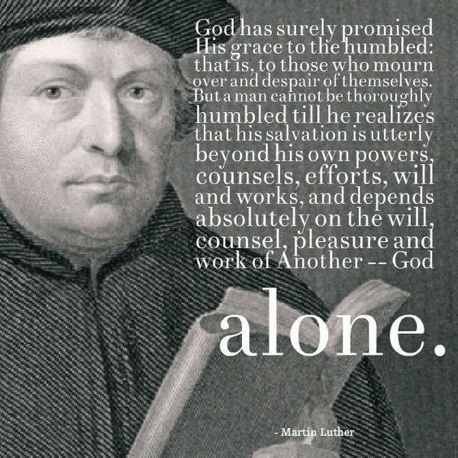
    “God has surely promised His grace to the humbled: that is to those who mourn over and despair of themselves. But a man cannot be thoroughly humbled till he realizes that his salvation is utterly beyond his own powers, counsels, efforts, will and works, and depends absolutely on the will, counsel pleasure and work of Another – God alone.” – Martin Luther

    “When a Christian comes to know Christ as his Lord and Savior, who has redeemed him from death, and is brought into His dominion and heritage, his heart is thoroughly permeated by God; then he would like to help everybody attain this blessedness. For he has no greater joy than the treasured knowledge of Christ. So he begins to teach and exhort others, confesses and commends his blessedness before everybody, and sighs and prays that they too, may come to this grace. He has a restless spirit while enjoying rest supreme, that is, God’s grace and peace. Therefore he cannot be quiet or idle but is forever struggling and striving with all his powers, as one living only to spread God’s honor and praise farther among mankind, to cause others also to receive this spirit of grace and through it also to help him pray.” – Martin Luther, as cited by Ewald Plass, What Luther Says, vol 2. Concordia Publishing House, 1955, page 959.

    “This noble Word brings with it a great hunger and insatiable thirst, so that we could not be satisfied even though many thousands of people believe on it; but we wish that no one should be without it. This thirst ever strives for more and does not rest; it moves us to speak, as David says: ‘I believed, therefore have I spoken.’” (Ps 116:10) – Martin Luther, Plass, page 959.


  • We are involved in a major capital stewardship campaign at St. John. “Abundantly More” – the title of the campaign effort – is based on Ephesians 3:20-21: Now to him who is able to do far more abundantly than all that we ask or think, according to the power at work within us, to him be glory in the church and in Christ Jesus throughout all generations, forever and ever. Amen. 

    One vital component of this campaign is the prayer vigil in which I am currently participating. Various people from St. John are taking time to pray for God’s blessing, guidance, favor, and power to be manifest through the campaign. Here are the prayer suggestions we are inviting people to use, and some thoughts about them. Having spent the last 30 minutes praying through this list, I want to share not only the list, but some thoughts. This is my way of praying through these items:

    • Thank God for all the blessings He has showered upon you. Be specific. Ask God to guide you in your Luke of these blessings – your time, your talents, and your treasure.

    Thank you, dear Father for the blessings you have showered upon me: my family, my wife and children, grandchildren, nieces, nephews, sisters, and brothers-in-law. Thank you for the home in which we live. Thank you for the technology you make available to us. Thank you for my photography gear. Thank you for our cars, our abundance of food and drink. Thank you for our friends. Thank you for the privilege of serving as pastor at St. John. Thank you for this time of prayer, for the talents you have given me, and the ways in which you allow me to serve in your kingdom.

    • Thank God for the great opportunities that He has presented to our congregation during this capital campaign.

    Praise be to you, O God, for the opportunities before us. For the opportunities to visit in the homes of our members, for the opportunities to dream and plan for the future. For the manner in which you have also forced us to think differently about the use of our campus buildings, and now for the opportunity to renovate and remodel some of the older facilities so that they serve us more effectively and efficiently. Thank you for the opportunity to step out in faith, trusting your promises as we and other smake our pledges and entrust ourselves to you for your abundant provision now and into the future.

    • Pray for forgiveness and ask for the presence of the Holy Spirit.

    Psalm 51

    Have mercy on me, O God,
    according to your steadfast love;
    according to your abundant mercy
    blot out my transgressions.
    Wash me thoroughly from my iniquity,
    and cleanse me from my sin!
    For I know my transgressions,
    and my sin is ever before me.
    Against you, you only, have I sinned
    and done what is evil in your sight,
    so that you may be justified in your words
    and blameless in your judgment.
    Behold, I was brought forth in iniquity,
    and in sin did my mother conceive me.
    Behold, you delight in truth in the inward being,
    and you teach me wisdom in the secret heart.
    Purge me with hyssop, and I shall be clean;
    wash me, and I shall be whiter than snow.
    Let me hear joy and gladness;
    let the bones that you have broken rejoice.
    Hide your face from my sins,
    and blot out all my iniquities.

    Create in me a clean heart, O God,
    and renew a right spirit within me.
    Cast me not away from your presence,
    and take not your Holy Spirit from me.

    Restore to me the joy of your salvation,
    and uphold me with a willing spirit.
    Then I will teach transgressors your ways,
    and sinners will return to you.
    Deliver me from bloodguiltiness, O God,
    O God of my salvation,
    and my tongue will sing aloud of your righteousness.
    O Lord, open my lips,
    and my mouth will declare your praise.

    • Offer a prayer of thanks that God loves you, forgives you, and redeems you.

    Psalm 103

    Bless the LORD, O my soul,
    and all that is within me,
    bless his holy name!
    Bless the LORD, O my soul,
    and forget not all his benefits,
    who forgives all your iniquity,
    who heals all your diseases,
    who redeems your life from the pit,
    who crowns you with steadfast love and mercy,
    who satisfies you with good
    so that your youth is renewed like the eagle’s.

    • Ask God to work in you through the Holy Spirit to deepen your trust and reliance on His guidance.

    Almighty God, I will trust in you – though sometimes that is so very difficult. It calls for me to wait for you. It calls for me to hope in your goodness, love, and presence. I trust you, but I don’t always trust you as I should. Help me O God. Send me your Holy Spirit so that I grow deeper in trust in you and willingness to believe and obey your word.

    • Ask for the calming power of God’s presence, and for God’s guidance to lead us to His will for St. John Lutheran Church.

    Calm my heart, O God, so that I am at peace in my soul – for you are at the helm, and you are working things together for the cause of your kingdom – your rule and reign in the hearts of all people through faith in Jesus Christ. Guide us all, and help us to follow where you lead us, doing your will in this and all things of our church.

    • Pray that people will open their homes and hearts to receive a visit to learn about, and share ideas, joys, and hopes for St. John.

    What a joy it has been for us to visit in several people’s homes, O God. Open others to this process so that we may all hear first-hand of your calling, our challenges, needs, and opportunities, and be able to make an informed decision about how to participate in this important appeal.

    My time is up now, so here are the rest of the prayer suggestions without further comment…

    • Pray that those who have been visited and made pledges will choose others to visit and share.
    • Pray that God will grant you a heart that trusts Him, a soul that steps out in obedience, and a mind that leaves success or failure to Him.
    • Pray that St. John will continue to be a strong presence for
      God in theCypress community.
    • Pray that others may come to know of God’s love, mercy and grace by our actions.
    • Pray for unity among members of our congregation.
    • Ask God to strengthen the ministries of our congregation, that we might more effectively proclaim God’s love to our members, our community, and our world.
    • Pray that these efforts might contribute to our youth’s development as disciples of Jesus.
    • That our renewed campus may be used to strengthen and unify families.
    • Acknowledge before God that everything we have belongs to Him. Ask God to move us to generosity as we dedicate our time, talent and resources to His will.
    • Pray that God’s name will be exalted in every aspect of the capital campaign. • Thank God that He can do exceedingly and abundantly more than we can ask or think.
    • After you pray, ask God to be with the other people committed to praying for the Abundantly More Capital Campaign.

    Amen…in the name of the One who can do far more abundantly than all we ask or imagine…to him be glory now and forever! Amen.

  • Soli Deo Gloria – To God Be the Glory
    Why This Sola Matters

    Here is another post from borrowed sources…Concordia Lutheran Church, San Antonio and other churches have a preaching resource offering thoughts on “What Matters Most” highlighting the five solos (or solas) of the Lutheran Reformation. I believe this may have dome from Dr. Dale Meyer, president of Concordia Seminary, St. Louis, MO. I found it to be edifying, so I am sharing it here. – DLB

    It keeps our good works good.

    The nemesis of this sola is moralism – where we don’t do what we do for God’s glory in light of what He’s done for us, but for our glory to earn God’s favor to get God to do stuff for us.

    Here’s the problem.  If that’s why we do good works, then they’re not really good – because we’re not doing them for someone else, we’re doing them for ourselves.  We expect a payoff!

    • Our love becomes utilitarian – we love so God will love us. It turns 1 John 4:19 on its head.
    • Our generosity becomes selfish – we give to get
    • Our grace becomes therapeutic – we show grace to salve our consciences


    Colossians 3:1-2 – It keeps our focus on Christ.

    “Set your hearts on things above, where Christ is, seated at the right hand of God. 2 Set your minds on things above, not on earthly things.” – Colossians 3:1-2

    When you keep in mind that what you’re ultimately doing is to God’s glory, do you know who you’re always thinking about?  God!  It shifts our focus to the right place!

    John 17:1 – It makes us look more like Christ.

    “Father, the hour has come. Glorify Your Son, that Your Son may glorify You.” John 17:1

    There’s this interesting line that Jesus prays right before He dies.

    Jesus wants to bring glory to the Father, even if it means a cross.  When we want to bring glory to God, we look like Jesus.

  • I received this from a member this morning. I offer it with the hopes you are edified. I will be taking a hiatus from blogging for an indeterminate time, so that I can re-engage in the future with a healthier focus. For more on the concept of rest/work rhythm, and the need occasionally to unplug, take a look at this blogpost: You Recharge your Phone, How About Your Soul.

    Lutheran Hour Ministries

    Daily Devotions from Lutheran Hour Ministries

    “Leftovers”

    October 19, 2017

    Psalm 51:16-17 – For You will not delight in sacrifice, or I would give it; You will not be pleased with a burnt offering. The sacrifices of God are a broken spirit; a broken and contrite heart, O God, You will not despise.

    Once upon a time, a Christian church was having a food drive. You know, the kind of program where the congregation was asking people to give canned goods, boxed goods, things that — like Hostess Twinkies — had a “forever” shelf-life.

    One mother, with her six-year-old, was going through her pantry. As she shuffled things around, she came across a bottle of beets. She brought those out. She found some condensed milk, which was also set aside. Lastly, she found some lima beans and placed that can with the other two.

    Surveying her gifts, mom said to her daughter, “There, that will do, and we won’t miss these things; nobody here likes them.”

    It took but a second for the girl to politely ask, “But if we give them only what we don’t want, aren’t they helping us?”

    Well, that may have been the case at a Cardiff food bank in Wales, Great Britain. The workers at the place were shocked to get a can of soup with unusual markers on the label. An examination of the price tag said the soup had been sold so long ago the country was using a different currency.

    The soup, Heinz kidney soup, was 46 years old. That type of soup itself had been discontinued more than 35 years before. In the same donation, was a can of Green Giant sweet corn whose label revealed it was a recent newcomer, having been canned in the 1980s.

    In spite of the shock, the manager of the food bank put the best construction on the gift when she stated, “It’s out of a generous heart, but I just think they don’t think and don’t necessarily look at the dates.” They are keeping both cans to educate folks on what people shouldn’t give.

    You know, I wonder how the Lord scans the gifts which come in for Him.

    The story of the widow’s mites tell us God doesn’t look with disfavor on gifts which flow from a solid, sincere heart. He certainly is more impressed by those donations than He is by all those who gave a bunch, but are only sacrificing a small percentage of the bounty the Lord has bestowed.

    The Psalmist tells us the Lord, who really owns everything, is not all that interested in sacrifices which cost a few coins, but leaves the individual untouched. Nor is the Lord going to be overwhelmed by a burnt sacrifice, which is only some individual going through the motions.

    What the Lord wants, first, foremost, and always is a Christian heart which has seen the Savior’s sacrifice and is moved to respond. That response may be shown through financial gifts, but it always finds its source in a broken and contrite heart.

    When we take a look at where we once were headed eternally and where we are going now, we should be touched with gratitude. When we see the Savior who left a heavenly throne to die on a cruel cross, we cannot help responding with a life of thanks and praise which begins in a new heart.

    THE PRAYER: Dear Lord, accept our hearts which, having been cleansed of sin’s stain by the Savior’s sacrifice, are willing to respond. May our gratitude, like Your grace and love, be undying. In Jesus’ Name I ask it. Amen.

    In Christ I remain His servant and yours,
    Pastor Ken Klaus
    Speaker Emeritus of The Lutheran Hour
    Lutheran Hour Ministries

    The above devotion was inspired by a number of sources, including one written by Daniel Uria for the UPI on October 7, 2017. Those who wish to reference that article may do so at the following link, which was fully functional at the time this devotion was written: click here.