David Bahn – Reflections

Light from the Word and through the lens

  • Click here for an audio version of this blog post.

    It was now the fifteenth year of the reign of Tiberius, the Roman emperor. Pontius Pilate was governor over Judea; Herod Antipas was ruler over Galilee; his brother Philip was ruler over Iturea and Traconitis; Lysanias was ruler over Abilene. Annas and Caiaphas were the high priests. At this time a message from God came to John son of Zechariah, who was living in the wilderness. Then John went from place to place on both sides of the Jordan River, preaching that people should be baptized to show that they had repented of their sins and turned to God to be forgiven. Isaiah had spoken of John when he said,

    “He is a voice shouting in the wilderness,
    ‘Prepare the way for the Lord’s coming!
        Clear the road for him!
    The valleys will be filled,
        and the mountains and hills made level.
    The curves will be straightened,
        and the rough places made smooth.
    And then all people will see
        the salvation sent from God.’”

    When the crowds came to John for baptism, he said, “You brood of snakes! Who warned you to flee the coming wrath? Prove by the way you live that you have repented of your sins and turned to God. Don’t just say to each other, ‘We’re safe, for we are descendants of Abraham.’ That means nothing, for I tell you, God can create children of Abraham from these very stones. Even now the ax of God’s judgment is poised, ready to sever the roots of the trees. Yes, every tree that does not produce good fruit will be chopped down and thrown into the fire.”

    10 The crowds asked, “What should we do?”

    11 John replied, “If you have two shirts, give one to the poor. If you have food, share it with those who are hungry.”

    12 Even corrupt tax collectors came to be baptized and asked, “Teacher, what should we do?”

    13 He replied, “Collect no more taxes than the government requires.”

    14 “What should we do?” asked some soldiers.

    John replied, “Don’t extort money or make false accusations. And be content with your pay.” 

    – Luke 3:1-14 [New Living Translation]

    Church Spires, Flag Poles, & Light Standards | Koblenz, Germany | December 2021

    We were ready to check out of the hotel, but there was a credit on our account, and we wanted to use it for an early lunch. When I checked with the hotel front desk they suggested that we wait to check out until after we had eaten and signed for our lunch. That way we would be more easily able to get the credit applied to our bill and have a free lunch of sorts. Sometimes timing is everything…or at least something.

    Luke anchors this part of his Jesus biography in a very specific time. It was the fifteenth year of the reign of Tiberius. Pontius Pilate was governor. Herod Antipas was ruler over Galilee. Philip was ruler over Iturea and Traconitis. Lysanias was ruler over Abilene. Annas and Caiaphas were the high priests. At this time John the Baptizer appears and calls people to repent, and to show that they had truly repented by the way they lived.

    This is no Once-Upon-A-Time fairy tale. This is an historical event in a specific place and time – sometime between 27-29 AD. But there is more here. Tiberius was known as a ruthless and cruel Roman emperor. Pontius Pilate was ineffectual and given to over-reaction and unnecessary brutality. Herod’s family was corrupt and cruel. Such was the political situation as John begins to call people to repentance. 

    I note that the powerful, ruthless, cruel, and corrupt leaders – who need more than the others to repent – are not moved by John’s call. The ones who were powerful and in control were more concerned in keeping their power than in connecting with the Ultimate Power over all creation and creatures. Their ears were deaf to John’s call, and their hearts were closed to their need to repent. 

    Against that backdrop the people come to be baptized. And the very ones who come John calls a bunch of snakes! This is not the Dale Carnegie manner of How to Win Friends and Influence People! But John is not interested in winning friends. He is committed to leveling the playing field in preparation for Jesus’ public ministry. He is preparing the way for Jesus to come. He is the voice in the wilderness, raising valleys and razing mountains. He is making a straight path to God. And it’s a path that is found in repentance.

    The importance of timing here is two-fold. It anchors these events in history, not philosophy. And as such it ties us to that time and situation. We have all manner of leaders and powerful people who care more about their power than their relationship with God. But even if they don’t repent we must. And that is the second truth: now is the time for us to repent. Joe Biden is President of the United States. Vladimir Putin is President of Russia. Greg Abbot is governor of Texas. Matthew Harrison is President of the LCMS. Michael Newman is President of the LCMS Texas District. 

    You might have thoughts about each of these men and their need to repent. But that is for them to deal with. We each must repent and rejoice in knowing that God has prepared a level and straight path to life and salvation: the path of faith that leads us to Jesus.


  • For your personal meditation and reflection on this Lord’s Day.

    Psalm 23

    The Lord is my shepherd; I shall not want.
        He makes me lie down in green pastures.
    He leads me beside still waters.
        He restores my soul.
    He leads me in paths of righteousness
        for his name’s sake.

    Even though I walk through the valley of the shadow of death,
        I will fear no evil,
    for you are with me;
        your rod and your staff,
        they comfort me.

    You prepare a table before me
        in the presence of my enemies;
    you anoint my head with oil;
        my cup overflows.
    Surely goodness and mercy shall follow me
        all the days of my life,
    and I shall dwell in the house of the Lord
        forever.

    Psalm 53:1-3

    The fool says in his heart, “There is no God.”
        They are corrupt, doing abominable iniquity;
        there is none who does good.

    God looks down from heaven
        on the children of man
    to see if there are any who understand,
        who seek after God.

    They have all fallen away;
        together they have become corrupt;
    there is none who does good,
        not even one.

    Psalm 83:1

    O God, do not keep silence;
        do not hold your peace or be still, O God!

    Psalm 113:1-3

    Praise the Lord!
    Praise, O servants of the Lord,
        praise the name of the Lord!

    Blessed be the name of the Lord
        from this time forth and forevermore!
    From the rising of the sun to its setting,
        the name of the Lord is to be praised!

    Psalm 143:1-10

    Hear my prayer, O Lord;
        give ear to my pleas for mercy!
        In your faithfulness answer me, in your righteousness!
    Enter not into judgment with your servant,
        for no one living is righteous before you.

    For the enemy has pursued my soul;
        he has crushed my life to the ground;
        he has made me sit in darkness like those long dead.
    Therefore my spirit faints within me;
        my heart within me is appalled.

    I remember the days of old;
        I meditate on all that you have done;
        I ponder the work of your hands.
    I stretch out my hands to you;
        my soul thirsts for you like a parched land. Selah

    Answer me quickly, O Lord!
        My spirit fails!
    Hide not your face from me,
        lest I be like those who go down to the pit.
    Let me hear in the morning of your steadfast love,
        for in you I trust.
    Make me know the way I should go,
        for to you I lift up my soul.

    Deliver me from my enemies, O Lord!
        I have fled to you for refuge.
    10 Teach me to do your will,
        for you are my God!
    Let your good Spirit lead me
        on level ground!

  •  

    Now his parents went to Jerusalem every year at the Feast of the Passover. 42 And when he was twelve years old, they went up according to custom. 43 And when the feast was ended, as they were returning, the boy Jesus stayed behind in Jerusalem. His parents did not know it, 44 but supposing him to be in the group they went a day’s journey, but then they began to search for him among their relatives and acquaintances, 45 and when they did not find him, they returned to Jerusalem, searching for him. 46 After three days they found him in the temple, sitting among the teachers, listening to them and asking them questions. 47 And all who heard him were amazed at his understanding and his answers. 48 And when his parents saw him, they were astonished. And his mother said to him, “Son, why have you treated us so? Behold, your father and I have been searching for you in great distress.” 49 And he said to them, “Why were you looking for me? Did you not know that I must be in my Father’s house? 50 And they did not understand the saying that he spoke to them. 51 And he went down with them and came to Nazareth and was submissive to them. And his mother treasured up all these things in her heart.

    52 And Jesus increased in wisdom and in stature and in favor with God and man. – Luke 2:41-52

    Just Three Trees in the Fog | Koblenz, Germany | December 2021

    We’ve been teaching ESL to some non-native, non-English-speaking people. That is not unusual for ESL classes. But these non-native folks are from Asia and their accents are so strong, that it is very difficult for them to form words we are used to saying every day. The result is two-fold. First of all we cannot understand them very well at all. Second, and because of that, they are embarrassed and possibly also frustrated. I have to say, however, that they have made progress, and their attitude is excellent. It is just difficult for us to understand them from time to time. And they us, I’m sure. 

    Mary and Joseph are experiencing a difficulty of understanding Jesus of a different kind. He tells them that he must be in his Father’s house. It seems clear to us today that Jesus was speaking of his Heavenly Father, and of the temple as his house. Jesus is the Son of God. His allegiance is to his Heavenly Father. His Father’s house is where he belonged. That’s true even as he will now return to Nazareth the Mary and Joseph and lived in submission to their authority, and as their human son. 

    I guess they didn’t understand what he said because he was still a young boy. He would need his human parents’ care. He still needed to grow in wisdom and stature, as well as in favor with God and man. So to some degree I get it: his comment about needing to be in his father’s house might seem precocious. Or confusing. 

    But it also makes me wonder what we might not fully understand of Jesus’ words and life. What might we scratch our heads at? Some things Jesus says are truly confusing. The parable of the unjust steward (Luke 6:1-13) comes to mind. The teaching about the end of the world is confusing to some. And some things Jesus teaches are patently hyperbole. Jesus speaks of straining a gnat and swallowing a camel (Matthew 23:24).

    But there are plenty of things Jesus says that are not difficult to understand. Rather than getting distracted with trying to grasp things too confusing or profound, we do better to take to heart those things we do understand.

    • Unless you too, repent you will likewise perish. – Luke 13:3
    • Let not your hearts be troubled. Believe in God. Believe also in me. – John 14:1
    • Which of you by worrying can add a single hour to his life? – Matthew 6:27
    • What will it profit a man if he gains the whole world but forfeits his soul? – Matthew 16:26
    • There is joy in heaven over one sinner who repents. – Luke 15:10
    • The time has come. The kingdom of God is at hand. Repent and believe the gospel. – Mark 1:15
    • Surely I am with you always, even to the end of the age. – Matthew 28:29

    Martin Luther is to have said, “When you come to a part of the Bible you don’t understand, praise God, pass it by and read on.” Good advice. For every word of Jesus that we don’t understand there are surely 50 or more that we do. 

  • Click here for an audio version of this blog post.

    Now his parents went to Jerusalem every year at the Feast of the Passover. 42 And when he was twelve years old, they went up according to custom. 43 And when the feast was ended, as they were returning, the boy Jesus stayed behind in Jerusalem. His parents did not know it, 44 but supposing him to be in the group they went a day’s journey, but then they began to search for him among their relatives and acquaintances, 45 and when they did not find him, they returned to Jerusalem, searching for him. 46 After three days they found him in the temple, sitting among the teachers, listening to them and asking them questions. 47 And all who heard him were amazed at his understanding and his answers. 48 And when his parents saw him, they were astonished. And his mother said to him, “Son, why have you treated us so? Behold, your father and I have been searching for you in great distress.” 49 And he said to them, “Why were you looking for me? Did you not know that I must be in my Father’s house? 50 And they did not understand the saying that he spoke to them. 51 And he went down with them and came to Nazareth and was submissive to them. And his mother treasured up all these things in her heart.

    52 And Jesus increased in wisdom and in stature and in favor with God and man. – Luke 2:41-52

    Trees in the Fog | Koblenz, Germany | December 2021

    What is your favorite memory from the time you were 10 years old? How about when you were 30, or 40? It might be a special Christmas present. It could be a successful project at your job, a new car, or your children’s achievements in sports or school. You might have other memories that are not so pleasant. It could be the day you learned a loved-one was diagnosed with cancer. Or you learned that a friend had died.  These are the things that we either treasure in our hearts, or wish we could forget. 

    We are told here that Mary treasured all these things in her heart. And this is the second time we are told this. The first was at Jesus’ birth and the visit of the shepherds. Now it is the three day lost and found adventure when they found Jesus in the temple. 

    I am struck by the word, “all,” in this passage. I’m wondering how it would be that she treasured a three day search, or the difficulty of a birth in a barn. And I think I have a clue. 

    It has to do with discerning God’s work in our lives and realizing that not all good or pleasant things are best for us. It also has to do with realizing how God uses difficulty for our good. And it has to do with recognizing that God really does work all things together for good for those who love him and are called according to his purpose. 

    It reminds me of the fable of the wise man and the farmer’s son. The son has a terrible accident on the farm, and a neighbor says, “That’s so bad.” The wise man says, “We’ll see.” Then war breaks out and all the able-bodied men are drafted into the army’s service. His neighbor says, “He is sure lucky since his injury prevented him from being drafted.” The wise man says, “We’ll see.” Then the enemy army invades and takes his son captive. The neighbor says, “That’s so sad.” The wise man says, “We’ll see.” While he is captive he learns of the enemy’s plans and manages to escape and shares the enemy’s plans. The neighbor says, “How fortunate!” The wise man says, “We’ll see.” And the story goes on and on like that. What may look good one day can become a difficult situation the next. 

    But God has a big-picture view of life. He is writing a saga of redemption, salvation, glory, and blessing for all people through Jesus. And I believe that Mary knew this. I don’t think she fully understood it, but she seems to have believed it. So she treasures the good and the bad, because Jesus, her son, is the Son of God. His birth was miraculous. His life would unfold in ways that would defy simple assessments of good or bad moments. 

    This is good for me to remember. What may seem like a set-back may be a set-up for something profoundly good. What may seem good may become a moment’s fleeting joy that dissolves into disappointment. But when we look to God, and see ourselves as part of his grand story of redemption we can hold all manner of things in our hearts. When we do we can look for God’s redeeming love to sustain us and work all things for our good. 

    For God is good and is working for the eternal blessing of all people. And it’s all connected to our faith Jesus.

  • Click here for an audio version of this blog post.

    Now his parents went to Jerusalem every year at the Feast of the Passover. 42 And when he was twelve years old, they went up according to custom. 43 And when the feast was ended, as they were returning, the boy Jesus stayed behind in Jerusalem. His parents did not know it, 44 but supposing him to be in the group they went a day’s journey, but then they began to search for him among their relatives and acquaintances, 45 and when they did not find him, they returned to Jerusalem, searching for him. 46 After three days they found him in the temple, sitting among the teachers, listening to them and asking them questions. 47 And all who heard him were amazed at his understanding and his answers. – Luke 2:41-47

    Christmas Market Pyramid | Frankfurt, Germany | December 2021

    She was precocious. She asked questions that were presumptious. Cheeky. Improperly assuming knowledge and insight beyond her years. It actually caused me to be a bit afraid – of an 8 year old girl! More than intimidating, it is off-putting. Like I said, Cheeky! Presumptuous. Precocious. What is it with these 8 or even 18-year-old boys or girls trying to tell me how the cow ate the cabbage? (Yes, it is a real figure of speech!) And don’t get me started with 30-year-olds who think they’ve got nothing to learn…not that I’m speaking from experience.

    So here is Jesus sitting in the temple, sitting with the teachers and asking them questions! On some level this is like an eighth grader discussing quantum physics with rocket scientists. It’s like a 12-year-old discussing the Genus Apotelesmaticum with a theology professor – although Jesus was living that reality before their very eyes. In this encounter and teaching and questioning Jesus had the inside track. He knew all about it all. He was God in the flesh. And though he still had things to learn, and wisdom to gain, he apparently had insights enough to hold his own. 

    “And all who heard him were amazed at his understanding and his answers.” He made quite an impression. But it seems that he was not thought to be precocious. There is not sense of cheekiness here. Nor is there any apparent presumption on his part – though it would be difficult for God to be presumptuous! Even now, however, Jesus was living out his mission in a state of humiliation (in the theological sense of the term). He, was God, but he did not think of equality with God as something to cling to. Instead, he gave up his divine privileges; he took the humble position of a slave and was born as a human being. He appeared in human form, and will humble himself in obedience to God and die a criminal’s death on a cross (cf. Philippians 2). 

    On the mountain of transfiguration Jesus’ deity would leak out for Peter, James, and John to see. And now, if they would recognize it, the true identity of Jesus as the Son of God was peeking out from behind the curtains. But it is only a peek. He will make nothing of it, except to remind his mom that his Father was the Heavenly Father, and that he would be dedicating himself to his Heavenly Father’s business. 

    When it comes to presumptuous behavior we human beings have that down to an art. Somehow we get the idea that we can call God into account for his actions toward us. We can question how God is drawing the lines in our lives and the lives of others. We can put God in the dock as C.S. Lewis speaks of. We can act as though God has to answer to us. But he does not.

    Jesus would ask questions his whole life and ministry. “What do you think? A man had two sons… What does the Word say? How do you read it? What can a man give in exchange for his soul? Who among you, by worrying, can add even a single hour to your life? Or, “What do you want me to do for you?” Jesus, as a 12-year-old boy is just now getting started. 

    What question would Jesus ask you? Would it be a challenge? Would it lead you to repentance? Would it be an invitation? Would he point you to hope? In either case, his questions might well amaze us too. 

  • Click here for an audio version of this blog post.

    Now his parents went to Jerusalem every year at the Feast of the Passover. 42 And when he was twelve years old, they went up according to custom. 43 And when the feast was ended, as they were returning, the boy Jesus stayed behind in Jerusalem. His parents did not know it, 44 but supposing him to be in the group they went a day’s journey, but then they began to search for him among their relatives and acquaintances, 45 and when they did not find him, they returned to Jerusalem, searching for him. 46 After three days they found him in the temple, sitting among the teachers, listening to them and asking them questions. 47 And all who heard him were amazed at his understanding and his answers. 48 And when his parents saw him, they were astonished. And his mother said to him, “Son, why have you treated us so? Behold, your father and I have been searching for you in great distress.” 49 And he said to them, “Why were you looking for me? Did you not know that I must be in my Father’s house? 50 And they did not understand the saying that he spoke to them. 51 And he went down with them and came to Nazareth and was submissive to them. And his mother treasured up all these things in her heart.

    52 And Jesus increased in wisdom and in stature and in favor with God and man. – Luke 2:41-52

    High Castle | Anweiler, Germany | December 2021

    Wikipedia mentions three “quest[s] for the historical Jesus.” These are “academic efforts to determine what words and actions, if any, may be attributed to Jesus, and to use the findings to provide portraits of the historical Jesus.” The idea is at least somewhat interesting, but certainly does not reflect a high regard for the truthfulness of the Bible. From my perspective it treats gaps or omissions between the accounts as though they are contradictions – which they are most assuredly not. 

    For example, Matthew records Jesus’ flight to Egypt and the visit of the Magi. The other gospel writers do not. That’s not a contradiction. That’s simply an editorial choice. God used each of the gospel writers – replete with their unique personalities and perspectives – to paint a portrait of Jesus. Matthew shows how Jesus is the fulfillment of Old Testament prophecies. Mark shows the urgency of preaching the gospel. Luke has miracles and shows Jesus as Savior. John shows again and again that Jesus is the Son of God. None of these contradict the others. They complement each other. They give us a more wholistic picture of Jesus. 

    Mary and Joseph are on a quest for the missing Jesus. And think of it: they’ve lost the Savior! They’ve lost the Son of God! They’ve lost the fulfillment of all the Old Testament prophecies, hopes, and dreams. They’ve lost the one who preaches the gospel to those who are in need (that’s us, by the way!). And they are urgently trying to find him. 

    They are trying to find him because they have a responsibility for his care. They have been entrusted with this child. He is part of their family, and as such they must raise him, provide for his needs, teach, and direct him until that time comes for him to leave home and strike out on his own. 

    We need to find Jesus for a different reason. We have been entrusted with him. We have been given the privilege of holding him in our hearts. And we are responsible for letting others know who he is and what he has done for them and for the sake of the whole world. But we need to find Jesus for our sakes as well. We need Jesus. We need his mercy and love. We need his grace and forgiveness. We need his word of grace and truth. We need his salvation.

    That truth comes more and more clear to me every day: I need Jesus. I need to find him in my heart. I need him in my mind. I need him in my life. For there are so many distractions, doubts, and detractors from Jesus’ grace and truth. We’re told all too often that we don’t really need to comply with God’s ways; we can choose our own path. Because of that, there is little need for grace. And while Jesus may teach about love, in the minds of the world, his definition of love is far too narrow. 

    Then there’s my own sinful flesh. This is “the good I would do, I do not do” (Romans 7) battle that seems to rear its ugly head all too often. It’s all too easy to hide Jesus in the folds of a busy life, opportunities for self-indulgence, and the blindness to my own faults, or  the slippery slope of life on my own. Where’s Jesus? Who cares; I’d just as soon that he stays over there in a corner, and does not bother me. 

    So where’s Jesus in those moments? He’s in the disturbing, nagging voice of my conscience. He’s in the dark moments of a sleepless night. He’s in his Word. He’s with his people. He’s in his Father’s house.

    This is the reason for regular worship. This is why I write this blog. This is why we read the Bible. This is why we pray. For we all need Jesus. And, thankfully, he’s right here for us. He has come to us, and continues to do so through his word, and through the sacraments. He sends his Holy Spirit to us to call us back again and again to himself. 

    Martin Luther famously said, “When our Lord and Master Jesus Christ called us to repent, he meant that the entire life of the believer should be one of repentance.” And when we repent, we will discover that Jesus has already come to us, is waiting for us, and has open arms (think the cross!) and an open heart. Just like Jesus’ parents discovered that he was not lost at all, we will discover that he has never abandoned us. We’ve abandoned him. Thank God he’s ready to be found, and welcomes us back into his heart whenever we repent.

  • Click here for an audio version of this blog post.

    Every year Jesus’ parents went to Jerusalem for the Passover festival. 42 When Jesus was twelve years old, they attended the festival as usual. 43 After the celebration was over, they started home to Nazareth, but Jesus stayed behind in Jerusalem. His parents didn’t miss him at first,44 because they assumed he was among the other travelers. But when he didn’t show up that evening, they started looking for him among their relatives and friends.

    45 When they couldn’t find him, they went back to Jerusalem to search for him there. 46 Three days later they finally discovered him in the Temple, sitting among the religious teachers, listening to them and asking questions. 47 All who heard him were amazed at his understanding and his answers.

    48 His parents didn’t know what to think. “Son,” his mother said to him, “why have you done this to us? Your father and I have been frantic, searching for you everywhere.”

    49 “But why did you need to search?” he asked. “Didn’t you know that I must be in my Father’s house?” 50 But they didn’t understand what he meant.

    51 Then he returned to Nazareth with them and was obedient to them. And his mother stored all these things in her heart.

    52 Jesus grew in wisdom and in stature and in favor with God and all the people. – Luke 2:41-52

    High Castle | Anweiler, Germany | December 2021

    If you have children or grandchildren, you’ve likely seen the book, Where’s Waldo. Throughout the book, on page after page, there are large numbers of things: people, toy cars, houses, hats, various people, bicycles, airplanes, flowers, musical instruments; the list goes on…did I say people? And on every page there is a cute little guy, Waldo, wearing a red and white striped hat and sweater. (See image below)

    The challenge is to look at each page to find the little character who seems to be able to hide quite well. It’s fun to see the pictures and to search for Waldo. Maybe parents and grandparents love it more than the little ones. 

    Mary and Joseph are in a “where’s Jesus” search on their trip home from Jerusalem. They thought the 12-year-old Jesus was with them, or perhaps with extended family along the way back to Nazareth. But he was nowhere to be found. And it wasn’t a matter of finding him among the caravan of folks with them. They determined that they would have to return to Jerusalem to retrieve the boy. And it’s not until the third day that they find him. I can imagine their worry. 

    Is he with your Uncle? No. 

    Your sister-in-law’s friend? No.

    Maybe he took up with the local carpenter. No.

    What about checking out the Shabbat Schools? Maybe a rabbi took him in. No.

    Let’s go to the temple. Let’s call on God to help us. Yes.

    And there they find him. Sitting in the temple. Among the rabbis there. Asking (and answering?) questions. I think their consternation is understandable. They’ve been searching for three days. They thought that he would be responsible to connect with their homeward-bound group. But he had not. So Mary exclaims: “Son, why have you done this to us?” 

    Why indeed. This is a better question than you might imagine. That’s especially true if you consider the question in a wider sense than the all-to-be-expected exasperation of a worried mom and dad. We go there so very easily. We see people as doing things to us, as though we are the focus and interest of everyone else in the world. when things happen to us – especially through the agency of someone close to us, or in the case of someone who is obviously set on our harm – we quickly conclude that there is an intent to upset or harm us.

    And it may be true. There are people who do want to hurt us. Sometimes it’s those who are close to us, but who are angry with us and want to strike back. But not everyone is out to hurt us. Not everyone is focused on pleasing or distressing us. We are not the center of the universe. It’s not all about us. 

    But Jesus’ actions are all about us. He was where he was because he had to be about his Father’s business (or in his Father’s house). Most translations have “Father’s house.” But the Greek says, literally, “about the things of my Father.” Jesus shows that he is very clear about two things here. First that he knew there was a necessity to which he must attend if he was to be true to his identity as the Savior. Second, that Joseph as not his true Father. He was the Son of God. He knew where his allegiance lay. 

    And that’s why he did what he did, treating his parents as he did. So, while life may not be all about you. Jesus is all about saving you and all people. That’s why he came. That’s why he did what he did. 

  • For your personal meditation and reflection on this Lord’s Day.

    Psalm 16:1

    Preserve me, O God, for in you I take refuge.
    I say to the LORD, “You are my Lord;
    I have no good apart from you.”

    Psalm 46

    God is our refuge and strength,
    a very present help in trouble.
    Therefore we will not fear though the earth gives way,
    though the mountains be moved into the heart of the sea,
    though its waters roar and foam,
    though the mountains tremble at its swelling. Selah
    There is a river whose streams make glad the city of God,
    the holy habitation of the Most High.
    God is in the midst of her; she shall not be moved;
    God will help her when morning dawns.
    The nations rage, the kingdoms totter;
    he utters his voice, the earth melts.
    The LORD of hosts is with us;
    the God of Jacob is our fortress. Selah
    Come, behold the works of the LORD,
    how he has brought desolations on the earth.
    He makes wars cease to the end of the earth;
    he breaks the bow and shatters the spear;
    he burns the chariots with fire.
    “Be still, and know that I am God.
    I will be exalted among the nations,
    I will be exalted in the earth!”
    The LORD of hosts is with us;
    the God of Jacob is our fortress. Selah

    Psalm 76:1-3

    In Judah God is known;
    his name is great in Israel.
    His abode has been established in Salem,
    his dwelling place in Zion.
    There he broke the flashing arrows,
    the shield, the sword, and the weapons of war. Selah

    Psalm 106:1-5

    Praise the LORD!
    Oh give thanks to the LORD, for he is good,
    for his steadfast love endures forever!
    Who can utter the mighty deeds of the LORD,
    or declare all his praise?
    Blessed are they who observe justice,
    who do righteousness at all times!
    Remember me, O LORD, when you show favor to your people;
    help me when you save them,
    that I may look upon the prosperity of your chosen ones,
    that I may rejoice in the gladness of your nation,
    that I may glory with your inheritance.

    Psalm 136:1-9

    Give thanks to the LORD, for he is good,
    for his steadfast love endures forever.
    Give thanks to the God of gods,
    for his steadfast love endures forever.
    Give thanks to the Lord of lords,
    for his steadfast love endures forever;
    to him who alone does great wonders,
    for his steadfast love endures forever;
    to him who by understanding made the heavens,
    for his steadfast love endures forever;
    to him who spread out the earth above the waters,
    for his steadfast love endures forever;
    to him who made the great lights,
    for his steadfast love endures forever;
    the sun to rule over the day,
    for his steadfast love endures forever;
    the moon and stars to rule over the night,
    for his steadfast love endures forever.

  • Click here for an audio version of this blog post.

    Anna, a prophet, was also there in the Temple. She was the daughter of Phanuel from the tribe of Asher, and she was very old. Her husband died when they had been married only seven years. 37 Then she lived as a widow to the age of eighty-four. She never left the Temple but stayed there day and night, worshiping God with fasting and prayer. 38 She came along just as Simeon was talking with Mary and Joseph, and she began praising God. She talked about the child to everyone who had been waiting expectantly for God to rescue Jerusalem. 

    39 When Jesus’ parents had fulfilled all the requirements of the law of the Lord, they returned home to Nazareth in Galilee. 40 There the child grew up healthy and strong. He was filled with wisdom, and God’s favor was on him. – Luke 2:36-40

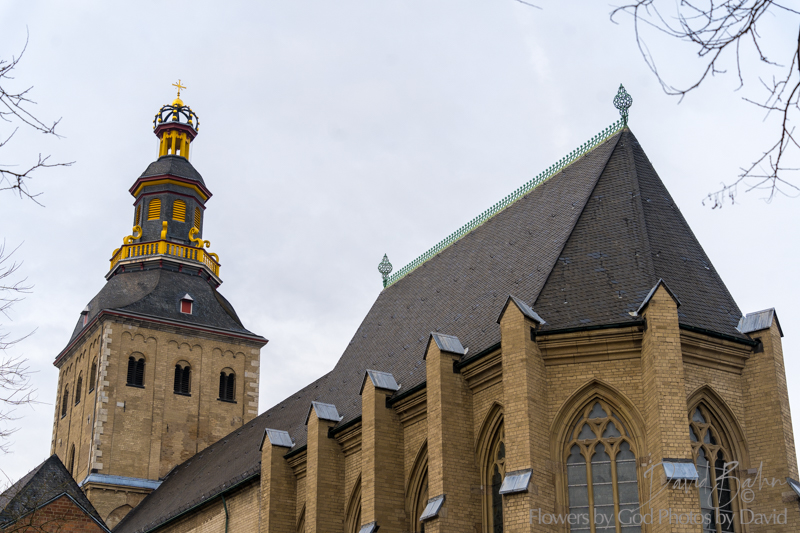
    Saint Ursula Cathedral | Cologne, Germany | December 2021

    I was in college – second go-round. I had nearly made the less-than-auspicious dean’s list a year earlier and had taken some time away. But now I was back and on a much better track. Rather than D’s and F’s I was earning A’s and B’s. Only part of the reason for that was the fact that the class load I carried was not exactly the most challenging. But still… A’s and B’s are better than D’s and F’s any day. My philosophy professor (Yes, it was an easy A, don’t laugh!) got to know me well. I told him of my life’s challenges at the time. 

    I had come to class one day sharing from Jesus’ Sermon on the Mount only to be strongly challenged and roundly ridiculed. I had met the love of my life and she was 5000+ miles away, studying for a semester in Germany. I was helping at my parents’ motel and enduring significant isolation and loneliness. And I was trying to figure out how my faith would really integrate with my life. I was in a crucible of sorts. 

    My professor knew some of these things, and pondered out loud, “I wonder what you are being prepared for.” I’m not sure he had God in the picture of my refining. I’m not sure he even factored God into any equation. But he did recognize that things were happening which were and would shape me for years to come. That’s what God does. He shapes people through our experiences, relationships, his word, and his providential daily guidance. 

    I’m thinking about that in regard to Jesus, even at this very early age. He’s barely 8 days old and already things are happening to him and around him that will be played out in his life and ministry. He was now a Son of the Covenant through circumcision. He was dedicated to the Lord by way of his parents’ obedience to the Law of Moses. He was identified as God’s salvation by Simeon. He was the source of Anna’s praise at this encounter. 

    But we don’t have to wonder what God had in mind for him. We know what he was being prepared for. He was being prepared for his life and ministry as God incarnate, the fulfillment of all of the prophecies and promises of God, the Second Adam, the embodiment of all that man was created to be. And it was beginning to unfold in the sight of the world in these days. 

    But it would not come immediately. Jesus’ ministry would not unfold publicly for 30 years. He would grow up in his hometown of Nazareth, under the care and guidance of his parents, and as his age, wisdom, physical strength, and social stature progressed. Jesus was not delivered as a done deal, a complete package.

    Jesus will grow up healthy and strong. Although he was already filled with wisdom, and God’s favor was already on him, there would be more to learn, more to be done. More opportunities to display his love for God and man. And while his earthly destiny would lead him to a horrific death on a cruel Roman cross, his ultimate destiny is that at his name every knee would bow in heaven and on earth, and every tongue confess that Jesus Christ is Lord, to the glory of God the Father.

    I believe Jesus Christ, true God, begotten of the Father from eternity, and true man, born of the Virgin Mary is my Lord. He has redeemed me, purchased and won me from sin, death, and the power of the devil. He did this not with gold or silver, but with his holy precious blood, his innocent suffering and death. He did this so that I may be his own and live under him in his kingdom, and serve him in eternal righteousness, innocence, and blessedness. And just as he was raised from the dead, he lives and reigns with the Father for all eternity. (Based on Luther’s Small Catechism, explanation to the 2nd Article of the Apostle’s Creed)

    All this begins now to unfold at the temple when Jesus is just 8 days old. What is God preparing you for today – no matter how old you are?

  • Click here for an audio version of this blog post.

    Anna, a prophet, was also there in the Temple. She was the daughter of Phanuel from the tribe of Asher, and she was very old. Her husband died when they had been married only seven years. 37 Then she lived as a widow to the age of eighty-four. She never left the Temple but stayed there day and night, worshiping God with fasting and prayer. 38 She came along just as Simeon was talking with Mary and Joseph, and she began praising God. She talked about the child to everyone who had been waiting expectantly for God to rescue Jerusalem. – Luke 2:36-38

    Trifels Castle | Antweiler, Germany | December 2021

    You may be able to identify with this. It’s not so true anymore, but when I was working full time, it was a well-worn pattern. I would come into the house at the end of the day, stick my head in the office where Diane was most often at work, and say, “Hi Babe! How was your day?” All I really wanted was to acknowledge her, let her know that I was home and receive a condensed executive summary of her wellbeing at the moment. I should have said, “Hi, Diane. I’m home. Hope you are doing well. I can’t wait to hear about your day after I’ve had a few moments to decompress. I’m not ready to listen to you now, but I’ll give you my full attention later this evening. You OK with that?” Or something like that.

    But I most often would not do that, and Diane took me at my word. She would begin to tell me about her day. I’m not a details person, and she is. So I would zone out after three or four specifics and she would need to keep filling in the details. So many words!

    I shouldn’t talk. Because I do talk – at least I did talk for a living. As a pastor, I would lead, teach, preach, counsel, direct, and advise regularly. I had lots of words and used them. In fact I have so many words that today, I find the hard drive in my head spinning furiously seeking the word that I know is there, but can’t quite bring to mind! But I digress. Words. How many do you have? How do you use them? 

    Anna apparently had many words. She used them to praise God, worshiping and praying day and night. And once she saw the Baby Jesus, she used her words to tell people about the child. Can you imagine what she said? Did she talk about how cute he was? Maybe. Maybe not. I’m not sure that was an item of conversation in those days. Did she talk about how Simeon blessed the child and spoke his prayer to God upon seeing him? Did she point people to the prophecies of Scripture and tell them that this Jesus was the promised One? Did she talk about what it meant that the Messiah had come? That Scripture had been fulfilled? That God had broken his 400 year silence? 

    It’s easy to get into a conversation these days. Mention COVID. Ask about families’ health. Comment on masks, vaccines, or mandates. You’re likely to unplug a pent-up spew of words – all emotionally-laden and charged. But what if we would learn to see Jesus at work in our lives? What if we would marvel at his grace toward us? What if we made a point of bringing people words of grace and life? 

    Anna couldn’t help herself in that moment. Perhaps you’ll experience a moment like that as well, when God shows up, and reminds you of his goodness, faithfulness, and love. Maybe we could pray for such moments. That’s what Anna had been doing prior to this encounter.