In 1968 Jerry Snell opened a door in the hallway outside our first hour chemistry class. He invited me into what I discovered was a darkroom. Soon I was on the school newspaper and annual staff as a photographer. Later I learned that Jerry was a Lutheran who was planning to become a pastor. A few years later I was not only a Lutheran, but I was heading off to seminary to become a Lutheran pastor, too. Jerry followed a year later and served as a pastor in Missouri until his untimely heart attack and death. I thank God for Jerry and enjoy photography still today – not to mention rejoicing in having served as a Lutheran pastor in congregations in Utah, Colorado, Arkansas and Texas. I’ve retired now and serve part time as a Congregational Support Specialist for the Texas District of the LCMS. I also provide coaching and leadership training through various PLI cohorts and with individual congregations and organizations.
David Bahn is a follower of Jesus Christ, husband to Diane, father and grandfather. He is an avid amateur photographer. His photo website is “Flowers by God Photos by David” He also publishes a devotional blog DavidBahn-Reflections.com.
He and Diane live in Cypress Texas and enjoy visiting their grandchildren who live in the United States and Germany.
He graduated from Concordia Theological Seminary in 1979, and earned a Doctor of Ministry degree from Fuller Theological Seminary in 1991.
Diane, his wife, is now retired from PLI (PLIleadership.org). They have offered presentations on Marriage and Ministry Partnership, Leadership, Changing Your Congregation’s Culture, and Missional Living. They look are working with PLI International training pastors and wives of the ELVD Diocese of the Lutheran Church of Tanzania.
David’s personal mission statement is “Leading people to realize Jesus’ calling and plans for their lives.”
On this Lord’s Day, we celebrate the resurrection of Jesus from the grave. Meditate on and pray these psalms on this day of victory and celebration. Note: This is a departure from my normal practice of reading psalms based on the day of the month. I hope you find it edifying and inspiring.
Psalm 16
1Preserve me, O God,
for in you I take refuge. 2I say to the Lord, “You are my Lord;
I have no good apart from you.”
3As for the saints in the land,
they are the excellent ones,
in whom is all my delight.
4The sorrows of those who run after another god shall multiply;
their drink offerings of blood I will not pour out
or take their names on my lips.
5The Lord is my chosen portion and my cup;
you hold my lot. 6The lines have fallen for me in pleasant places;
indeed, I have a beautiful inheritance.
7I bless the Lord who gives me counsel;
in the night also my heart instructs me. 8I have set the Lord always before me;
because he is at my right hand, I shall not be shaken.
9Therefore my heart is glad, and my whole being rejoices;
my flesh also dwells secure. 10For you will not abandon my soul to Sheol,
or let your holy one see corruption.
11You make known to me the path of life;
in your presence there is fullness of joy;
at your right hand are pleasures forevermore.
Psalm 118:15-29
15Glad songs of salvation
are in the tents of the righteous:
“The right hand of the Lord does valiantly, 16the right hand of the Lord exalts,
the right hand of the Lord does valiantly!”
17I shall not die, but I shall live,
and recount the deeds of the Lord. 18The Lord has disciplined me severely,
but he has not given me over to death.
19Open to me the gates of righteousness,
that I may enter through them
and give thanks to the Lord. 20This is the gate of the Lord;
the righteous shall enter through it. 21I thank you that you have answered me
and have become my salvation. 22The stone that the builders rejected
has become the cornerstone. 23This is the Lord’s doing;
it is marvelous in our eyes. 24This is the day that the Lord has made;
let us rejoice and be glad in it.
25Save us, we pray, O Lord!
O Lord, we pray, give us success!
26Blessèd is he who comes in the name of the Lord!
We bless you from the house of the Lord. 27The Lord is God,
and he has made his light to shine upon us.
Bind the festal sacrifice with cords,
up to the horns of the altar!
28You are my God, and I will give thanks to you;
you are my God; I will extol you. 29Oh give thanks to the Lord, for he is good;
for his steadfast love endures forever!
Psalm 100
1Make a joyful noise to the Lord, all the earth! 2Serve the Lord with gladness!
Come into his presence with singing!
3Know that the Lord, he is God!
It is he who made us, and we are his;
we are his people, and the sheep of his pasture.
4Enter his gates with thanksgiving,
and his courts with praise!
Give thanks to him; bless his name!
5For the Lord is good;
his steadfast love endures forever,
and his faithfulness to all generations.
Click here for an audio version of this blog post.
Surely he has borne our griefs and carried our sorrows; yet we esteemed him stricken, smitten by God, and afflicted. 5 But he was pierced for our transgressions; he was crushed for our iniquities; upon him was the chastisement that brought us peace, and with his wounds we are healed.
– Isaiah 53:4-5
Common Mullein-Leaning | Hawaii | March 2022
The Events of Holy Week Saturday
Jesus’ disciples and the Jewish people observe the Sabbath
Jesus lies buried in a borrowed grave
Sometime before his resurrection, Jesus also went into the very stronghold of Satan, and proclaimed his victory over Satan, sin, and death.
Ragman by Walter Wangerin, Jr.
I saw a strange sight. I stumbled upon a story most strange, like nothing in my life, my street sense, my sly tongue had ever prepared me for. Hush, child. Hush now, and I will tell it to you.
Even before the dawn one Friday morning I noticed a young man, handsome and strong, walking the alleys of our city. He was pulling an old cart filled with clothes both bright and new, and he was calling in a clear tenor voice: ‘Rags!’ Ah, the air was foul and the first light filthy to be crossed by such sweet music.
‘Rags! New rags for old! I take your tired rags! Rags!’
‘Now this is a wonder,’ I thought to myself, for the man stood six-feet-four, and his arms were like tree limbs, hard and muscular, and his eyes flashed intelligence. Could he find no better job than this, to be a ragman in the inner city?
I followed him. My curiosity drove me. And I wasn’t disappointed.
Soon the ragman saw a woman sitting on her back porch. She was sobbing into a handkerchief, sighing, and shedding a thousand tears. Her knees and elbows made a sad X. Her shoulders shook. Her heart was breaking.
The Ragman stopped his cart. Quietly, he walked to the woman, stepping round tin cans, dead toys, and Pampers.
‘Give me your rag,’ he said gently. ‘And I’ll give you another.’
He slipped the handkerchief from her eyes. She looked up, and he laid across her palm a linen cloth so clean and new that it shined. She blinked from the gift to the giver.
Then, as he began to pull his cart again, the Ragman did a strange thing: he put her stained handkerchief to his own face; and then he began to weep, to sob as grievously as she had done, his shoulders shaking. Yet she was left without a tear.
‘This is a wonder,’ I breathed to myself, and I followed the sobbing Ragman like a child who cannot turn away from mystery.
‘Rags! Rags! New Rags for old!”
In a little while, when the sky showed grey behind the rooftops and I could see the shredded curtains hanging out black windows, the Ragman came upon a girl whose head was wrapped in a bandage, whose eyes were empty. Blood soaked her bandage. A single line of blood ran down her cheek.
Now the tall Ragman looked upon this child with pity, and he drew a lovely yellow bonnet from his cart.
‘Give me your rag,’ he said, tracing his own line on her cheek, ‘and I’ll give you mine.’
The child could only gaze at him while he loosened the bandage, removed it, and tied it to his own head. The bonnet he set on hers. And I gasped at what I saw: for with the bandage went the wound! Against his brow it ran a darker, more substantial blood—his own!
‘Rags! Rags! I take old rags!’ cried the sobbing, bleeding, strong, intelligent Ragman.
The sun hurt both the sky, now, and my eyes; the Ragman seemed more and more to hurry.
‘Are you going to work?’ he asked a man who leaned against a telephone pole. The man shook his head. The Ragman pressed him: ‘Do you have a job?”
‘Are you crazy?’ sneered the other. He pulled away from the pole, revealing the right sleeve of his jacket—flat, the cuff stuffed into the pocket. He had no arm.
‘So,’ said the Ragman. ‘Give me your jacket, and I’ll give you mine.’
So much quiet authority in his voice!
The one-armed man took off his jacket. So did the Ragman—and I trembled at what I saw: for the Ragman’s arm stayed in its sleeve, and when the other put it on, he had two good arms, thick as tree limbs; but the Ragman had only one.
‘Go to work,’ he said.
After that he found a drunk, lying unconscious beneath an army blanket, an old man, hunched, wizened, and sick. He took that blanket and wrapped it round himself, but for the drunk he left new clothes.
And now I had to run to keep up with the Ragman. Though he was weeping uncontrollably, and bleeding freely at the forehead, pulling his cart with one arm, stumbling for drunkenness, falling again and again, exhausted, old, old, and sick, yet he went with terrible speed. On spider’s legs he skittered through the alleys of the city, this mile and the next, until he came to its limits, and then he rushed beyond.
I wept to see the change in this man. I hurt to see his sorrow. And yet I needed to see where he was going in such haste, perhaps to know what drove him so.
The little old Ragman—he came to a landfill. He came to the garbage pits. And I waited to help him in what he did, but I hung back, hiding. He climbed a hill. With tormented labor he cleared a little space on that hill. Then he sighed. He lay down. He pillowed his head on a handkerchief and a jacket. He covered his bones with an army blanket. And he died.
Oh, how I cried to witness that death! I slumped in a junked car and wailed and mourned as one who has no hope—because I had come to love the Ragman. Every other face had faded in the wonder of this man, and I cherished him; but he died. I sobbed myself to sleep.
I did not know—How could I know?—that I slept through Friday night and Saturday and its night too.
But then, on Sunday morning, I was wakened by a violence.
Light—pure, hard, demanding light—slammed against my sour face, and I blinked, and I looked, and I saw the first wonder of all. There was the Ragman, folding the blanket most carefully, a scar on his forehead, but alive! And, besides that, healthy! There was no sign of sorrow or age, and all the rags that he had gathered shined for cleanliness.
Well, then I lowered my head and, trembling for all that I had seen, I myself walked up to the Ragman. I told him my name with shame, for I was a sorry figure next to him. Then I took off all my clothes in that place, and I said to him with dear yearning in my voice: ‘Dress me.”
He dressed me. My Lord, he put new rags on me, and I am a wonder beside him. The Ragman, the Ragman, the Christ!
I am publishing this under the Fair Use provisions of the Copyright Act. This comes from Wangerin’s Ragman and Other Cries of Faith, a book I encourage you to consider purchasing. Edifying and creatively written, Wangerin’s book is a collection of interweaves vivid stories, deep meditations, and provocative allegories that together explore the power and meaning of love within an often inhumane urban landscape.
Click here for an audio version of this blog post.
Jesus Before the Council
When day came, the assembly of the elders of the people gathered together, both chief priests and scribes. And they led him away to their council, and they said,67 “If you are the Christ, tell us.” But he said to them, “If I tell you, you will not believe,68 and if I ask you, you will not answer.69 But from now on the Son of Man shall be seated at the right hand of the power of God.”70 So they all said, “Are you the Son of God, then?” And he said to them, “You say that I am.”71 Then they said, “What further testimony do we need? We have heard it ourselves from his own lips.”
Then the whole company of them arose and brought him before Pilate.2 And they began to accuse him, saying, “We found this man misleading our nation and forbidding us to give tribute to Caesar, and saying that he himself is Christ, a king.”3 And Pilate asked him, “Are you the King of the Jews?” And he answered him, “You have said so.”4 Then Pilate said to the chief priests and the crowds, “I find no guilt in this man.”5 But they were urgent, saying, “He stirs up the people, teaching throughout all Judea, from Galilee even to this place.”
Jesus Before Herod
6 When Pilate heard this, he asked whether the man was a Galilean.7 And when he learned that he belonged to Herod’s jurisdiction, he sent him over to Herod, who was himself in Jerusalem at that time.8 When Herod saw Jesus, he was very glad, for he had long desired to see him, because he had heard about him, and he was hoping to see some sign done by him.9 So he questioned him at some length, but he made no answer.10 The chief priests and the scribes stood by, vehemently accusing him.11 And Herod with his soldiers treated him with contempt and mocked him. Then, arraying him in splendid clothing, he sent him back to Pilate.12 And Herod and Pilate became friends with each other that very day, for before this they had been at enmity with each other.
13 Pilate then called together the chief priests and the rulers and the people,14 and said to them, “You brought me this man as one who was misleading the people. And after examining him before you, behold, I did not find this man guilty of any of your charges against him.15 Neither did Herod, for he sent him back to us. Look, nothing deserving death has been done by him.16 I will therefore punish and release him.”
Pilate Delivers Jesus to Be Crucified
18 But they all cried out together, “Away with this man, and release to us Barabbas”—19 a man who had been thrown into prison for an insurrection started in the city and for murder.20 Pilate addressed them once more, desiring to release Jesus,21 but they kept shouting, “Crucify, crucify him!”22 A third time he said to them, “Why? What evil has he done? I have found in him no guilt deserving death. I will therefore punish and release him.”23 But they were urgent, demanding with loud cries that he should be crucified. And their voices prevailed.24 So Pilate decided that their demand should be granted.25 He released the man who had been thrown into prison for insurrection and murder, for whom they asked, but he delivered Jesus over to their will.
The Crucifixion
26 And as they led him away, they seized one Simon of Cyrene, who was coming in from the country, and laid on him the cross, to carry it behind Jesus.27 And there followed him a great multitude of the people and of women who were mourning and lamenting for him.28 But turning to them Jesus said, “Daughters of Jerusalem, do not weep for me, but weep for yourselves and for your children.29 For behold, the days are coming when they will say, ‘Blessed are the barren and the wombs that never bore and the breasts that never nursed!’30 Then they will begin to say to the mountains, ‘Fall on us,’ and to the hills, ‘Cover us.’31 For if they do these things when the wood is green, what will happen when it is dry?”
32 Two others, who were criminals, were led away to be put to death with him.33 And when they came to the place that is called The Skull, there they crucified him, and the criminals, one on his right and one on his left.34 And Jesus said, “Father, forgive them, for they know not what they do.” And they cast lots to divide his garments.35 And the people stood by, watching, but the rulers scoffed at him, saying, “He saved others; let him save himself, if he is the Christ of God, his Chosen One!”36 The soldiers also mocked him, coming up and offering him sour wine37 and saying, “If you are the King of the Jews, save yourself!”38 There was also an inscription over him, “This is the King of the Jews.”
39 One of the criminals who were hanged railed at him, saying, “Are you not the Christ? Save yourself and us!”40 But the other rebuked him, saying, “Do you not fear God, since you are under the same sentence of condemnation?41 And we indeed justly, for we are receiving the due reward of our deeds; but this man has done nothing wrong.”42 And he said, “Jesus, remember me when you come into your kingdom.”43 And he said to him, “Truly, I say to you, today you will be with me in paradise.”
The Death of Jesus
44 It was now about the sixth hour, and there was darkness over the whole land until the ninth hour,45 while the sun’s light failed. And the curtain of the temple was torn in two.46 Then Jesus, calling out with a loud voice, said, “Father, into your hands I commit my spirit!” And having said this he breathed his last.47 Now when the centurion saw what had taken place, he praised God, saying, “Certainly this man was innocent!”48 And all the crowds that had assembled for this spectacle, when they saw what had taken place, returned home beating their breasts.49 And all his acquaintances and the women who had followed him from Galilee stood at a distance watching these things.
Jesus Is Buried
50 Now there was a man named Joseph, from the Jewish town of Arimathea. He was a member of the council, a good and righteous man,51 who had not consented to their decision and action; and he was looking for the kingdom of God.52 This man went to Pilate and asked for the body of Jesus.53 Then he took it down and wrapped it in a linen shroud and laid him in a tomb cut in stone, where no one had ever yet been laid.54 It was the day of Preparation, and the Sabbath was beginning.55 The women who had come with him from Galilee followed and saw the tomb and how his body was laid.56 Then they returned and prepared spices and ointments.
– Luke 22:66-23:55
Common Mullein-Alone | Hawaii | March 2022
The Events of Holy Week Friday
From Luke’s Gospel, we learn that on Friday…
Jesus is accused before the Sanhedrin
Jesus is sent by Pilate to Herod
Herod sends Jesus back to Pilate
Pilate delivers Jesus to be crucified
Jesus is Crucified
Jesus is buried
The various accounts of the events of Good Friday may be harmonized. David Steele, friend, Bible scholar, and dedicated lay leader at St. John Lutheran Church has put together a parallel and chronological account that would allow the reader to compare and supplement each of the accounts. This is a free resource he has made available on his website: Leader Guide Bible Studies. A harmonized version taken from Lutheran Service Builder may be found here: 2022 The Passion of our Lord Jesus Christ.
Let’s look at the Seven Words of Jesus from the cross on this Good Friday:
Father, forgive them; for they know not what they do. Luke 23:34
Truly, I say to you, today you will be with me in Paradise. Luke 23:43
Jesus said to his mother: “Woman, this is your son.” Then he said to the disciple: “This is your mother.” John 19:26-27
My God, my God, why have you forsaken me? Matthew 27:46 and Mark 15:34
I thirst. John 19:28
It is finished. John 19:30
Father, into your hands I commend my spirit. Luke 23:46
Each of these express terrible agony, deep love, and redemptive purpose. The saying I go to more often than the others, is recorded in both Matthew and Mark. It is the only one recorded in both gospels. And it speaks of a pain we do not have to bear because Jesus stood in for us. And, although it is a grave lament, and expresses an unfathomable sense of abandonment, it also expresses faith. For in the hour that God abandoned Jesus, Jesus still calls him, “My God.” His God. He has been abandoned. But he will not abandon God.
That’s good for us who wish to claim Jesus’ righteousness as our own. And that is exactly what we do when we put our faith in Jesus. We claim his righteousness. His robe of righteousness is given to us in baptism (Galatians 3:27).
A beautiful expression of this act is offered by Walter Wangerin in Ragman. I will offer it here tomorrow for your personal edification.
Click here for an audio version of this blog post.
Now before the Feast of the Passover, when Jesus knew that his hour had come to depart out of this world to the Father, having loved his own who were in the world, he loved them to the end.2 During supper, when the devil had already put it into the heart of Judas Iscariot, Simon’s son, to betray him,3 Jesus, knowing that the Father had given all things into his hands, and that he had come from God and was going back to God,4 rose from supper. He laid aside his outer garments, and taking a towel, tied it around his waist.5 Then he poured water into a basin and began to wash the disciples’ feet and to wipe them with the towel that was wrapped around him.6 He came to Simon Peter, who said to him, “Lord, do you wash my feet?”7 Jesus answered him, “What I am doing you do not understand now, but afterward you will understand.”8 Peter said to him, “You shall never wash my feet.” Jesus answered him, “If I do not wash you, you have no share with me.”9 Simon Peter said to him, “Lord, not my feet only but also my hands and my head!”10 Jesus said to him, “The one who has bathed does not need to wash, except for his feet, but is completely clean. And you are clean, but not every one of you.”11 For he knew who was to betray him; that was why he said, “Not all of you are clean.”
12 When he had washed their feet and put on his outer garments and resumed his place, he said to them, “Do you understand what I have done to you?13 You call me Teacher and Lord, and you are right, for so I am.14 If I then, your Lord and Teacher, have washed your feet, you also ought to wash one another’s feet.15 For I have given you an example, that you also should do just as I have done to you.16 Truly, truly, I say to you, a servant is not greater than his master, nor is a messenger greater than the one who sent him.17 If you know these things, blessed are you if you do them.
34 A new commandment I give to you, that you love one another: just as I have loved you, you also are to love one another.35 By this all people will know that you are my disciples, if you have love for one another.” – John 13:1-17, 34-35
And when the hour came, he reclined at table, and the apostles with him.15 And he said to them, “I have earnestly desired to eat this Passover with you before I suffer.16 For I tell you I will not eat it until it is fulfilled in the kingdom of God.”17 And he took a cup, and when he had given thanks he said, “Take this, and divide it among yourselves.18 For I tell you that from now on I will not drink of the fruit of the vine until the kingdom of God comes.”19 And he took bread, and when he had given thanks, he broke it and gave it to them, saying, “This is my body, which is given for you. Do this in remembrance of me.”20 And likewise the cup after they had eaten, saying, “This cup that is poured out for you is the new covenant in my blood.21 But behold, the hand of him who betrays me is with me on the table.22 For the Son of Man goes as it has been determined, but woe to that man by whom he is betrayed!”23 And they began to question one another, which of them it could be who was going to do this.
39 And he came out and went, as was his custom, to the Mount of Olives, and the disciples followed him.40 And when he came to the place, he said to them, “Pray that you may not enter into temptation.”41 And he withdrew from them about a stone’s throw, and knelt down and prayed,42 saying, “Father, if you are willing, remove this cup from me. Nevertheless, not my will, but yours, be done.”43 And there appeared to him an angel from heaven, strengthening him.44 And being in agony he prayed more earnestly; and his sweat became like great drops of blood falling down to the ground.45 And when he rose from prayer, he came to the disciples and found them sleeping for sorrow,46 and he said to them, “Why are you sleeping? Rise and pray that you may not enter into temptation.”
47 While he was still speaking, there came a crowd, and the man called Judas, one of the twelve, was leading them. He drew near to Jesus to kiss him,48 but Jesus said to him, “Judas, would you betray the Son of Man with a kiss?”49 And when those who were around him saw what would follow, they said, “Lord, shall we strike with the sword?”50 And one of them struck the servant of the high priest and cut off his right ear.51 But Jesus said, “No more of this!” And he touched his ear and healed him.52 Then Jesus said to the chief priests and officers of the temple and elders, who had come out against him, “Have you come out as against a robber, with swords and clubs?53 When I was with you day after day in the temple, you did not lay hands on me. But this is your hour, and the power of darkness.” – Luke 22:14-23, 39-53
Common Mullein-IV | Hawaii | March 2022
The Events of Holy Week Thursday
Peter and John sent to make preparation for Passover meal
After sunset, Jesus eats the Passover meal with the twelve; washes disciples’ feet; Judas departs
Jesus institutes the Lord’s Supper
Jesus and the twelve go to Garden of Gethsemane; Jesus prays in agony there
Jesus is betrayed by Judas and arrested by officers of the Sanhedrin
Jesus is taken to the house of High Priest as the Sanhedrin is convened; Peter betrays Jesus
Wednesday is silent. Thursday bursts with activities. The list above testifies to that. And there are many things that capture my attention. But I will focus on two mandates of this day.
On Thursday Jesus institutes the Lord’s Supper. “Do this,” he says, “in remembrance of me.” You might not immediately think of the Lord’s Supper as a command. It is a blessing. It is a wonderful gift. It is a mystery. It is a meal for the soul. It is a treasure. But it is also a command. It is something we who follow Jesus should do. He commands it.
St. Paul reminds us that “Whenever you eat this bread and drink this cup, you proclaim the Lord’s death until he comes.” (1 Corinthians 11:26) So our obedience to Jesus’ command to “do this in remembrance of me,” is a command both to remember and to proclaim. It means we recall that we were redeemed by God at a great price: the death of his Son on the cross. It means we remember Jesus as we receive this Lord’s Supper. It means there is a somberness to this meal. But there is also a great joy in knowing that Jesus died for us, and that he is also risen from the dead. Salvation secured. Redemption won. Obeying this command is a joyful responsibility.
While he is with the twelve in the upper room, he also teaches us about servanthood. He washed the disciples’ feet. The master rabbi is now the humble servant. He tells them that even as he washed their feet they ought to wash one another’s feet. The message is far more significant than calling for a literal foot washing. It is about humility. Willingness to serve. Learning that true greatness is not only might and power. It is a confidence from within of your true value in God’s eyes, and your place under Christ.
In that same room and recorded just a few verses later comes Jesus’ second mandate: He says, “Love one another: just as I have loved you, you also are to love one another.” That calls for pure love. Sacrificial love. Courageous love. Forgiving love. Redeeming love. Unconditional love. Love for the sister or brother in Christ especially. But love for all people. Even to the point of death.
Of these two mandates, the second is far more challenging and difficult. It requires such a major focus away from self-interest and toward others’ true needs. It means we purify our own motives as far as it is possible. It means we care more for the good of the other than their comfort or our own. It means going the extra miles – not just the one.
But make no mistake, the first command – while it is a joyful responsibility – is also quite a challenge. It requires great humility and an honest assessment of our need for redemption. It means we do not look away from the cross of Jesus and his suffering and death. It means we take seriously the price of our redemption.
And as we do this, we will see how true it is: We love because he first loved us. For that I am thankful. I need to remember that this Maundy Thursday. I suspect you do too.
PS: There is at least one more mandate on this day. In the Garden of Gethsemane Jesus tells his disciples, “Pray that you may not enter into temptation.” That is a command worthy for all of us to heed. This day and every day of our lives.
Click here for an audio version of this blog post.
Then the chief priests and the elders of the people gathered in the palace of the high priest, whose name was Caiaphas,4 and plotted together in order to arrest Jesus by stealth and kill him.5 But they said, “Not during the feast, lest there be an uproar among the people.” – Matthew 26:3-5
Then one of the twelve, whose name was Judas Iscariot, went to the chief priests15 and said, “What will you give me if I deliver him over to you?” And they paid him thirty pieces of silver.16 And from that moment he sought an opportunity to betray him. – Matthew 26:14-16
Then Judas Iscariot, who was one of the twelve, went to the chief priests in order to betray him to them.11 And when they heard it, they were glad and promised to give him money. And he sought an opportunity to betray him. – Mark 14:10-11
Then Satan entered into Judas called Iscariot, who was of the number of the twelve.4 He went away and conferred with the chief priests and officers how he might betray him to them.5 And they were glad, and agreed to give him money.6 So he consented and sought an opportunity to betray him to them in the absence of a crowd. – Luke 22:3-6
Common Mullein-III | Hawaii | March 2022
The Events of Holy Week Wednesday
The Sanhedrin plots to kill Jesus
Judas agrees to betray Jesus
There’s not much written about Jesus’ words and deeds on Wednesday of Holy Week. The biblical writers don’t provide an explicit chronology of Jesus’ final week before his death on Good Friday. But there seems to be agreement among scholars that there is no specific action of Jesus on Wednesday. Wednesday is a down day for our Lord and his disciples.
It is, however, not a down day for Jesus’ enemies. The religious leaders begin in earnest to plot Jesus’ death. It becomes specific: Not during the feast, “lest there be an uproar among the people,” they say. And Judas also closes the deal on betraying Jesus. Thirty pieces of silver is his price. Wednesday things are happening. It is as though God is silent. Waiting. Allowing things to happen that will bring Jesus into custody, and ultimately to his death.
There are two sides to these events. Those of Jesus’ enemies and co-conspirators on the one side plot and posture. They want to keep things as they are. They don’t want to upset their little fiefdom. They don’t want to have to explain these things to the people. They work behind closed doors. They protect themselves and even Judas who is now their lacky in this effort to take Jesus out of the picture. Judas himself – guided by Satan – sneaks away. Under the cover of darkness he sets up his deed of betrayal. Under the cover of darkness it will be carried out.
On the other side, God seems to be withdrawn. Truly, not everything Jesus did is contained in the Gospel accounts (cf. John 21:25). But Holy Week is a climatic time. You’d think that God would have a more active role in what is happening.
Not a bird falls to the ground apart from the knowledge of the Father. The very hairs of our head are numbered. We live and move and have our being in God. These truths are witnessed to throughout Scripture. He upholds the world in the might of his power. But just as God rested from his labors on the seventh day of creation, Jesus seems to be resting in anticipation of what lies ahead for him.
But don’t mistake inaction on his part for complacency or impotence. All is well in hand. Nothing is spinning out of control. Even though it may seem as though God is absent, he is not abandoning either Jesus or his people. That will come on Friday. God will abandon his Son – the horror! But all things are now in motion according to God’s plan.
The plots, schemes, plans, and strategies of the evil one and his minions will only play into God’s plans.
Maybe you feel like God is all too silent. Too aloof. Too removed. Too inactive. Trust me – or better yet, trust God – he has a plan. It is good. Better than anything we might even try to plan. It will come to pass.
Click here for an audio version of this blog post.
The same day Sadducees came to him, who say that there is no resurrection, and they asked him a question,24 saying, “Teacher, Moses said, ‘If a man dies having no children, his brother must marry the widow and raise up offspring for his brother.’25 Now there were seven brothers among us. The first married and died, and having no offspring left his wife to his brother.26 So too the second and third, down to the seventh.27 After them all, the woman died.28 In the resurrection, therefore, of the seven, whose wife will she be? For they all had her.”
29 But Jesus answered them, “You are wrong, because you know neither the Scriptures nor the power of God.30 For in the resurrection they neither marry nor are given in marriage, but are like angels in heaven.31 And as for the resurrection of the dead, have you not read what was said to you by God:32 ‘I am the God of Abraham, and the God of Isaac, and the God of Jacob’? He is not God of the dead, but of the living.”33 And when the crowd heard it, they were astonished at his teaching.
34 But when the Pharisees heard that he had silenced the Sadducees, they gathered together.35 And one of them, a lawyer, asked him a question to test him.36 “Teacher, which is the great commandment in the Law?”37 And he said to him, “You shall love the Lord your God with all your heart and with all your soul and with all your mind.38 This is the great and first commandment.39 And a second is like it: You shall love your neighbor as yourself.40 On these two commandments depend all the Law and the Prophets.”
– Matthew 22:23-40
Common Mullein-II | Hawaii | March 2022
The Events of Holy Week Tuesday
Jesus…
Teaches his disciples about faith when they notice the withered fig tree the day after he had cursed it
Faces opposition from both Pharisees and Sadducees
Teaches the parable of the two sons, the vinedressers, and the wedding feast, ten virgins, talents, and sheep and goats
Prophesies the destruction of Jerusalem
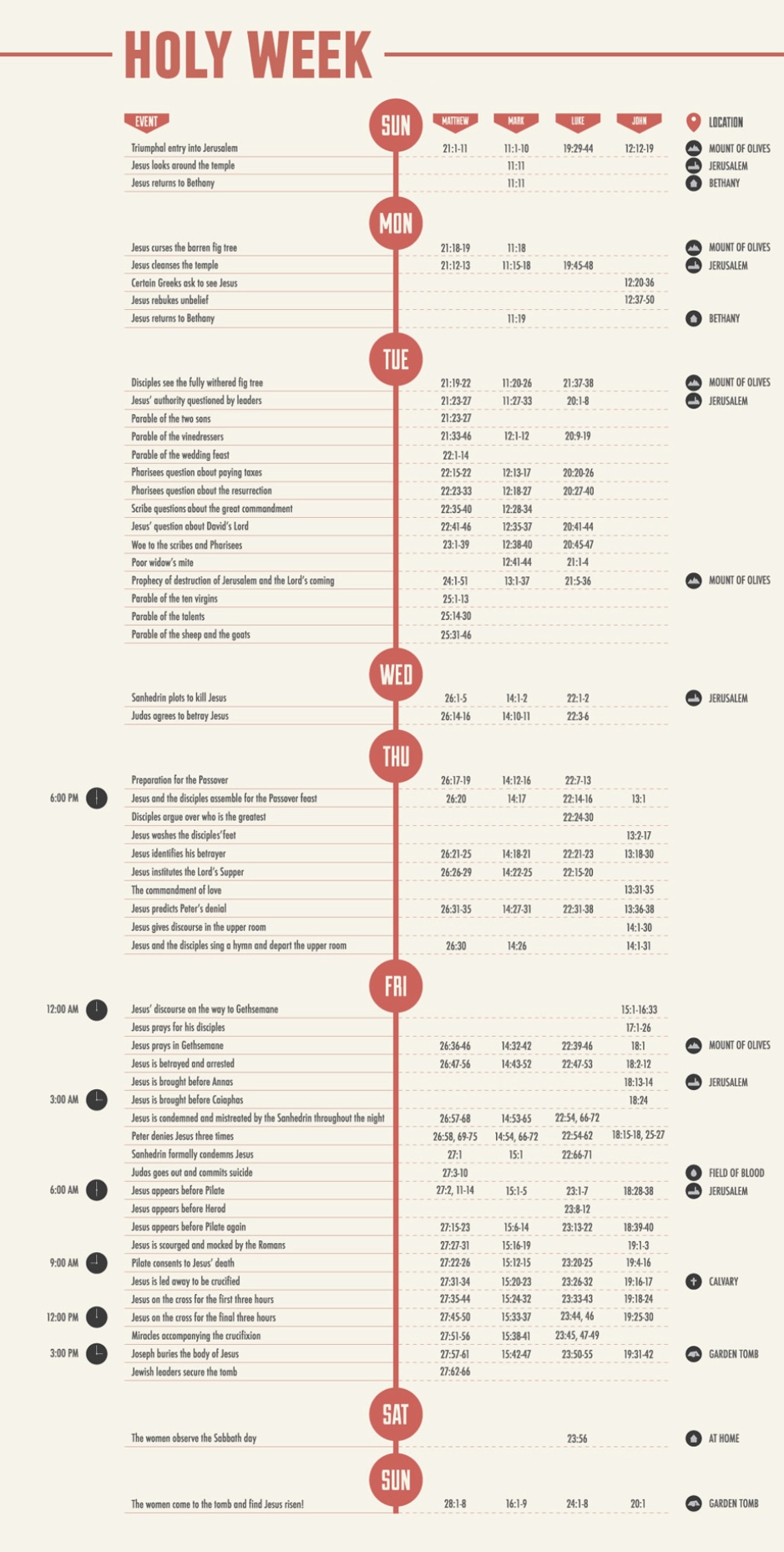
A clear and tidy summation of the events of Holy Week is not readily available. There is some clarity to be sure, but the exact chronology is difficult to discern. The graphic below may be helpful. But the various graphics and outlines do not line up perfectly. That’s not a problem with the Bible, nor anything that should make us doubt the veracity of Scripture. It seems none of the writers tried to nail down what happened on each day, as much as they simply wanted to give witness to Jesus’ actions, words, and to some extent his thoughts on the days leading up to the crucifixion.
The two examples above give us a picture of Jesus’ dealings with two of his critics. The Sadducees did not believe in the resurrection. When they try to put Jesus in a corner over that teaching, he sets aside their trap, saying that they had the whole premise wrong. The resurrection is a real hope and promise. It is good to keep this in mind during this week. That truth will no doubt sustain Jesus in his final hours.
Not to be dissuaded, the Pharisees then challenge Jesus about the Law. They ask, “Which is the greatest commandment of the Law?” Danger! All the Laws of God are good. There should certainly be no favorites. Unless you’re the Son of God. Then you can determine if there is one that rises above the rest.
And there is. Love the Lord God first and most of all. And that first and greatest commandment has a near twin. Love your neighbor as yourself. “On these two commandments depend all the Law and the Prophets,” says Jesus. This is the axis on which turns the whole of God’s Law, his desire for his people, and the life to which we who claim Jesus as Lord and called to live.
There will be parables about how that is lived out. There will be further confrontations. But Jesus is fully engaged with friends, disciples, and enemies. The only difference is how he engages with them.
A colleague reminded me a few years ago of what I had learned at the seminary about preaching. He said we are to “Discomfort the comfortable, and comfort the anxious.” That’s what Jesus does. He will do all he can to challenge the self-righteous religious leaders as he heals, comforts, forgives, and teaches those who recognize their need for God’s grace.
We may wish to join the disciples in marveling at the withered fig tree. We can certainly delight in seeing Jesus answer the criticisms of his detractors. We should hear in our hearts Jesus’ teaching in the parables. But we must keep in mind these two commandments:
“You shall love the Lord your God with all your heart and with all your soul and with all your mind.38 This is the great and first commandment.39 And a second is like it: You shall love your neighbor as yourself.40 On these two commandments depend all the Law and the Prophets.”
Jesus is in the process of living them out. May we follow him in that spirit of love for God and our neighbor.
Click here for an audio version of this blog post.
And Jesus entered the temple and drove out all who sold and bought in the temple, and he overturned the tables of the money-changers and the seats of those who sold pigeons.13 He said to them, “It is written, ‘My house shall be called a house of prayer,’ but you make it a den of robbers.”
– Matthew 21:12-13
When they came from Bethany, he was hungry.13 And seeing in the distance a fig tree in leaf, he went to see if he could find anything on it. When he came to it, he found nothing but leaves, for it was not the season for figs.14 And he said to it, “May no one ever eat fruit from you again.” And his disciples heard it.
– Mark 12:12-14
And when he drew near and saw the city, he wept over it,42 saying, “Would that you, even you, had known on this day the things that make for peace! But now they are hidden from your eyes.43 For the days will come upon you, when your enemies will set up a barricade around you and surround you and hem you in on every side44 and tear you down to the ground, you and your children within you. And they will not leave one stone upon another in you, because you did not know the time of your visitation.”
– Luke 19:41-44
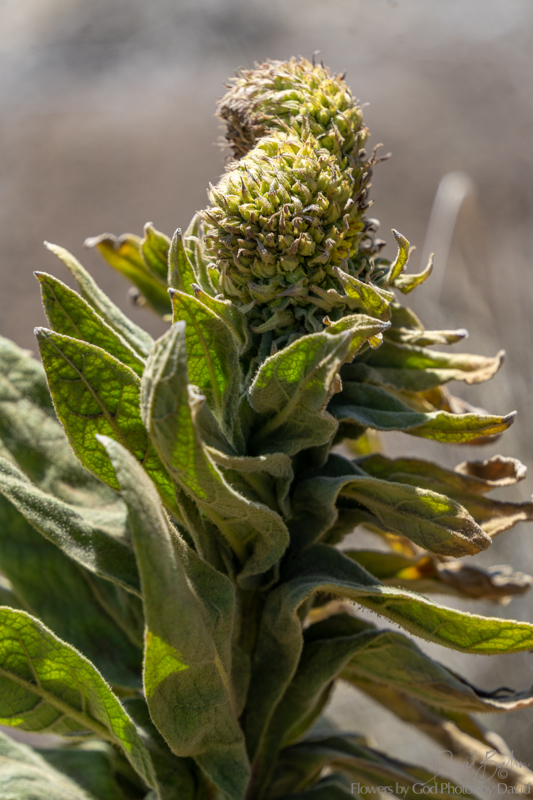
Common Mullein | Hawaii | March 2022
The Events of Monday of Holy Week
Jesus…
Leaves Bethany
Curses the fig tree on the way into the city
Weeps over Jerusalem
Cleanses the temple for the second time in His ministry
Late in day, looks into the Temple, then leaves the city
Spends the night in Bethany
Let’s walk with Jesus this Holy Week. Let’s see how he lives the last week of his life on earth. To be more precise, let’s see how he lives the week of his death on the cross. After his resurrection Jesus appeared to his disciples several times as recorded in the gospels. Those appearances are important in their own right. We’ll look at those next week. But for now let’s look at the events leading up to Jesus’ crucifixion.
After the remarkable Palm Sunday reception Jesus is not to be deterred from his mission to save the world by his sacrificial death on the cross and his victorious resurrection from the grave. There will be a Day when the praises ring eternally for his glorious grace (Ephesians 1:6). But for now there is other business to attend to.
Jesus cleanses the temple. This is the second time he’s done this. John records the first in the early days of his 3-year ministry (John 2:13-22). Here, in this climatic week Jesus again drives out the money changers. His house will be a house of prayer for all the nations. There must be nothing man-made to limit people’s access to God’s help and grace.
When Jesus curses the fig tree, he shows his sovereign power over all things, his authority to judge. He needs no permission. He alone can see the heart of man and determine the value of a tree.
But Jesus’ heart is broken over Jerusalem. He weeps at their refusal to recognize God’s favor to them. He greives their unwillingness to be gathered to himself. He laments their coming destruction. He will not prevent it – out of justice and pure holiness. But it breaks his heart. Their refusal will add to the pain he endures on the cross.
He returns to the temple late in the day, and then goes back to Bethany. It’s as though he must take one more look at the splendor of this building dedicated to God’s glory. It will soon be torn down. Israel will be expelled. All this is a terrible and sad commentary on what it will cost Jesus to redeem lost and fallen mankind.
But he will do it. He will go to the cross. He will die. He will lay in the tomb. He will rise from the dead. He will ascend into the heavens. He will come again at the end of time. Then the praises will ring out for we will all see the amazingly incredible grace of God. We will rejoice in the reality of salvation. We will be rid of every vestige of sin, sickness, sadness, and Satan’s deceit.
It’s Monday. Friday’s coming. And then Sunday. But for now, it’s Monday. Let’s walk with Jesus this week.
On this Lord’s Day, please continue to pray these psalms for the people of Ukraine.
Psalm 10:16-18
The Lord is king forever and ever; the nations perish from his land. 17 O Lord, you hear the desire of the afflicted; you will strengthen their heart; you will incline your ear 18 to do justice to the fatherless and the oppressed, so that man who is of the earth may strike terror no more.
Psalm 40:1-5
I waited patiently for the Lord; he inclined to me and heard my cry. 2 He drew me up from the pit of destruction, out of the miry bog, and set my feet upon a rock, making my steps secure. 3 He put a new song in my mouth, a song of praise to our God. Many will see and fear, and put their trust in the Lord.
4 Blessed is the man who makes the Lord his trust, who does not turn to the proud, to those who go astray after a lie! 5 You have multiplied, O Lord my God, your wondrous deeds and your thoughts toward us; none can compare with you! I will proclaim and tell of them, yet they are more than can be told.
Psalm 70:4
May all who seek you rejoice and be glad in you! May those who love your salvation say evermore, “God is great!”
Psalm 100
Make a joyful noise to the Lord, all the earth! 2 Serve the Lord with gladness! Come into his presence with singing!
3 Know that the Lord, he is God! It is he who made us, and we are his; we are his people, and the sheep of his pasture.
4 Enter his gates with thanksgiving, and his courts with praise! Give thanks to him; bless his name!
5 For the Lord is good; his steadfast love endures forever, and his faithfulness to all generations.
Psalm 130
Out of the depths I cry to you, O Lord! 2 O Lord, hear my voice! Let your ears be attentive to the voice of my pleas for mercy!
3 If you, O Lord, should mark iniquities, O Lord, who could stand? 4 But with you there is forgiveness, that you may be feared.
5 I wait for the Lord, my soul waits, and in his word I hope; 6 my soul waits for the Lord more than watchmen for the morning, more than watchmen for the morning.
7 O Israel, hope in the Lord! For with the Lord there is steadfast love, and with him is plentiful redemption. 8 And he will redeem Israel from all his iniquities.
In these days he went out to the mountain to pray, and all night he continued in prayer to God.13 And when day came, he called his disciples and chose from them twelve, whom he named apostles: 14 Simon, whom he named Peter, and Andrew his brother, and James and John, and Philip, and Bartholomew,15 and Matthew, and Thomas, and James the son of Alphaeus, and Simon who was called the Zealot,16 and Judas the son of James, and Judas Iscariot, who became a traitor.
17 And he came down with them and stood on a level place, with a great crowd of his disciples and a great multitude of people from all Judea and Jerusalem and the seacoast of Tyre and Sidon,18 who came to hear him and to be healed of their diseases. And those who were troubled with unclean spirits were cured.19 And all the crowd sought to touch him, for power came out from him and healed them all.
20 And he lifted up his eyes on his disciples, and said:
“Blessed are you who are poor, for yours is the kingdom of God.
21 “Blessed are you who are hungry now, for you shall be satisfied.
“Blessed are you who weep now, for you shall laugh.
22 “Blessed are you when people hate you and when they exclude you and revile you and spurn your name as evil, on account of the Son of Man!23 Rejoice in that day, and leap for joy, for behold, your reward is great in heaven; for so their fathers did to the prophets.– Luke 6:12-22[ESV]
Volcanic Mound | Mauna Kea, Hawaii | March 2022
We made tee shirts with the Hebrew word for “blessed” printed on them. We also included the Greek as well. They were in support of the sermon series we were using titled, you guessed it… “Blessed.” Now, however, I tend to shy away from the word blessed in favor of the word grateful. For each of us is blessed in so many ways. We live and move and breathe each day by God’s gracious provision. We have food and shelter, clothing, blue sky, and green lawns. In so many ways we are blessed.
But we are not all grateful. Too often the blessings of God are ignored, taken for granted, or even despised. It’s as though we are not truly grateful unless we receive just exactly what we long for in the moment. I’m reminded of the hymn, Forgive us, Lord, for shallow thankfulness.
Forgive us, Lord, for shallow thankfulness, For dull content with warmth and sheltered care, For songs of praise for food and harvest press, While of Your richer gifts we’re unaware:
Jesus points us to a greater blessing than those things we typically think of in that category. He says the poor, the hungry, those who mourn, and those who suffer for Christ are blessed. Doesn’t this call for a radical recalibration of our blessing meter? I don’t typically think that way. I’m too worldly-minded.
The only way I can get at this is to understand just how corrupted and upside-down the world is. Somehow the things we associate with blessing – an easy life, fun times, new experiences, peace, and gladness – don’t make the list. I’m thinking that’s because all those things are a pale imitation of the ultimate rest, delight, joy, peace, and happiness that will be ours in the life of the world to come.
I believe it is a good thing to be thankful for the good things we have this side of heaven. The beauty of creation. The love of a spouse. The joy of friendship. Even a good night’s sleep. For all these I thank God. But when I hunger for righteousness (yearn for justice), mourn any sort of loss, or suffer for the sake of the gospel, I am no less blessed. That’s when I must lean of Jesus’ promise that there will be a great heavenly reward for the faithful.
In these days he went out to the mountain to pray, and all night he continued in prayer to God.13 And when day came, he called his disciples and chose from them twelve, whom he named apostles: 14 Simon, whom he named Peter, and Andrew his brother, and James and John, and Philip, and Bartholomew,15 and Matthew, and Thomas, and James the son of Alphaeus, and Simon who was called the Zealot,16 and Judas the son of James, and Judas Iscariot, who became a traitor.
17 And he came down with them and stood on a level place, with a great crowd of his disciples and a great multitude of people from all Judea and Jerusalem and the seacoast of Tyre and Sidon,18 who came to hear him and to be healed of their diseases. And those who were troubled with unclean spirits were cured.19 And all the crowd sought to touch him, for power came out from him and healed them all.
20 And he lifted up his eyes on his disciples, and said:
“Blessed are you who are poor, for yours is the kingdom of God.
21 “Blessed are you who are hungry now, for you shall be satisfied.
“Blessed are you who weep now, for you shall laugh.
22 “Blessed are you when people hate you and when they exclude you and revile you and spurn your name as evil, on account of the Son of Man!23 Rejoice in that day, and leap for joy, for behold, your reward is great in heaven; for so their fathers did to the prophets.– Luke 6:12-22[ESV]
Pacific Sunset | Hawaii | March 2022
I first learned it as a balanced life. UP-IN-OUT, all equally balanced in focus, energy, and intent. Our relationship with God, our connection with other believers, and our evangelistic interactions with people outside the faith all equally balanced. But perhaps “integrated” is a better word than “balanced.” In either case, Jesus is a wonderful example of such a life. In these few verses of Luke we see just how true that was for Jesus.
Jesus spends the night in prayer. He was deeply connected with his heavenly Father. There is a great mystery here. How could Jesus as the Son of God, or as God incarnate, need to spend time in prayer? Why would he do that? How could God-in-the-flesh need anything from God-in-heaven? But mystery aside, Jesus did pray. A lot. A long time. This wasn’t the only time either. Jesus had a deep relationship with his Father in heaven, looking up to him for strength and guidance.
Immediately we learn that Jesus then chooses the 12 and designates them as apostles: sent ones. He will pour himself into these 12 for the next three years. He will travel with them. Teach them. Challenge them. Comfort them. Send them out on mission. Receive them back when they return. Test them. Bless them. He poured himself into these 12 men.
And then he takes them with him down to the larger crowd of his disciples. They were joined by a great number of people from all over Judea, from Jerusalem, and from the coast of Tyre and Sidon. Jesus was deeply concerned for those who were not part of God’s reign and rule. People from Gentile Tyre and Sidon are also in the crowd. His mission was to seek and save the lost. And he would take the 12 along with him in pursuit of those he came to save. He was always looking out for people in need of a Savior.
Rather than doing these three things in order to check them off the list, Jesus did them as a way of life. His approach to God and religion as a whole was wholistic as well. He didn’t have separate categories for his up, in, and out relationships. He embraced those three facets of faithfulness as an expression of his love for God and his love for us all.
As a follower of Jesus, I might imagine I have some pull with God. I expect him to hear and answer my prayers. I expect him to notice me when I stumble. But I must also realize that he hears others when they call. He notices when they stumble. He forgives and redeems. As a follower of Jesus, I must do the same. Not to fill in some sort of spiritual/discipleship checklist. But as a whole way of life. The way of an integrated life: faith, love and life all mixed together makes a beautiful thing.







 David Bahn - Reflections