

Click here for an audio version of this blog post.
These devotions are part of the Follow the Word Bible reading program at St. John Lutheran Church in Cypress, Texas. This year we are reading through the Scriptures together, listening for how God speaks through his Word day by day. I hope you will join me on this journey.
Today’s readings are Judges 9-11, Psalm 100.
Judges 10:8-18
For eighteen years [the Philistines and Ammonites] oppressed all the people of Israel who were beyond the Jordan in the land of the Amorites, which is in Gilead. 9 And the Ammonites crossed the Jordan to fight also against Judah and against Benjamin and against the house of Ephraim, so that Israel was severely distressed.
10 And the people of Israel cried out to the Lord, saying, “We have sinned against you, because we have forsaken our God and have served the Baals.” 11 And the Lord said to the people of Israel, “Did I not save you from the Egyptians and from the Amorites, from the Ammonites and from the Philistines? 12 The Sidonians also, and the Amalekites and the Maonites oppressed you, and you cried out to me, and I saved you out of their hand. 13 Yet you have forsaken me and served other gods; therefore I will save you no more. 14 Go and cry out to the gods whom you have chosen; let them save you in the time of your distress.” 15 And the people of Israel said to the Lord, “We have sinned; do to us whatever seems good to you. Only please deliver us this day.” 16 So they put away the foreign gods from among them and served the Lord, and he became impatient over the misery of Israel.
17 Then the Ammonites were called to arms, and they encamped in Gilead. And the people of Israel came together, and they encamped at Mizpah. 18 And the people, the leaders of Gilead, said one to another, “Who is the man who will begin to fight against the Ammonites? He shall be head over all the inhabitants of Gilead.”

Judges 9–11 traces Israel’s deepening faithlessness – from Abimelech’s violent, self-made rule to the nation’s return to idolatry and the oppression that follows. Leadership falters, the people wander, and the familiar cycle spirals downward. Yet when Israel cries out again, the response is not immediate rescue but a searching confrontation that exposes the emptiness of the gods they have chosen. It is here, in the tension between judgment and compassion, that the focus sharpens – leading into Judges 10:8–18, where repentance deepens and the heart of God toward his people is revealed.
In the face of these threats the people of Israel confessed: “We have sinned against you, because we have forsaken our God and have served the Baals.” It wasn’t just that they had done some bad things like stealing, adultery, or even murder. They sinned by forsaking God and looking to false gods, the Baals – man-made answers to fear, dressed up as divine power.
So God’s answer was not simply to forgive, “That’s OK, I forgive you.” This struck me strongly – as one who deals so consistently in God’s grace. In fact it struck me pretty hard to hear God say, “Go and cry out to the gods whom you have chosen; let them save you in the time of your distress.”
God wanted more than a contrition borne of desperation. He wanted – and always does want – true repentance. He desires not just empty words – especially those that sound sincere but are driven by sincere sadness of being in distress. God is always concerned with the heart. It’s like John the Baptist said to the people coming out to be baptized by him 1200 years later: “Bring forth the fruits of repentance.” In other words, sincere repentance isn’t just an Old Testament ideal. It’s the center of our relationship with God.
The people of Israel show true repentance by throwing away their idols and foreign gods. I noticed that God “became impatient over the misery of Israel.” And God acted in their behalf. Deliverance begins even before a deliver appears. Here we learn the danger of self-made salvation, the depth of Israel’s wandering, and the persistence of God’s mercy.
And so it is today. We might discover the same truth. Revival begins with repentance. It might be that God begins to act before we see the fruits of his deliverance. But it always starts with true repentance for sin isn’t just an act. It is a condition that can be overcome only by God’s grace and we discover that grace as we approach him in humility and contrition. Let not the persistence of God’s mercy ever lead us to abandon our faith in him and his ways.
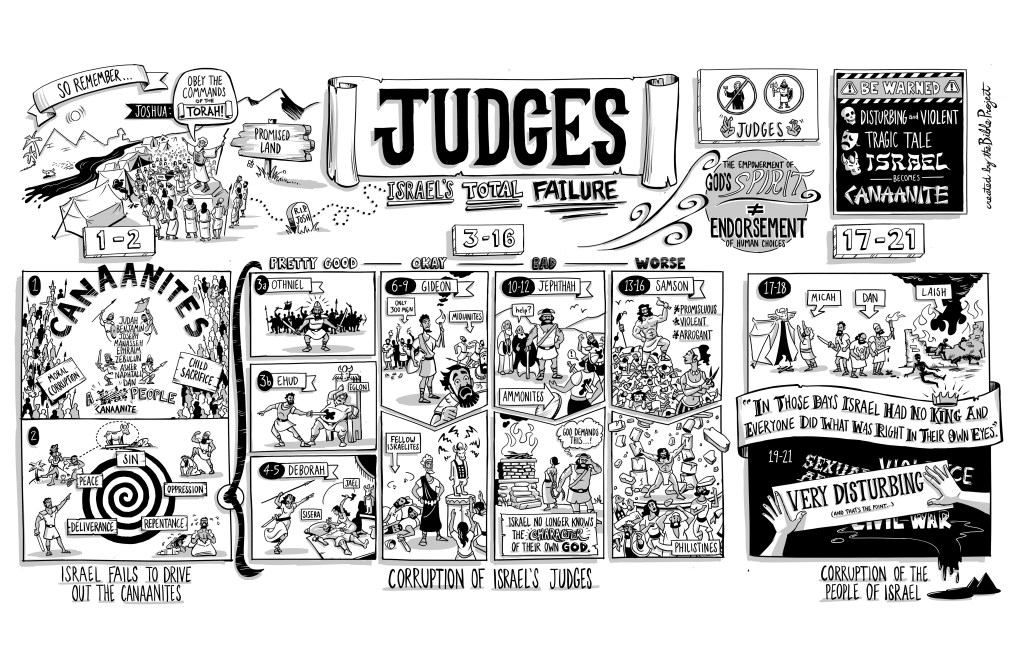
Click on the graphic below to watch the Bible Project video summary of the book of Judges.
 David Bahn - Reflections
Leave a comment